


The author presents a new agricultural model, whose protagonists are both farmers and consumers. He suggests that future consumers must adapt by changing their diet to include more fruit and vegetables and less meat. His alternative: if necessary, pay more for commercial products with healthier production, while limiting pesticides while maintaining or even increasing yields. The author shows that this model, while it has made it possible to considerably increase yields considerably, has also generated significant environmental, social and economic costs. In particular, he highlights soil depletion, dependence on inputs, loss of biodiversity and the weakening of farms. He proposes a gradual transformation transformation of the agricultural system based on greater consideration of ecological balances and a reduction in dependence on external resources. resources. It stresses the need to rethink public policies in order to truly support farmers in this transition. The change of model cannot be based solely on the individual responsibility of farmers. Agriculture must be more integrated with its environment This well-researched book on new agricultural models and on global agricultural markets does not, however, address large-scale retail, as the average cost of producing agricultural products is only 8% of the final cost of the product. Moreover, the bibliography mentioned at the end of each chapter remains incomplete. In his preface, MEP Pascal Cantin expresses his support for his preface to the reading of this book, which is the result of work carried out at IDDRI), in which the author summarises the issues addressed by this institute. Pierre Marie Aubert is an AgroParisTech engineer and programme manager at IDDRI (a think tank) conducting studies on these subjects with a political and international aspect. Pona Samnik

Pierre-Antoine DONNET, Chine, la défaite de l’Occident, Editions de l’Aube,230 pages.
For more than two decades, the loyal readers and listeners of Pierre-Antoine DONNET, recognised over the years as one of the great experts on the Chinese world of China and the Asian world, have been eagerly awaiting their annual rendezvous annual appointment with the new publication by their favourite author. And each time, their patience is rewarded with the publication of the new “AP Donnet” of the year, an illuminating work that sheds light on global geopolitics and the Chinese world, each time with a new point of view. The author’s biography is impressive, marked by an immense culture enriched by the perspective of the journalist (former editor-in-chief of AFP and currently of Asia magazine), who is committed to covering both the ins and outs of Chinese politics, as well as the geopolitical data of the visible or covert relations it maintains with its allies and global competitors. This new publication sounds like a warning signal for all democracies that are asleep and withered by too much arrogance and naivety: “a danger that is both deadly and imminent for Europe and its industry in the face of the Chinese war machine.” As his illustrious predecessor Alain Peyrefitte* had already largely anticipated, China has not only awakened, but has unleashed a veritable economic and technological tsunami, and technological tsunami, making it “the world’s leading economic and commercial giant ahead of the United States, a true factory of the world and soon its laboratory”. Also, the central thesis that the author maintains remains that the real long-term threat to the West is not Russia, ” admittedly an inconvenient partner”, but China. In his six brilliantly documented chapters, Pierre Antoine Donnet illustrates his conviction by analysing the causes and consequences of the Chinese strategy, including a feeling of humiliation (the West did not taken it seriously), leading to a desire for revenge, the dream of a “peaceful” awakening fuelled by the blindness of our elites, the structural distrust of the “regime” towards the democratic model that it constantly discredits in order to sow chaos, the obsession with the stability of the “one-party” system, leading to absolute control of information (700 million surveillance cameras) …. The fascination with gigantism and the adventure of excess… In this geopolitical game of Go, China can count on the de facto vassalisation of Russia and the blindness of the American president, president, “the laughing stock”, weighed down by his intemperance and his disproportionate ego. This threat most often advances quietly, quietly, in the logic of influence and domination where it excels, but Xi Jinping’s global objectives and ambitions clearly remain become the world’s leading power: it is moving towards its goal patiently, with an undervalued currency, while attacking European and Western industry head-on and unfairly, European and Western industry, by rearming intensively, and by preparing for a long-term conflict, including the conquest by blockade of Taiwan and the taking of control of the Pacific. Faced with these disturbing and painful realities, the question of the end of the game arises for the West. Has it already lost? The point of no return is near… but the author wants to believe that there is still time to find a “balance” in the ongoing competition; this last resort requires cooperation between all democracies, European and Asian, to build together strategic convergences by sharing their common values and with a view of China that is “free of our naivety”. Pierre-Antoine DONNET is a former central editor-in-chief of Agence France-Presse, editor-in-chief editor-in-chief of ASIA magazine. A recognised expert on the Chinese world, author of an impressive collection of reference works (including Le choc Europe-Asie in1998, Chine le grand prédateur in 2021) and winner of numerous awards, including the Grand Prix Turgot for Chief Financial Officers in 2021. Jean Louis CHAMBON *Alain Peyrefitte, Quand la Chine s’éveillera .. le monde tremblera, Fayard,1973.

TWO MESSAGES FROM JEAN-CLAUDE TRICHET FOR THE NEXT FIVE YEARS
Jean-Claude Trichet is a former Director of the Treasury, Honorary Governor of the Banque de France, former President of the European Central Bank, President of the Académie des Sciences Morales et Politiques, Honorary President of the Bruegel Institute (Brussels) and the Group of 30 (Washington)… and President of the Jury of the Prix Turgot. I would like to highlight two key messages for the five years following the presidential election of April and May 2027. For France, the courageous restoration of public finances. This consolidation effort is essential, as the current situation not only hampers only the country’s competitiveness and prosperity, but also undermines its authority in Europe and around the world. For Europe, the next five years will also be crucial. From a long-term perspective, Europe should consider the economic, political and geostrategic conditions that would allow it to make a resolute commitment to a political federation. France would have an important role to play in this strategic thinking. France: restoring public finances Restoring public finances is an essential obligation obligation for the new President of the Republic, the government and the Parliament of our country. A very serious situation, which has completely deteriorated since the great crisis of 2007-2008. Four considerations show the need for a fundamental correction. Firstly, in 2025, our country will devote the highest percentage of GDP to public spending the largest percentage of GDP to public spending in 2025 among all the countries in the eurozone, zone, tied with Finland – more than 57% in both cases. That’s 6% more than Italy, 12% more than Germany and more than 7% more than the eurozone average 1. Compared to the main large comparable European countries, European countries, the recurring overhead costs of the French economy constitute a very serious handicap. Secondly, our country has the highest public deficit in the eurozone in 2025, tied with Belgium (5.1%) and well above Italy (3.1%), Spain (2.5%) and Germany (2.7%). Thirdly, our country is the slowest in the entire eurozone to restore its public accounts. France’s current commitments will lead it to bring its public deficit below the 3% of GDP threshold only in 2029. only. Italy is expected to be at 3% by 2026, Belgium and Slovakia by 2027, and Finland and Austria in 2028. Fourthly, French public debt has been the one which has worsened the most in Europe since the global subprime subprime loans and Lehman Brothers. In 2007, French public debt represented 64% of GDP, the same level as Germany. In 2025, this debt amounted to around 116% of GDP, while the German level was still around 64%. This rapid deterioration in our situation has contributed to a significant correlative deterioration in the quality of our credit rating. At the time of the very great crisis of 2008 and in the following years, the France’s credit rating had not been called into question by national, European and global savers, unlike the five countries that were found themselves in turmoil (Greece, Ireland, Portugal, Spain and Italy). We were then borrowing at an interest rate much lower than theirs and close to that at which Germany was borrowing. Today, France borrows at 10 years, more expensively than Portugal, Ireland, Spain, Greece, and also more expensive than Italy. The relative quality of France’s credit rating has continued to deteriorate since the great crisis of 2008. Recovery measures to be taken from May 2027 This article does not contain a programme. I will not draw up a list of the essential and possible measures to remedy the situation. In any event, a very large number of decisions that could be taken are in the public domain. But the President, the government and the Parliament will have an obligation to achieve results: to convince the country, Europe and the world that France will henceforth be at a “turning point” in the management of its public finances and that it intends to radically change its approach from a medium- and long term. I will simply emphasise two points. First, decide from the outset to initiate the necessary reforms without delay. The consistent experience of recent years shows that waiting inevitably leads to doing only a tiny fraction of what should be done. It is therefore immediately after the elections that the decisions that appear necessary to give credibility to the “radical change of direction”: de-index many benefits 2, increase many user fees, not neglect anything because little streams make great rivers, also in terms of public finances, and – this is crucial – reform pensions without delay, which our European partners have all done 3. The example of Italy is particularly telling: this country decided in December 2011 to raise the retirement age of retirement to 67 years. This vote was passed in the Italian Parliament by a considerable majority. It has not been called into question since. The political cost of these measures would be only a small fraction of the price to be paid by our fellow citizens in the financial crisis that would punish the government’s inaction. Naturally, the new government should simultaneously indicate to our partners and to the Commission that it intends to be below 3%, not in 2029 but as early as 2028 (two years after Italy and at the same time as the target of Finland and Austria). Europe: reflecting on the conditions for the success of apolitical federation Over the past 76 years, since the presentation of the idea of a European Coal and Steel Community by Robert Schuman in 1950, Europe has shown dynamism and resilience, as well as the desire to build an “ever closer union” 2. Social protection expenditure is growing faster than the GDP growth in value terms in 2024 and 2025 (5.3% versus 3.6% in 2024; 3.6% compared to 1.9% in 2025). This trend observed in recent years is obviously unsustainable. Will the next 74 years be marked by the same historical dynamism? The European Union today has many reasons not only to continue its historical
ISSUES AND CHALLENGES OF AGENTIC AI IN THE FINANCIAL SECTOR
Nadia ANTONIN Since 2022, the debates on artificial intelligence (AI) have mainly focused on language models and conversational assistants (chatbots), such as ChatGPT (OpenAI), Copilot (Microsoft), Gemini (Google), Claude (Anthropic) or Chat (Mistral). In this regard, there are different formats of conversational robots, including one based on generative AI using machine learning machine learning and natural language processing. After chatbots and generative AI, a new generation of AI systems is emerging: agentic AI, which is already being used in many sectors. In the financial sector, this technological development opens up significant opportunities, but also raises major challenges. Agentic : a: conceptual analysis “The era of agentic AI has already arrived. Agents are being deployed on a large scale in the economy to perform all kinds of tasks,” said Sinan Aral, Professor of Management, Computer Science and Marketing at MIT Sloan. A report by the MIT Sloan Management Review and the Boston Consulting Group in November 2025 reveals that 76% of executives now consider agent AIs more as colleagues than as tools. Moreover, in less than two years, 35% of companies have already adopted agentic AI and a further 44% plan to deploy it very soon. As the National Institute for Research in Digital Science and Technology (INRIA), agentic AI represents less of a fundamental scientific breakthrough than a functional and systemic breakthrough. For the AI and Digital Council, Digital Council, agentic AI does not constitute a single technological breakthrough but rather corresponds to the combination of technological accelerations. The Organisation for Economic Co-operation and Development (OECD) points out that the concepts of “AI agents” and “agentic AI” are sometimes used interchangeably, which leads to some confusion and a lack of conceptual However, closer examination reveals important distinctions between these two concepts (“The agentic AI landscape and its conceptual foundations”, February 2026). For the OECD, “Agentic AI refers to systems composed of multiple coordinated AI agents that are coordinated, capable of breaking down tasks, collaborating and pursuing complex goals autonomously over long periods of time. These systems are designed to operate in more open and less predictable physical or virtual environments that are more open and less predictable, and to operate with minimal human supervision “. Unlike generative AI, which is limited to producing content, agentic AI, an autonomous autonomous AI system, is capable of acting independently to achieve predetermined objectives. It is delegated a task to perform. It consists of AI agents, machine learning models capable of imitating human human decision-making to solve problems in real time. The main challenges of agentic AI in the financial sector Agentic AI can automate complex processes to improve productivity while reducing operational costs: market analysis and business intelligence, detection of fraud and suspicious transactions, automation of compliance processes, etc. In addition, agentic AI makes it possible to accelerate decision-making thanks to better use of data: improving the relevance of the data used and consolidation of previously dispersed data. Finally, thanks to agentic AI, AI, bankers, insurers and asset managers can offer personalised financial services. Some examples of the use of agentic AI in the banking and financial sector This new AI system is booming in US banks. According to a survey by Ernst and Young and MIT, by 2025, 70% of banking sector executives say their banks are already using agentic AI. In the field, the applications in the banking sector are multiplying. For example, JPMorgan Chase is exploring the use of agentic AI to detect fraud, provide personalised financial advice, automate loan approval processes processes and process legal documents. In France, Société Générale, through its new entity SocGen AI, is transforming its digital transformation by focusing on agentic AI, which it sees as the next major step beyond traditional generative AI. The BPCE Group is relying on AI to automate more processes, while keeping humans at the heart of strategic decisions. Tests are being carried out on different business areas: customer relations, middle and back offices, controls. The main challenges related to agentic AI One of the biggest challenges concerns the question of liability in the event of a failure of an autonomous system. Hence the need to maintain human oversight. In addition, with agentic AI, AI, we face the risks of regulatory non-compliance (GDPR, European AI Act, anti-money laundering, etc.). Regarding cybersecurity, while agentic AI can be put to use (detection of fraud, in particular), it nevertheless creates new threats: attacks by injection of generative instructions (prompts), leakage of sensitive data, leaks, etc. A Senate report of 28 April 2026 highlights that agentic AI accelerates attack capabilities much faster than the installation of cyber defence tools. In addition, the proliferation of agentic AI leads to new systemic risks such as the amplification of market reactions, the increase in financial contagion, etc. Finally, among the ethical challenges of agentic AI, its deployment poses risks of algorithmic bias bias and breaches of personal data privacy. As conclusion, agentic AI now heralds profound changes within the finance sector. finance sector. It is gaining ground by automating complex processes, by establishing itself as the new driver of customer relations and improving risk management. However, its deployment raises considerable challenges in terms of governance, regulatory compliance, cybersecurity and systemic risk management. To succeed in this new revolution of artificial intelligence, it will be necessary to combine agent autonomy, human supervision and regulatory compliance. As Bpifrance points out, agentic AI, AI, however powerful it may be, has its limitations and risks. “The balance between autonomy, supervision and human responsibility remains essential to ensure the reliability and the ethics of the decisions made.”
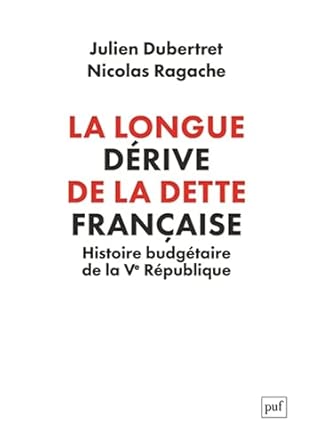
DUBERTRET Julien & RAGACHE Nicolas. La longue dérive de la dette française, Editions PUF, 2026, 670 pages
“The long drift of French debt” could be the headline of an economic media outlet at a time when the yield on the French 10-year OAT 10-year yield has just crossed the 4% threshold, its highest level since October 2008. In this essay, published last April, Julien Dubertret and Nicolas Ragache have traced essay, published last April, 70 years of France’s fiscal policy, from 1958 to the present day. The work is extensively documented using the long series from INSEE. The economic guidelines and the presentations of the draft finance bills are supplemented by extracts from general policy statements. A remarkable account, after years of work and research, with a clear objective: to inform citizens about the successes and failures observed over the period. A look back into the past necessary in order to better understand the current situation of public finances and to try to answer this question: how could we have gone go from a public debt-to-GDP ratio of 48% in 1980 to 109% in 2023 and more than 115% in 2025? We learn that the real turning point for the French public deficit French public deficit was in 1981 and not in 1975. The second half of the 1970s 1970s saw a period of rising labour costs in France and a very long-lasting loss of competitiveness among French companies, aggravated by the introduction of business tax. The 3% deficit limit was formulated in France in 1982-1983. This limit would later be adopted by European legislation and has become entrenched as a dogma to be respected, making it acceptable as long as it remains below 3% of GDP: “The deficit has become a public resource public resource in its own right.” Some lessons from this budgetary history noted over the years: – The temptation to see public spending as the fundamental source of growth, even at the peak of the cycle – Combating inflation: the State must not resort to money creation to finance its own expenses – The widespread over-regulation was already highlighted in the 1960s – The post-oil shock recovery plan: an accommodating fiscal and monetary policy was not the right solution in the face of a major supply shock linked to the rise in oil prices. – “The excessive focus on the economic situation to the detriment of the needs for structural adjustment is a recurring trap.” For example, the use of privatisation revenues, which are by nature one-off, to finance current budgetary expenditure – In the early 1980s, the reform of the financial markets allowed the issuance of the first OATs (Obligation Assimilable au Trésor) in 1985. A reform which, in the long term, would facilitate the financing of public deficits. – The equation aimed at reducing public spending to simultaneously reduce taxes and the deficit, works if growth is sufficiently dynamic – Michel Rocard’s White Paper, published in April 1991, first raised the question of the balance of pension schemes with the lowering to 60 years of the full pension age to 60, which came into force in 1983 The book ends with a bleak picture of the economic situation in France, based on a model of public spending and high compulsory levies, in a fragmented parliamentary landscape. This essay is recommended for future presidential election candidates, election, where the authors invite them to rely on a better understanding of the economic cycle and on ambitious long-term objectives that are that are less dependent on growth. Julien DUBERTRET was budget adviser to the PrimeMinister before taking over as head of the Budget Directorate in 2011, where hehe had joined in 1992, and then to serve in the General Inspectorate of Finance. He is now an expert at the firm Global Sovereign Advisory. Nicolas RAGACHE is an economist and lawyer who graduated from Ensae,the École d’économie de Paris and Paris-Panthéon-Assas. He has heldadministrator positions at Bercy, ministerial adviser, and is currentlychief economist of the Afep (French Association of Private Companies). Reading note by SophieFRIOT

THE RETURN OF MILTON FRIEDMAN
Jean-Jacques Pluchart There has been a renewed interest in Milton Friedman’s thinking in recent weeks, as the US economy is marked by a return of inflation, a stagnation of real wages and a rejection by the courts of the customs duties imposed by the new US presidency. After studying economics and mathematics, Milton Friedman (1914-2006) was the assistant to Simon Kuznets, the “father of GDP”, and then a lecturer and researcher at several American universities, notably Stanford. He was involved in the design of the Marshall Plan before receiving the Nobel Prize in Economics (1976). He was notably the inspiration behind the Chicago School and the anti-staginflationary policies initiated at the end of the post-war boom in the United States and the United Kingdom – and to a lesser extent in continental Europe – during the 1970s and 1980s. He has published numerous books, including A Monetary History of the United States, 1867–1910, Inflation and the Monetary System, and Capitalism and Freedom. His thinking is unfairly summarised by a few simple formulas according to which “business has an economic and not a social role”, or “the market is better than the State for the conduct of economic activity”. But he actually developed an original and prescient way of thinking on the “inflation-unemployment” dilemma, on the missions of central banks, on the trade-off between freedom and equality, and on the role of education in reducing inequalities. Milton Friedman became known for his analysis of the 1929 crisis and for his criticism of the “Fordian compromise” and especially of the Keynesian analysis of consumption. He argued that the latter did not depend on household income at a given time, but rather on the perception of their “permanent income” in the medium term, which he described as “adaptive anticipation”. If the future is perceived as stable, agents tend to consume, and if the economic situation is perceived as unstable, they tend to save. But above all, Milton Friedman is the “champion” of entrepreneurial freedom and market competition. He opposes all situations of monopoly, “free rider” or market dominance. He denounces Keynes’ “error”, according to which “inflation combats unemployment”, and he criticises the “Phillips curve”, according to which the unemployment rate is inversely related to nominal wages (“the greater the increase in wages, the lower the unemployment”). He considers that the key indicators are real wages and not nominal wages, as well as the “natural rate of unemployment”, that is to say the minimum rate below which a State cannot boost employment through purely cyclical measures. He thus criticises the “monetary illusion” whereby the unemployment rate does not depend in the short term on changes in nominal wages and prices, but rather in the long term on changes in real wages and employment. He thus inspired the famous NAIRU and NAWRU indicators (non-accelerating wage rate of unemployability), which arecurrently closely monitored due to the resurgence of unemployment and inflation in some countries. Friedman also argues that the “arbitrator state” must confine itself to exercising sovereign functions (justice, security, transport), guaranteeing competition in the markets and refraining from any regulation that might limit the efficiency of the markets. The state must avoid increasing the “compulsory expenditure” of businesses (which weighs on their investments) and households (which reduces their consumption). It must favour measures that promote the mobility of the factors of production, and in particular of talent, in order to “limit the simple reproduction of the elites”. Like Tocqueville, he considers that inequalities are “fair” when they are justified by talent and/or work and not by situations of rent. He is in favour of competition between public and private schools and universities in order to develop capacities and skills, and to reduce the costs of education. Milton Friedman is the champion of monetary orthodoxy. He denounces the “versatility” of governments and central banks in monetary matters, as well as the cult of the gold standard. He recommends applying a stable “rule”, believing that the role of a central bank is first and foremost to pursue an anti-inflationary policy (the inflation rate must, according to him, be between 2 and 2.5%) by setting interest rates to regulate credit and by providing forward guidance that gives indications on the future direction of monetary policy. On the fiscal front, he opposes progressive income taxation (with the exception of very high incomes), but he is in favour of low taxation of dividends and high taxation of inheritances, with the exception, however, of “fair inheritances” accumulated through talent and effort, his objective being to promote the efficiency of the financial markets and the equity financing of the most profitable investments. He is opposed to any universal income but is in favour of a “negative tax” for the lowest-income households and scholarships for the most deserving students. A reading or re-reading of Milton Friedman’s numerous publications and communications is therefore essential in the face of the “pressing national obligation” to restore fundamental economic balances

Masson A. (2025), L’héritage au XXIe siècle, Odile Jacob.
The book is presented as a handbook with answers to 50 frequently asked questions on inheritance taxation. The book is organised into three parts dealing with the role of inheritance in social life, the decline of inheritance taxes, and then formulating proposals for reforming the current arrangements. One of the most sensitive tax issues in France for several decades has been the taxation of capital (real estate and financial) and inheritance, particularly since the publication of Piketty’s book, Capital in the 21 st Century (2021). The latter proposes a “Great Transfer” of capital between seniors (holders of 60% of the national private wealth) and the younger generations. This issue has been addressed by distinguished economists and sociologists, such as Atkinson, Friedman, Rawls, Pikettey, Sen, etc. It is a revealing indicator of the economic and social positioning of the French. It is all the more divisive as it pits against each other or divides generations, households (more or less wealthy), political movements and European governments. However, inheritance has never been taxed so little in France (it generates less than 1% of state revenue); this is why there is an increasing temptation to redress public accounts by “overtaxing the rich”, but this radical measure is likely to intensify tax exile. In particular, “systemic” reforms are advocated and then quickly forgotten, such as the allocation of a minimum inheritance at the start of working life, the surtaxation of inheritances derived fr In order to redirect low-return savings placed in cash accounts and government bonds, several economists (Artus and Viard, 2022; Tirole and Blanchard, 2021; Masson, 2025) propose hybrid formulas combining incentives for donations, the creation of new tax bands (up to 60%) for inheritance, and tax exemptions on the proceeds of “future investments” intended to finance very long-term projects (up to 25 years) that meet ESG principles.om other inheritances or produced by unproductive income, etc. André Masson isDirector of Research at the CNRS and the EHESS, as well as a researcher at the École d’économie de Paris. Jean-Jacques Pluchart
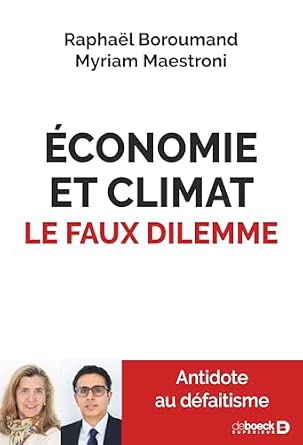
BOROUMAND Raphaël & MAESTRONI Myriam. Economie et Climat – le Faux dilemme, De Boeck Supérieur, 2026, 288 pages
In their book, Myriam MAESTRONI and Raphaël BOROUMAND propose reconciling the “climate sceptics” and the “climate defeatists”. They believe in combining all the levers in favour of selective, restrained and low-carbon growth, “without pitting the concerns of making ends meet against those of the end of the world”. Decarbonisation will be expensive, but these investments are much lower than the costs of climate change. This requires the decline of certain sectors, such as textiles, and the growth of low-carbon sectors that are useful to the economy. They refer to the “champagne curve” effect by showing that, above a certain threshold of economic development, the growth of carbon emissions no longer improves the well-being of populations. The authors advocate energy efficiency as one of the major solutions, along with the massive development of renewable energies, in order to reduce greenhouse gas emissions. This energy efficiency must be optimised in all sectors: increasing renewable energies and managing their intermittency through storage solutions, massively developing green hydrogen, decarbonising transport and developing carbon dioxide capture. The authors present a comprehensive overview of energy systems and new geopolitical challenges. Europe wants to be a champion of sustainable development but is heavily dependent on external suppliers, such as China for rare metals and the United States for shale gas, since the start of the war in Ukraine. It “must not confuse regulatory leadership with climate leadership”. Indeed, to achieve the renewable energy development goals, it had abolished customs duties on Chinese solar panels in 2018. Barely 10 years later, this decision shows the mistakes made in meeting short-term objectives, while a new European energy and industrial policy requires a long-term vision. In the absence of strategic resources on its territory, the authors believe that Europe has a role to play in the development of processing plants dedicated to the recycling and refining of minerals. No energy source is risk-free or universally accepted. But the book gives pride of place to hydrogen, seen as the energy of the future since it does not emit CO2. The emergence of the green hydrogen sector can meet the combination of economic growth, job creation and ecological transition. All these developments require investments that states will not be able to finance on their own. The financial world and citizens’ savings will have to be called upon to ensure the decarbonisation objectives are met. A comprehensive and well-researched book that will delight readers who are convinced that a new path of economic and sustainable development is possible. Raphaël BOROUMAND is a professor of economics at PSB,and a specialist in energy and climate. He holds a PhD from EHESS-Paris and is a HDRin Economics (Paris-Saclay University). He advises public institutions (ministries, parliament, regulators, think tanks) and private institutions on strategies for energy, climate policy, and risk management in the commodities markets. Myriam MAESTRONI is a leader committed to theenergy transition, who became a managing director in the energy sector at a very young agebefore founding Economie d’Energie and the company DEESCO. She chairs the E5T endowment fund as well as the “100 leaders pour la Planète” programme. Decorated with the Legion of Honour and the National Order of Merit, she sits on several boards of directors and is in the top 40 of the Forbes France ranking. Reading note by SophieFRIOT

Generative AI and LLMs: towardsblack swans?
Jean-Jacques Pluchart The many stakeholders involved in Artificial Intelligence are questioning the ability of generative AI models and LLMs (large language models) to generate profits for their designers and productivity gains for their users. The latest report from the MIT (MassachusettsInstitute of Technology) entitled “The GenAI Divide: State of AI in Business 2025″, notes that 95% of generative AI programmes launched since 2022 have still not achievedtheir profitability targets among publishers and American user companies. It is true that global spending on AI peaked in 2026, with investment projects estimated at €2.5 trillion worldwide, having more than tripled since 2023. After sharp price increases, the fear of severe stock market corrections is intensifying, and the most recognised experts seem to be unable to predict the timing and extent of the corrections. However, the stock market outlook differs depending on the links in the AI value chain: the stock prices of semiconductor equipment manufacturers (Nvidia in the USA, TSMC in Taiwan, Samsung in Korea) and those of electricity suppliers are on a positive trend; those of data, computing, storage and rental (cloud) centers are uneven; software publishers, such as the GAFA companies, are more uncertain, as are those of European equipment manufacturers (ASML and STMicroelectronics). The AI ecosystem seems to be threatened by the “Thucydides trap”, whereby a rivalry between a leader and its followers often leads to takeovers and sometimes conflicts. The trap threatens industry leaders such as Open AI and Anthropic, who are competing with several application developers, but also American leaders who are being challenged by Chinese designers such as MiniMax M3 and DeepSeek V4 Pro. Western and Asian companies are increasingly testing Chinese applications, which are less expensive in terms of tokens and more energy-efficient. They are also striving to diversify their sources of supply for equipment and applications, for fear of higher fees and a US or Chinese embargo on certain applications. Finally, in Europe, designers and users may be taxed by the governments of the Member States in order to contribute to public investments in the infrastructure (electricity, water, access routes) of digital platforms. For all these reasons, the prospects, particularly the financial ones, of the AI ecosystem can be described as a “black swan” in the sense of Taleb.
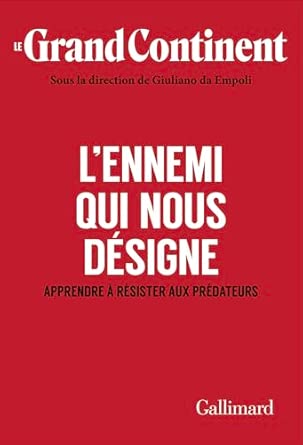
Collectif Le Grand Continent, L’ennemi qui nous désigne, Éditeur Gallimard,mai 2026 , 378 pages.
“The enemy who designates us” means that we become the enemy of others as soon as they choose to consider us as such, regardless of our intentions or our protests.” Carl SCHMITT. It’s 1965 at the Sorbonne. A young philosopher, Julien Freund, is sitting behind a table. In front of him, several great masters of French philosophy are listening to him, with a mixture of interest and concern. We need to return to his mysterious phrase: “The enemy will prevent you from cultivating your garden”, to understand the world into which the presidency of Donald Trump has dramatically plunged us. And Julien Freund goes on to say to a distinguished member of the jury: “You think that it is you who designates the enemy, like all pacifists. And so, as long as we don’t want an enemy, we won’t have one! But it is the enemy who designates you, and if it wants you to be its enemy, you are! This is the starting point of this fifth volume of Le Grand Continent, which once again brings together leading specialists and decisive voices to help us navigate this geopolitical moment. If we feel so dizzy in the face of the current upheavals, it is perhaps because we still refuse to take into account a massive dimension of the contemporary world: China. The authors devote an exclusive report to it by publishing – often for the first time in French – renowned Sinologists and key Xi Jinping doctrinaires who openly and authoritatively state why and how the West “will lose”. “We are currently experiencing changes that are unprecedented in a century, and it is we who, together, are at the origin of these changes,” President Xi told Vladimir Putin. Thus, all the converging forces risk subjecting the European liberal democracies to a fate not unlike that of the Florentine Republic in the time of Machiavelli, who said to the Florentine citizens: “Do not be deceived by the hundred years you have lived and in which you have kept yourselves free, ….for you will see that it is impossible for you to safeguard your freedom today in the manner of yesterday.” Within this framework of reflection and action, Le Grand Continent strives to provide, in addition to analytical tools, some means of learning to resist predators. While the outlines of the threat appear, at this stage, terribly clear, a response commensurate with the times is struggling to emerge. Giuliano da Empoli, with contributions from Michael Albertus, Robert-Henri Berger, Emily Feng, Stacie Goddard, Beeban Kidron, Phil Klay, Oleksandra Matviitchouk, Abraham Newman, Minxin Pei, Paul Saffo, Afra Wang, Dan Wang and Meredith Whittaker, draws a quantified map of the trends that are already shaping a new industrial and technological hegemony. The China dossier, under the scientific direction of David Ownby, includes contributions from Lu Feng, Wang Huning, Jiang Shigong and Zhao Xiaozhuo, who argues that no service-based power has ever won against technologically well-equipped adversaries. This confirms the Chinese military adage that the best victory is the one obtained without having fought a battle. The contents of the book are as follows: Introduction by Giuliano da Empoli and Gilles Gressani; Stacie Goddard and Abraham Newman, Neo-Royalism: The New World Order of Donald J. Trump; Phil Klay, The Digital Colosseum: The Geopolitics of Brainrot; Meredith Whittaker, The Digital Infrastructure of Sovereignty Depends on Our Choices; Michael Albertus, Recolonisation: The Return of Empire and Grounding in the 21stCentury; Oleksandra Matviïtchouk, The Strength of Our Struggle: Dan Wang; An Engineer State: Figures and Trends of the New Chinese Hegemony: Minxin Pei; Emily Feng, Totalitarian Modernisation: At the Origins of Xi Jinping’s Regime; “Let the Red Flowers”: The Problem of Chinese Identity: Wang Huning; America Against America: Selected Excerpts: Lu Feng; Industrial Maximalism: The Economic Doctrine of the Chinese Century: Zhao Xiaozhuo; The Chinese Plan to Take Taiwan: Jiang Shigong; The Empire and the World Order: Paul Saffo; The New Grotius Moment: Beeban Kidron; AI Generation: Notes for the Lost Children of the Digital Age: Robert-Henri Berger; Winning the War: For a New Army: Afterword by Afra Wang; The Awakening of Lingao: Presentation of the authors. Le Grand Continent, a journal that was created online and is driven by a new generation, has established itself as the leading platform for strategic, political and intellectual debate on a continental scale. This very clear “albeit technical” book should be read by anyone interested in the future of our liberal democracy, particularly in this six-month period that will lead France and Europe to make crucial choices. As JF Kennedy said, it will not be easy, but it is because it is difficult that we must choose this path! Dominique CHESNEAU