

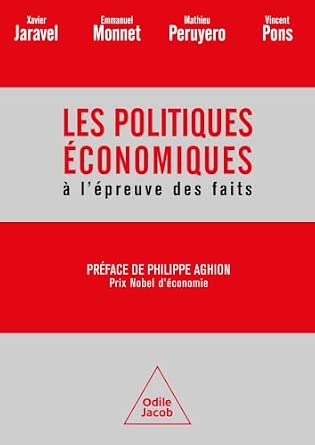
The ambition of this book is to defend an idea that may, at first sight, appear straightforward: economic policies should be judged on the basis of their observed effects, rather than according to grand egalitarian, utilitarian, liberal, Keynesian, interventionist or other doctrines. The design of public policies should follow an iterative process in which evaluation is integrated at every stage. The authors draw on recent advances in empirical economics, causal evaluation and the use of large databases to establish facts and examine what actually works in such diverse areas as employment, education, public debt, inequality, globalization and the ecological transition.
Their approach does not claim that economics could replace political decision-making. On the contrary, they advocate dialogue between those who produce rigorous knowledge, but are sometimes distant from the practical constraints of policymaking, and those involved in action who do not always understand what actually works. The objectives of economic policy and the trade-offs involved must remain collective choices and be subject to democratic debate. Once these objectives have been defined, however, economic analysis can help identify the most effective and least costly policy instruments, and a number of disagreements can be settled empirically.
It is within this framework and hybrid approach that the authors make an alarming assessment. France faces major economic challenges while, at the same time, experiencing a technological and industrial decline exacerbated by the AI revolution and climate shocks. They propose an economic strategy structured around six major areas.
Education and human capital occupy a central position, as they determine employment, productivity, innovation and the ability to reduce long-term inequalities. Education spending should be directed towards policy levers whose effectiveness has been documented and demonstrated. The authors also emphasize the importance of innovation for growth, but advocate an approach to innovation focused on strategic priorities.
With regard to public finances, restoring sound public accounts is a sine qua non for ensuring the sustainability of our social model. Debt must be stabilized, and support measures whose effectiveness has not been demonstrated should be discontinued.
On inequality, the book calls for moving beyond redistribution after the fact. Policies relating to early childhood, education, healthcare and access to economic opportunities can reduce disparities at their source. Wealth inequality and inheritance are also among the important issues addressed.
This book proposes a new philosophy of public action: diagnose, experiment whenever possible, measure the results, and then adjust. Politics sets the objectives, but facts should guide the choice of means. As Philippe Aghion writes in his preface, “the faster decisions are made and the more fragmented knowledge becomes, the rarer and more necessary a rigorous synthesis of knowledge is.” This book provides precisely that.
Xavier Jaravel is Professor of Economics at the London School of Economics and Deputy Chair of the Council of Economic Analysis.
Emmanuel Monnet is Inspector General of Finance.
Mathieu Peruyero is a senior civil servant and teaches at Sciences Po.
Vincent Pons is Professor of Economics at Harvard Business School and a member of the Council of Economic Analysis.
Ph. Alezard