

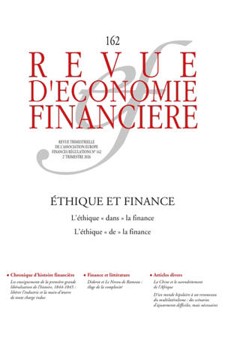
Issue No. 162 (2nd quarter 2026), ‘Finance and Ethics’ The special issue was edited by A. Buresi, Presiding Judge of Chamber at the Rennes Court of Appeal, and Ch. Walter, Scientific Adviser to the Cercle Turgot and Associate Researcher at EHESS. It brought together 29 authors and 20 articles. The publication of the dossier led to a conference on 21 September at the Institut de France, which was chaired by J-C. Trichet (Chair of the Turgot Prize jury) and by P. Berès (Chair of the Europe-Finance-Regulation Association). The publication is divided into four parts: Ethics, finance and behaviour of stakeholders; Ethics and business; Ethics and market finance; Ethics of the financial system. In each of the sections, the authors distinguish, on the one hand, the reprehensible behaviour of financial actors and the institutional mechanisms frameworks (civil and criminal) put in place to regulate them, and on the other hand, unethical biases – described as epistemic – introduced by financial systems and models into the functioning of organisations. The authors specifically clarify the differences between the concepts of ethics, professional ethics, conflict of interest, social, civil and liability, market integrity, etc. They show that the presentation of non-financial data (ESG) is a new challenge for the Chief Financial Officer. They highlight the growing difficulty of balancing finance and performance, financial return return and collective objectives, responsible finance and sustainable investment… The authors trace the evolution of European and French law as applied to finance, in order to integrate compliance into the strategy and operations of the company, and to ensure compliance with the standards, codes and charters issued by the State and companies. The authors also endeavour to measure the contributions of AI to sustainability reporting and the alignment of management practices with compliance requirements. The most interesting issue, which was highlighted by J-C. Trichet during the conference, concerned the ethics of the financial system, the organisation of which can lead to behaviours that are incompatible with the collective interest and whose some of its models contain biases . The topic and the wealth of content in this special issue make it essential reading essential reading for regular readers of the Cercle and Turgot Club newsletter. J-J. Pluchart

Philippe AGHION, Anne BOUVEROT, I.A. Notre ambition pour la France, Eds Odile Jacob, 275 pages.
This book presents the official report of the Study Commission on Artificial Intelligence created by the government of Elisabeth Borne in September 2023. The Commission was tasked with presenting “operational, realistic and ambitious proposals supported by a long-term, comprehensive and objective vision”. AI is ubiquitous in public debate, although it is not new. Alan Turing, the British mathematician and cryptologist considered to be its founder, was already interested in the ability of a machine to imitate a conversation in 1950. However, the generative AI that emerged in 2022 represents a decisive turning point in this new technology. Through a written or oral dialogue interface with humans, the machine generates content in the form of text, images, sound, video or code, opening up a field of automatable possibilities. This technological revolution, with its considerable potential for progress, affects all areas of activity and all social groups. Although Europe – and France in particular – have real assets in terms of AI, they seem to be victims of a feeling of helplessness and technological downgrading, unlike China and the United States, which have made AI the pillar of their power strategy and the engine of their development. The “Aghion – Bouverot Commission” has identified, detailed and quantified 25 recommendations grouped into six main lines of structuring actions, considered essential if Europe and France want to lead a policy of deployment and control of the potential of AI; immediately launch an awareness and training plan; redirect savings towards innovation and create a “France & AI” fund; make France a major center of computing power; facilitate access to personal data while respecting intellectual property, assume the principle of an AI exception in public research and finally promote global governance of AI. The proposed plan corresponds to an annual commitment of around 5 billion euros for the next five years, of which 45% will be mobilized in technological and industrial investment and 35% in the dissemination of AI in the economy. This represents an increase of about 0.3% in public spending, knowing that the cost of inaction would be much higher and would put France at risk of historic downgrading. Philippe Aghion is a professor at the Collège de France, INSEAD and the London School of Economics. Anne Bouverot chairs the board of directors of the ENS and co-founded Abeona, which works for the development of responsible AI. Chronicle by Ph ALEZARD