


Jean-Jacques Pluchart France has become the European leader in AI. France Digitale’s 2025 AI mapping, carried out with Sopra Steria Ventures and the H7 accelerator, lists 751 startups as of January 1, 2025, an increase of 27% compared to March 2023. It “exclusively lists start ups created since 2004, whose head office is based in France, employing at least 2 people and which develop at least one product that is based on, integrates or serves the development of artificial intelligence technologies”. The French ecosystem has raised €13 billion and created 36,000 jobs since March 2023, and 92% of them intend to recruit in 2025, which could represent 3,500 additional jobs. Île-de-France remains the main innovation hub, with 63% of start ups, followed by Occitanie (6.5%) and Auvergne-Rhône-Alpes (6.1%). However, the mapping reveals that there are still many challenges to be met in terms of financing, recruitment, computing power and market conquest (especially public). Startups are using an increasingly wide range of technologies: 43% of startups are developing generative AI, 47% are developing solutions based on machine learning, deep learning, computer vision or symbolic AI. The application sectors are increasingly diversified, and the main ones are health and biotechnology (13%), software development (9%), data and cloud (8%). © France Digitale. Répartition des start-ups par secteur The mapping also reveals that 32% of French AI start ups are already profitable, and 54% of them expecting to be profitable within three years. These performances are explained by the relevance of their business models: 27% offer “off-the-shelf solutions”, 22% offer customizable solutions, 37% support their customers in deployment, 13% co-develop their products with their customers. Their main customers are large companies (34%) and mid-caps (20%). 60% of start ups already generate part of their revenues internationally. Two-thirds of start-ups have obtained class A funding, and 24 of them have raised more than €100 million, 2.5 times more than in 2023. Access to data remains a major obstacle for 25% of startups, who would like to see the creation of a European regulation of data access. Computing power (11%) and recruitment (13%) are also cited as challenges. Energy consumption is also a problem, although France has several data centers. According to Maya Noël, director of France Digitale, competition with the United States requires a collective approach: “France is the European hub for AI startups in Europe. However, this national scale is not realistic for anyone: faced with the increased competitiveness of the United States, Europe must now constitute a united ecosystem that offers turnkey solutions to support the deployment of AI in companies and in public administrations”.

Trannoy Alain, Virmani Arundhati (eds.), Economists and Historians. A dialogue of the deaf?, Odile Jacob, 2025, 300 pages
This collective work brings together 18 historians and economists who compare the respective methodologies of their disciplines and question the ways in which they can be reconciled. They illustrate their reflections through the cross-analysis of three different fields of research: colonialism, the creation of academic knowledge, and women’s work. The first part of the book focuses on the main biases that distort the sources – namely the stories for the historians and the figures and date for the economists – of their research. The second part covers the logic of processing these sources, and in particular, certain contradictions in the “chains of causality” that make it possible to explain the phenomena. The third part is devoted to the methods of results restitution of these treatments. The authors show the flaws in the narratives, especially analytical ones, that make it possible to explain and discuss the results of the research. They discuss the positive but also negative contributions of the use of Artificial Intelligence in research and expertise practices. In particular, they argue that the “structural thinking” of historians and economists can be distorted by changes in the way phenomena are approached throughout history: data focused on prices and incomes until the mid-nineteenth century, then measured volumes and capital until the end of the twentieth century, before focusing on the behavior of the actors-subjects of society and the economy. In economics, these three stages correspond to the succession of political economy, macroeconomics and narrative economy, and in history, to the movement from the “big history” to the “new history” and then to the historial economics. The authors point out that in economics, the most recent Nobel Prize winners have been historians of economics. Alain Trannoy and Arundhati Virmani are members of the EHESS. Note by Jean-Jacques Pluchart

Christian de Boissieu et Marc Schwartz, La nouvelle guerre des monnaies, Odile Jacob, 2025, 294 pages.
The theme of the “Currency War” remains a great classic that has been the subject of abundant literature, stimulating for economists and invigorating for generations of students. But the “New Currency War » that is looming, in the wake of the upheavals linked to digital technologies, promises to introduce new challenges, without being able to erase the fundamentals, in terms of status of common good, sovereignty and the purpose of improving each competitive position. This is indeed the thesis developed by this duo of authors whose expertise is well established – Christian de Boissieu and Marc Schwartz – in this brilliant publication, displaying a conviction that “the “New” Currency War »will oppose, in the digital sphere, public currencies and private currencies”. Also, one of the great merits of this very well-documented work is that it offers a broad panorama of reflection on each component of this issue: the relations between currency, power, and sovereignty, extended to the political and social dimension of currency; the evolution of the power of Central Banks; the future of cash in the face of digital currency; the unduly consecrated active cryptos, as the authors also wonder about the future of the official digital currencies of Central Banks, versus the public-private currency war; reserve currencies and the illusion of “de-dollarization”; the financial aspects of the energy transition; and the implied financing conflicts. Finally, the authors attach great importance to the need to develop a “qualitative theory” complementing the various quantitative approaches: the major facets of money – stability, liquidity, backing by developed financial markets, political and social role, international influence, available quantity – must also take into account the duty of competitiveness of the currency which is not reduced to its exchange rate but “can face the competition of other currencies and embody a country or an economic zone”. A reference publication, valuable for specialists and essential for students and a wide audience looking for meaning in the evolution of monetary policies. Christian de BOISSIEU: Professor Emeritus of Paris1 Panthéon Sorbonne – Vice President of the Cercle des Economistes. Marc SCHWARTZ: CEO of La Monnaie de Paris. Jean- louis CHAMBON’ s note
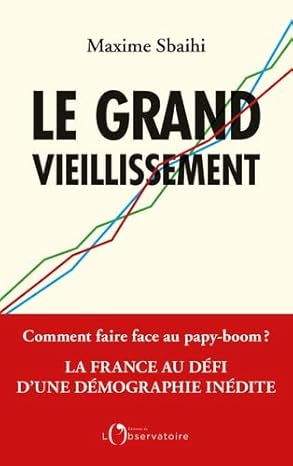
Maxime Sbaihi, Le Grand Vieillissement (The Great Aging), Alpha / Humensis, 272 pages.
Like most Western countries, and despite having one of the highest fertility rates in Europe, France is not immune to the aging of its population. In his essay, Maxime Sbaihi analyses the consequences of this ageing on the economy and on our social model. Since the end of World War II, our social model has been based on intergenerational solidarity, which is sensitive to demography, the engine of its financing. The conclusion is clear today: the working population must finance, through pay-as-you-go, a record number of retirees who are spending an incresaing time in retirement. The beneficiaries of the pension system are now on average richer than its contributors. Our pension system is theoretically based on 3 levers: working longer, lowering the level of pensions and increasing contributions. It is understandable that politicians have often struggled to find the best combination without altering the social model. Social needs are increasing, but it is difficult to raise the contributions when the workforce represents 50% of the total population. (The number of active persons in relation to the number of inactive ones aged 60 or over was 1.9 in 2020 but is projected to be 1.6 in 2040 and 1.4 in 2070, source INSEE) The author then focuses on the impoverishment of young people, an increasingly worrying situtation: “the poor of yesterday were retirees at the end of their lives, the poor of today are young people facing the future”. He believes that intergenerational equity is no longer guaranteed. Income gaps are widening in the face of a “patrimonialization” of society. He specifies that the real estate and financial assets of the sexagenarians (and older) are the highest of all the other age groups. He points out the fact that this overabundant savings has little impact on the financing of the economy since it is mainly oriented towards low-risk and liquid investments. Thanks to a longer life expectancy, today’s retirees postpone the transmission of their wealth. On the political side, the author paints a picture that may once again prove to be divisive: – Young people abstain the most at each election, are often poorly registered on electoral lists, tend to become radicalized and rather prefer a citizenship of commitment, especially on ecology – Those over 50 are the most mobilized, compose the absolute majority of the electoral college, are often seduced by centrism and prefer a citizenship of duty Democracy tends to slide towards gerontocracy since politicians tend to give priority to older voters in the face of a youth who shun the polls. The author proposes rather liberal solutions to limit this intergenerational injustice: the establishment of an universal income, modification of inheritance and estate taxation, a new status mixing permanent and fixed-term contracts, and intragenerational solidarity. The essay is well documented, with numerous bibliographical references, and is written in a very accessible style. The subject is topical and is at the heart of political debates in the context of public debt management. Maxime SBAIHI is an economist and essayist. After starting his career in the banking sector in Paris, then at Bloomberg in London, he was a Director of Studies at the Institut Montaigne and is now the Strategy Director of Club Landoy. Note by Sophie Friot
Les Economistes atterrés, La dette publique, précis d’économie citoyenne, Points, 256 pages.
This “citizen’s economic primer” is a second edition [1] with an additional chapter devoted to inflation. In the first part of the book, the authors argue, as opposed to the popular belief, that debt is not a burden for the future generations since the current generation already benefits from it through investments in infrastructure and public services. They also promote the idea that, in times of crisis, one should not tighten the belt, since an increase in public spending will lead to a greater increase in activity through the effect of the fiscal multiplier: the ratio between the rate change in GDP and the rate of public spending. Public deficits are thus necessary to achieve full employment or to finance collectively useful investments, but they are harmful in times of full employment where they have an inflationary potential. This ideology goes against neoliberal politics, which argues that it is by producing more wealth that we can finance the social model, by working more (unemployment insurance reform) and longer (pension reform). The second part is dedicated to the trajectory of the French debt in order to understand its evolution since 1945, and more precisely, the dependence on financial markets observed since the 1980s. Some economists believe that the increase of debt contributes to raising interest rates, which discourages private investment. This raises the question of the public debt sustainability . The authors believe that a State’s reimbursement ability is linked to the strength and reliability of its tax system, as well as to the possibility of borrowing from banks and financial markets. They believe that the French public debt is sustainable, especially since more than 50% of French debt holders are not French resident. This level proves the attractiveness of the French public debt on a global scale. Finally, the third part is a presentation of the solutions and manoeuvers to make public debt acceptable to all. Since the COVID crisis and the return of inflation, the ECB has increased its key rates 10 times (between July 2022 and September 2023) aiming reduce inflation at the cost of an economic slowdown and a rising unemployment, thus limiting the ability of the states to collect tax revenues. As a remedy, the authors recommend a comprehensive tax reform, focusing on three major areas: 1- Restoring the progressivity of income tax 2- Implementing an effective fight against tax evasion 3- Focusing on a better consideration of ecology, with the evocation of a Green New Deal In conclusion, this book calls to get out of catastrophism, since public debt can be part of the solution and not the problem. They go against the grain of the policies applied for decades by successive governments and confront current political debates in the midst of the 2025 budget vote and the issue of financing the energy transition. The concepts are rather pedagogically approached and accompanied by technical sheets allowing each reader to understand all the contours of public debt and thus form their own opinion. Éric Berr (University of Bordeaux), Léo Charles (University of Rennes 2), Arthur Jatteau (University of Lille), Jonathan Marie (Sorbonne Paris North University) and Alban Pellegris (University of Rennes 2) are members of the Économistes Atterrés. Sophie Friot’s note
Daron Acemoglu and Simon Johnson, Power and Progress. Technology and Prosperity, Our Millennial Struggle, Peason, 2024, 610 pages.
The book presents the research work of two Nobel Prize winners in Economics awarded in 2024. It takes the form of a monumental review of scientific literature on the factors, forms, and combined effects of technological innovation and institutional change throughout the ages. It focuses in particular on the interactions between the digital revolution and the globalization of the markets since the 1980s. The book begins with a discussion around the notions of progress, which is at the same time technical, institutional, as well as ideological. It continues with a review of the debates on the mechanization of agriculture and then of industrial processes, leading to several waves of “technological unemployment”. The two authors compare in particular the sometimes contradictory positions adopted by the greatest economists on these phenomena, which resulted in a concentration of wealth and a widening of inequalities between labor and capital. They show in particular that these technological and socio-economic changes have been favored by institutions and ideologies, first Keynesian and then neo-liberal, which have been increasingly adapted to social groups the power of which is based more on capital than on labor. They analyze in particular the decline of unions and political parties influence in the fight against social inequalities. The two Nobel Prize winners also observe that AI, especially in its generative form, generates low productivity gains, but stimulates creativity in all its forms and develops human relationships, which are both sources of economic growth and social well-being. They argue that humanity should seek to improve the usefulness of machines rather than perceive only their dangers. They deplore in particular the use of AI to misinform and manipulate opinion. They denounce the current trend of considering AI as being at the service of a society of surveillance and control of citizens in the name of an ideology. They compare the ethical frameworks established by different countries and propose a new form of global AI governance promoting both technological innovation and the common good. One of the main interests of the book is therefore to present in a didactic form the main Anglo-Saxon research devoted to the evolution of the relationship between technical progress and the institutions of Western countries, but also to contribute to the current thought leadership on the supervision of AI. Daron Acimoglu and Simon Johnson are professors at the MIT and co-winners of the 2024 Nobel Prize in Economics. Note by J-J.Pluchart
CAPITALISM, ALONE: The Future of the System That Rules the World, Harvard University Press , 2019, 300 pages.
Since his book entitled Global Inequalities, Branko Milanovic has asserted himself as one of the champions of the fight against socio-economic inequalities. He deepens the reflection initiated by Fukuyama on “the end of history”, by trying to show that capitalism now reigns supreme in Europe, the United States and Asia (in an authoritarian form). The capitalist system presents the same three principles in these three areas: production dictated by profit, a mostly salaried workforce, and private capital with rather decentralized governance. However, it distinguishes two forms of capitalism: liberal and meritocratic, authoritarian and state-run. He shows that the spread of capitalism has contributed to raising the average standard of living, but also to widening inequalities, as the share of capital in global income has increased by 4 to 5% at the expense of labor, both in rich and poor countries. The author also analyzes the evolution of forms of work and predicts a development of remote work, and therefore, a decline in population migration. He finally wonders about the alternatives to the current capitalism, concluding that they can only be worse. Notes by Jean-Jacques Pluchart
CAPITAL AND IDEOLOGY, Editions du Seuil, 2019, 1024 pages
In his latest monumental book, Thomas Piketty continues his reflection on social inequalities on a global scale, trying to show, contrary to popular belief, that they are not natural but are generated by “conservative ideologies and discourses”. According to him, the legitimacy of these inequalities throughout history is based on simulacra of objectification. He denounces in particular the “proprietary ideology” based on the right of ownership inherited from the French Revolution, which is supposed to guarantee the stability of institutions and avoid “generalized chaos”. He perceives in individual property a “particular form of social domination”. He formulates proposals aimed at eradicating the concentration of wealth and promoting “the circulation of capital”: confiscatory tax on capital of up to 90% of income; universal endowment of capital to each citizen… Opening up a 3rd way between capitalism and collectivism, he finally advocates a development of co-management of companies between shareholders and employees. Thomas Piketty’s previous book (“Capital in the 21st Century”) had been criticized by economists for its methods and sometimes questionable statistical sources. This latest book meets the skepticism of political economists for its sometimes questionable scientific ethics, because the author “is careful not to measure the economic and social consequences of “going beyond private property”. The book raises various questions about the reasons for its success. Is it a provocation to neo-liberal economists? Does it call for the advent of a new crypto-collectivist system? Is it trying to launch a new movement of “French theory” on American campuses? Is it a new encyclopedic curiosity? review by J-J.Pluchart

ANTI-PIKETTY. LONG LIVE CAPITAL IN THE TWENTY-FIRST CENTURY, Jean-Philippe Delsol, Nicolas Lecaussin and Emmanuel Martin (coord.), Librechange Editions, 2015, 380 pages.
A bestseller in economic literature, Thomas Piketty’s book Capital in the 21st Century (sold nearly 2.5 million copies) attempts to demonstrate the fundamental inequality that generates a return on capital higher than the growth rate of the economy (r> g), but it has been the subject of much criticism. French liberal economists – such as Alain Madelin, Henri Lepage and Nicolas Baverez – have challenged the assumptions, reasoning, figures and graphs presented by the author. The collective led by Nicolas Lecaussin and Jean-Philippe Delsol – which includes twenty economists, historians and tax experts, including Daron Acemoglu, Martin Feldstein and James A. Robinson – argues that Thomas Piketty’s thesis is more political than economic. The authors claim that economic and social inequalities have not exploded, but rather have been reduced in several areas (including education and health). They consider that “the rich do not eat the bread of the poor”, but that they give it to them, taking risks and creating millions of jobs. Wealth cannot indefinitely grow faster than economic growth, and excessive taxation does not solve problems but rather exacerbates them. According to the authors, Thomas Piketty’s data seem to be used for essentially ideological purposes. The collective proposes “a reasoned and reasonable argument” opposed to the ideology qualified as “Marxist essence” by Thomas Piketty, by opposing academic criticism and contradictory facts. They recall the main scientific criticisms against “Pikettymania” and denounce its simplistic and populist theses. Jean-Philippe Delsol is a director of the Association for Economic Freedom and Social Progress (ALEPS). Nicolas Lecaussin is the Director of Development at the Institute for Economic and Fiscal Research (IREF).

CAPITAL IN THE TWENTY-FIRST CENTURY, Éditions du Seuil, 2013.
The author observes, like Tocqueville, an increasingly unequal distribution of income from capital and labor. His thesis is based on the hypothesis of a return on capital (consisting of natural resources, infrastructure and public and private facilities, net of debt) always higher than the economic growth rate (covering in particular changes in wages), since the beginning of history, except during periods of war and economic depression (as in the 1930s). The unequal relationship between rentiers and workers should, according to him, grow rapidly in the twenty-first century. This structural inequality (denoted r> g) between the return on capital (including the “top 1%” in the income scale) and the return on labor is a potential source of social conflict and threat to modern capitalism. This gap is mainly explained by the rapid increase in savings of the wealthiest households. Thomas Piketty advocates the introduction of a more progressive tax and the establishment of a new global tax on capital. The publication of Thomas Piketty’s latest book has had a global impact. It was considered by some Anglo-Saxon economists as a turning point in economic thought. This thesis has sparked mixed reactions in all Western countries. The author was notably accused of revisiting the Marxist approach to the “class struggle between bourgeois and proletarians.” The work of Thomas Piketty has been the subject of much criticism of an ideological and methodological nature, summarized in the following book, reviewed by the Turgot Club.