

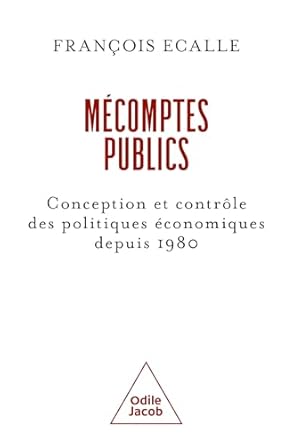
This book is a journey through the author’s personal history and the public accounts of the French state. First of all, we follow the young centralist as he joins the ENA and discovers, throughout his many training courses, the (dys)functioning, the mysteries, the conflicts of different public services and administrations in the field. Then, through these 32 years spent in the service of the republic, initially, in the forecasting department of the Ministry of Finance, we learn, among other things, how the Ministry of Finance works, how budget forecasts are made, international exchange relations, the lack of cooperation and coordination between the different departments of the ministry. But also, since we have the chance to (re)live the 80s/90s with François Ecalle, we follow him during the liberalization of prices, the preparation of the euro and the European budgetary rules as well as the difficult opening of services to competition. Then, at the Court of Auditors, we control the banking sector and discover, at the Banque de France, an accounting system that is, to say the least, heterogeneous, but also very specific accounts and secret loans from the state, accounting and tax processing of certain equity investments in BNP and Banexi, whose legal exemplarity is not obvious. After the banking sector, the journey continues in the public companies of the world of transport, in agriculture, and we hallucinate with the author in front of the irregularities, the favors obtained, the bad choices, the waste, the absurd reforms, and the calamitous management. Some of the recommendations proposed during the audits have been implemented, but these decisions took a long time to make and were sometimes thwarted or canceled by other reforms. It is striking to note the permanence of fiscal, economic, financial, and political problems and the measures that should be taken to solve them. The observations, the diagnoses made on social VAT, on pensions, on employment policy, on sectoral policies such as industry, housing, agriculture, etc. and the recommendations proposed thirty years ago are still relevant. But all is well, the Court of Auditors continues to publish reports that remain a dead letter, the Treasury management continues to write to its minister that the public deficits recorded in the finance law are unattainable without the adjustment of accounts, the state continues to let its deficit and debt slip away and the French continue to ask the state for everything. Be careful, however, not to lose our sovereignty through the action of certain foreign actors… François Ecalle is Honorary Master Advisor at the Court of Auditors and President of Fipeco, the Public Finance and Economy Association Ph Alezard
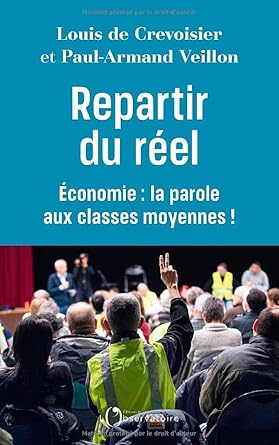
DE CREVOISIER Louis, VEILLON Paul-Armand. Repartir du réel, L’OBSERVATOIRE, 205 pages
“Starting from reality”, a certain touch of arrogance in the title as if it was just necessary to start again and listen to what the “France from below” says to put equity and justice in public policies and reforms. The authors report a certain self-criticism of their peers and what they have lacked until today: understanding the experience of workers, far from the metropolises, public transport and the Grandes Écoles. They drew inspiration from their experiences, the cahiers de doléances and the reports of the great national debate established in 2019, a few months after the start of the yellow vests crisis. In December 2024, President Emmanuel Macron called, “to govern”, “from reality and not from fantasies or untruths”. The words are clear, but the middle classes are getting impatient. These middle classes, neither poor nor rich, seek at all costs to have a job that pays, a decent standard of living and hope for their social advancement and that of their children. Starting point of the yellow vests crisis and the mobilizations on the roundabouts. Employees must be able to consider an increase in their wages throughout their career and the social system must be more incentive to work: the gap between inactivity and a job at the minimum wage is considered too small. The authors propose the creation of an “employee dividend” in order to increase the sharing of value. In an indebted France, the financing of the social model remains a stumbling block between politicians and economists. Solutions exist to support the purchasing power of workers but require courage in implementation: lower public spending, increase social contributions and/or working time, or change the way the pension system works. Taxes for whom and for what? The middle classes are not against taxes but want value for their money and are not satisfied with the level of public services. Given this, the authors propose to directly link the Court of Auditors to Parliament in order to have a better assessment of public spending. Regarding taxation, it must be more virtuous in order to reward behaviors that contribute to collective interests. Purchasing power, another theme discussed at length by politicians in search of voters. In a service and deindustrialized France, productivity has been slowing down for several decades and can no longer guarantee dynamic growth. Constrained by their income, the middle classes are eyeing their spending. Among the avenues mentioned for leveraging growth, the authors mention complementary health and highways. Added to this is the ecological crisis and adaptation to the energy transition. Once again, the middle classes find themselves in difficulty to find decent, isolated housing and are often “strangled” by rising energy costs. In the last part, the authors highlight the opportunities for the middle classes. In terms of education, the authors wish to strengthen the level of mathematics and encourage students to move towards scientific fields; without forgetting the revaluation of teachers. At the dawn of future electoral periods and budgeting, the authors thus establish many concrete proposals that must be at the heart of the debates. An educational and enlightening book, a must read. Louis DE CREVOISIER is a senior official, Inspector of Finance. He was previously Deputy Director of the Cabinet of the Minister of Transport. Paul-Armand VEILLON is a senior civil servant, deputy director of the office of the Minister in charge of Public Accounts. Sophie FRIOT

Olivier BABEAU, L’ère de la flemme, Editions Buchet-Chastel, 288 pages, février 2025.
The author – PRIX TURGOT 2020 – in his latest work transports us to a new dimension by explaining the paradigm shift that is the loss of the sense of effort. A civilizational rupture is taking place. The effort that was exalted – and which is at the heart of any successful life – is no longer of interest, it is no longer given as an example, and we prefer the egalitarian virtues of humility and passivity. We no longer salute the hero, but the victim. Elitism was a laudatory qualification, we are wary of excellence, the mediocre reassures, we have entered the lazy thirties which will logically lead to a form of economic and political bankruptcy and to a cultural, economic colonization and also to the end of our political model based on democracy because the era of laziness mainly concerns the old countries of the West. Artificial intelligence does not make effort useless, but it changes what is essential to live happily. We cannot rule out the possibility that work will disappear and if the civilization of idleness is confused with that of laziness – which has significant consequences on our material lives – it will lead to the disappearance of the individual. Effort also dies from the profound transformation of our relationship with society because it is no longer necessary to obtain most of the things that yesterday cost so much to acquire. One sometimes has the impression that the essential goal of every citizen is to succeed in capturing the perks of redistribution during working life and retirement. The preference for laziness has spread to all dimensions of society. The extraordinary latitude of choice conferred by prosperity ends up being tiresome, because freed from the burden of hunger, we are less able to bear the other rules that constrain us. The development of modern civilization has changed the rites of integration and the rules of the social game. For millennia, belonging to a group meant conforming, otherwise one was not recognized as a member. We do not negotiate with the rigor of social prescriptions, because existence was precarious and relatively short, suffering and death being omnipresent. One could not be idle; the idleness of the Greek citizen is not considered laziness because it allows a work on oneself beneficial for the community. One did not choose one’s spouse or religion. Degradation is no less formidable than death, since an existence rejected by the group is not really an existence. We must make an essential difference between pre-industrial society and ours. Today, the range of choices to be made in our lives is almost infinite. Effort is no longer the prerequisite for survival. Everyone enjoys a piece of the collective prosperity without having to participate. This opens up a new possibility: doing nothing. And it all starts at school, for the success rates of the patent are boosted by 3 to 6 points according to the academies. The progression of the number of baccalaureate recipients is a sign of its change of function. It has become a ritual of social aggregation. It is up to the institution to adapt rather than to ask students to make an effort. Now, we no longer read because the effort required is too great, we learn by entertaining ourselves via digital means. The effort would not have disappeared if it had not been discriminated against. At the beginning of the 21st century, all the conditions are met for the death knell of the effort, which is no longer the rule but the exception, or rather that it is replaced by the trumpets of laziness, because the progress of industrial and agricultural civilization has been immense. We have access to a standard of living prodigiously superior to that of our ancestors at the cost of a considerably lower effort. We want to consume, but less and less to produce. It is no longer a question of achieving the best possible performance, but of doing what is enough to earn a salary. Laziness is no longer a flaw but an asset to be managed, the most spectacular sign – sedentary lifestyle – of triumphant laziness is the decline of our physical abilities. Today’s teenagers have lost a quarter of their lung capacity compared to those of 1990. In September 2022, Santé Publique France launched an advertising campaign “getting teenagers to move is not easy, but encouraging them is important” compare to another advertising campaign “install WhatsApp effortlessly on your tablet”. In December 2023, we celebrated the 25th anniversary of the 35-hour work week, which caused us to lose one of our two competitive advantages vis-à-vis Germany, and the 42nd anniversary of retirement at 60 years of age by distribution. The problem with political decisions is that they take a very long time to prove their merits or their shortcomings. In this case, these decisions turn out to be absolute disasters. The 35-hour week was the illusion of free money before the letter (it should be noted that we were not copied on this subject). France works too little. In 1980, we were the 13th country in terms of GDP per capita, and we are 25th in 2023. France has been living beyond its means for several decades. We buy the work we don’t want to do abroad by paying either with assets or with a drawing right on our future taxes. Yesterday, we only existed through the group, now everything happens as if the group only existed for us. This is the second pillar of the effort that collapses, we no longer exist for others but to have fun. Avoiding effort decreases the quantity produced but also our tolerance to effort. This also affects China, where revolt is not possible and young people protest by staying in bed. The end of the effort disarms the mind by weakening reason in favor of emotion, it makes the bed of the serious social crisis that we are going through. The world of emotion claims

Vladimir Atlani-VictorSTORCHAN , Anti-manuel d’intelligence artificielle, Eyrolles, 192 pages.
This is a title that intrigues, at first glance, and which reflects the general tone of this work which seeks to demolish the ideas received on AI and to stimulate our intellect to take advantage of it in a reasoned and reasonable use, bringing great progress in all areas of social life, scientific life and business life. The title “anti-manual” means that there is not one AI but AI with different expectations and models for each of them. There is, therefore, no perfect user manual, but a progressive learning, both empirical and scientific, of the immense, even unlimited possibilities offered by these technologies. In the broadest sense, AI encompasses all the techniques that can replicate the cognitive behavior of the human brain on machines. Beyond a simple replication, the explosion of absorption capacities, by machines of increasingly large volumes of data, has made it possible to develop uses of these increasingly promising technologies. This is the case of “machine learning” which, in a very simplistic way, beyond the automation of existing processes, will strive to optimize the use of computers based on real examples that will make it adapt new ways of working, for example, in the medical, legal, anti-fraud fields… Beyond the restructuring of complex processes, the potential of AI extends to the powerful creation of new organizational models in all areas of society, “deep learning”, consuming exponentially growing volumes of data. If the potential for progress is considerable, the ethical and geopolitical risks are immense and can threaten individual freedom. In short, there is a risk for our democracies. One requirement is the implementation of very strict governance rules at both the national and global levels. One of the strengths of the book is its clarity and the many examples and anecdotes that illustrate the point and fortunately complement a very broad, very rich and sometimes difficult subject. This enlightening book deserves a prize. Denis Molho
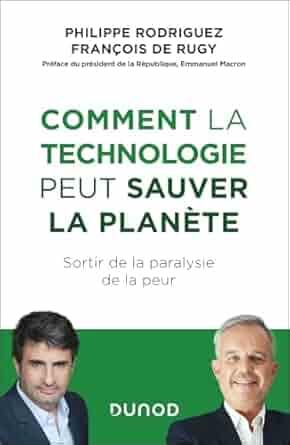
Comment la technologie peut sauver la planète – Sortir de la paralysie de la peur ,Philippe RODRIGUEZ et François de RUGY,Dunod, février 2025, 180 pages.
“Neither a fantasized return, nor a decline; This struggle is a matter of life and death” We live in a time that forces us into bitter economic rivalries against the backdrop of energy transition. We must move forward without fear or complaint and stick to our agenda. This book by Philippe Rodriguez and François de Rugy, divided into five parts, bears witness to the obstacles to be overcome, the challenges to be met, the initiatives to be undertaken, and the means to be devoted to this national priority, which must give a central place to the deployment of innovations of all kinds to preserve France’s technological sovereignty. In the first three chapters, the authors highlight the narrow path to be traced between a technophile Prometheism and ecological sobriety. The abundant catalog of leads and the enumeration of pillars, energy sources, actions to be taken, and their expected returns are reviewed to achieve energy efficiency. Storage appears to be a crucial element in managing this transition. While France is lagging behind in “cleantech”, disruptive innovations such as SMRs provide it with undeniable advantages. This transition and its complexity are at the heart of diplomatic and geopolitical influences in view of the concentration of energy resources in their distribution in certain parts of the world. In this regard, rare earths, placed at the heart of green technologies, pose a serious dilemma related to the requirement of the highly polluting refining of this resource. The last two chapters highlight the pressing time in this period of budgetary scarcity and the importance of the efforts to be made. The Draghi report of September 2024, with the doubling of the budget to 200 billion euros of Europe’s program for research and innovation, must be reflected in national strategies. The authors call for an administrative revolution as a cardinal condition of success. The opus closes optimistically with eight avenues and a long list of recommendations to think outside the box and boost the energy transition. But it is indeed a paradigm shift that is at stake, with a certain apostolic effect. The uniqueness of this enlightened book can be summed up in a few words: we must act quickly! But the exercise is not simple and seems to have to articulate short-term actions in a long-term approach. Philippe RODRIGUEZ, director of Avolta, and of several companies for thirty years. His experience as a multi-entrepreneur and his various activities allow him to be a particularly wise observer of current themes. François de RUGY, was Minister of the Ecological and Solidarity Transition (20189-2019) and played a key role in the adoption of laws related to ecological issues. As a Senior Advisor at Avolta and an independent consultant, he helps companies and investors develop new ecological models. Reading notes by Freddi Godet des Marais –
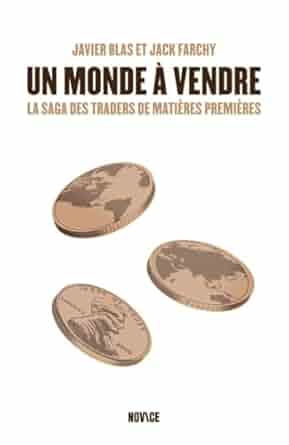
Javier BLAS et Jack FARCHY, Un monde à vendre : la saga des traders de matières premières, Edition Novice ( traduction), juin 2025, 405 pages
This book traces the history of commodity trading houses over the last sixty years, from their births to their hands placed on the world trade of oil, cereals and metals in the most remote areas of the planet, where power and money mix. The first part of this book explains how the pioneers of oil trading (Philipp Brothers, then Marc Rich & Co, and finally Glencore) supplanted the 7 major oil companies (including Exxon, BP, Shell, etc.) in terms of trading black gold, by putting oil in the wheels in countries like Russia and others. And the second part of the book, to understand the interactions between countries in Africa and South America, to help support global economic development. A modern world, where the market is king and where multinationals seem to be able to free themselves from any attempt at regulation. Clearly, the author explains that commodity traders, with their actions, have transformed the world economic order, participating in the disintegration of the oligopolies that previously controlled many markets. While the trading houses based in Switzerland (canton of Zug) were able to develop in the greatest discretion, acting in relation with heads of state producing energy and mineral wealth, the latter were caught up by American institutions to stop practices that are often unspeakable. Moreover, while China, since its entry into the WTO, has been the main catalyst for the demand for raw materials on the planet, the trading house landscape has begun to change since its economic slowdown. The latter must address the following three constraints: the United States/China trade war (2018), climate change (electricity), the arrival of Chinese competition developing its own trading structures; without forgetting transparency, a key element of the 21st century. In the end, an interesting book to read for anyone working in the commodity trade or being an analyst in the finance sector. Because without commodity trading, there is no economic development or monetary stability. Javier Blas is a columnist at Bloomberg Opinion covering energy and commodity issues from London. Jack Farchy is a senior reporter specializing in natural resources at Bloomberg News. Reading notes by Claude Georgelet
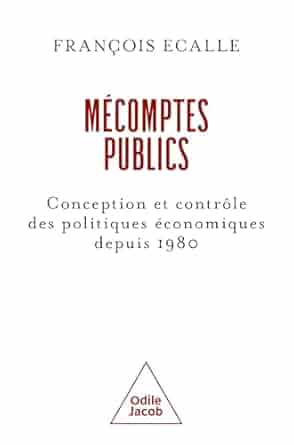
François Ecalle, Mécomptes Publics, Eds Odile Jacob, 311 pages.
This book is a journey through the personal history of the author and the public accounts of the French state. First of all, we follow the young “centralien” as he integrates into the ENA and discovers, throughout his many training courses, the (dys)functions, the mysteries, and the conflicts of different public services and field administrations. Then, through these 32 years spent in the service of the republic, firstly, at the forecasting department of the Ministry of Finance, we learn, among other things, how the Ministry of Finance works, how budget forecasts are made, international exchange relations, and the lack of cooperation and coordination between the different departments of the ministry. But also, since we have the chance to (re)live the 80s/90s with François Ecalle, we follow him during the price liberalization, the preparation of the euro and the European budgetary rules as well as the difficult opening of services to competition. Then, at the Court of Auditors, we control the banking sector and we discover, at the Banque de France, an accounting system that is heterogeneous to say the least, but also very special accounts and secret state loans, accounting and tax treatments of certain equity investments in BNP and Banexi whose legal exemplarity is not obvious. After the banking sector, the journey continues in public companies in the world of transport and agriculture. We are stunned by the irregularities, the favors obtained, the bad choices, the waste, the absurd reforms, and the calamitous management. Some of the recommendations proposed during the audits have been implemented, but these decisions have been slow to take and sometimes thwarted or canceled by other reforms. It is striking to note the permanence over time of fiscal, economic, financial, and political problems and the measures that should be taken to solve them. The observations and diagnoses on social VAT, pensions, employment policy, sectoral policies such as industry, housing, agriculture, etc., and the recommendations proposed thirty years ago are still relevant today. But all is well, the Court of Auditors continues to publish reports that remain a dead letter, the Treasury Department continues to write to its minister that the public deficits included in the Finance Act are unattainable without recovery of the accounts, the state continues to let its deficit and debt spiral, and the French continue to ask the state for everything. Be careful, however, not to lose our sovereignty through the actions of certain foreign actors… François Ecalle est conseiller maître honoraire à la cours des comptes et président de Fipeco, l’association Finances publiques et économie Ph Alezard
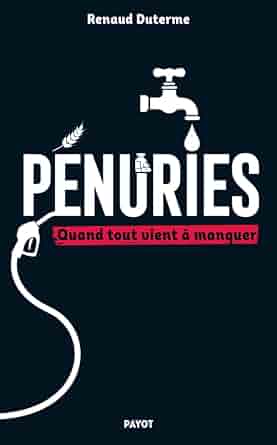
Duterme R., Pénuries – Quand tout vient à manquer, Payot, 211 pages
“The 20th century was the century of abundance. The 21st will be one of limits.” We frequently discuss energy transition, relocalization and sobriety, but partly as if they were simple options. The author leads us to see that these are no longer options, but realities. This book makes this perfectly clear, and not by hyperbole or by trying to scare the reader. It’s not a doomsday story, nor is it about eternal progress. It simply welcomes the fact that we’ve reached the limits. Scarcity is no longer the exception and is now becoming the norm. Oil is at the heart of his analysis. He reminds us of a little-known fact: Energy Returned on Energy Invested (EROEI). From 100:1 at the beginning of the twentieth century, it now stands at 11:1, a figure that threatens our entire equilibrium. Nothing can be done without abundant, cheap energy. Electricity is not a silver bullet, just a vector. It’s a means of transporting energy. The author also mentions minerals and raw materials. We depend disproportionately on scarce resources, often from unstable countries. We use them for everything: telephones, batteries, infrastructure. But if one link breaks, we have no plan B. Freight transport is under pressure worldwide. It has a very low profit margin. One small thing can paralyze an entire production operation. Even industrial agriculture depends on it: fertilizers, machinery, transport… in reality, nothing is autonomous. It’s a system we’ve built ourselves. Over-specialization, globalization and the cult of efficiency have left us unable to cope when things go wrong. We’ve pursued efficiency and forgotten resilience. Renaud Duterme links this to the economic logic handed down by Ricardo and the rise of neoliberalism. The issue is not just technological; it’s a political vision. In the final section, he is less alarmist, but just as serious. He says we’re going to suffer shortages, and the question is really this: do we want to suffer them or be prepared for them? It’s not a question of stopping everything or going backwards. It’s an invitation to reconsider what we make, why and for whom. Relocate where it really counts. To overcome this system of unlimited growth and recognize that this century will have limits – physical and environmental, as well as social. In other words, this is not a technical manual or a political tract. It’s a clear, honest text. It confronts us with reality. It doesn’t try to scare us; it tries to convince us, by giving us the facts, and it succeeds. It’s a book to read not so much for what you can learn from it, but for what you can prepare yourself for. Because, in the future, it won’t just be a question of technologies, but of choices, compromises and even collective thinking. Renaud Duterme holds a degree in development sciences from the Université Libre de Bruxelles, where he also teaches geography. Attentive to questions of inequality and ecology, he is the author of De quoi l’effondrement est-il le nom? (2016, foreword by Pablo Servigne), Petit manuel pour une géographie de combat (2020) and Nos mythologies écologiques (2021). Florence Anglès ‘ note
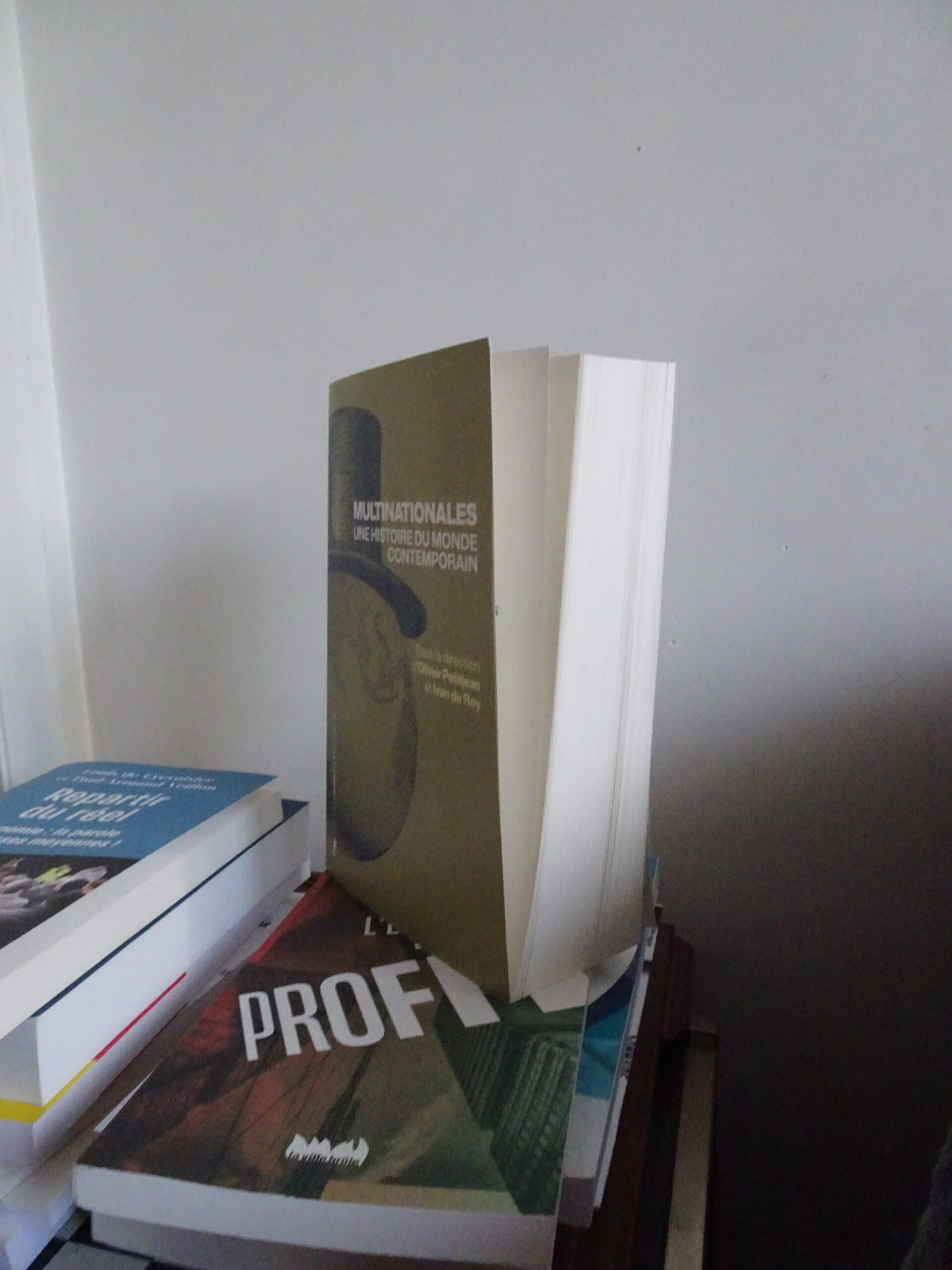
Oliver Petitjean et Ivan du ROY, Multinationales. Une hstoire du monde contemporain, La Découverte, 797 pages.
The book is monumental in its subject – the history of multinational companies – but also in the number of its authors (56) and its volume (857 pages). It appears at a turning point in the history of multinationals, as their expansion is threatened by the increase in customs duties, the multiplication of environmental standards, and the strengthening of competition rules. Their wealth, power, and practices feed the imaginations – and sometimes the fantasies – of people in both the West and the Global South. They are sometimes accused of being at the origin of certain crises or abuses from which industrialized states and developing countries suffer. The book is in the form of short documented stories and journalistic articles presented in chronological order, from 1857 (the creation of the Singer group) to 2025 (agribusiness and the mining industry in Brazil). The authors’ ambition is to “reintroduce the vicissitudes of multinationals into the great world history”. They want to reveal the real roles played by the key players in economic and social life for nearly two centuries. They deny having written another “black book” on the actions of certain companies, although some articles recall their post-colonialist, monopolistic, commercial, financial, and fiscal deviations… In fact, most of the stories highlight the known – and sometimes unknown – technical, economic, and/or social advances that have been generated by certain major multinational projects. Through the diversity of approaches and styles adopted by the authors, the book shows that the questions raised by the practices of multinationals do not only cover academic issues or political debates, but that they challenge all citizens through the media and social networks. Throughout the chapters, the reader of the book perceives the scale, dynamics and complexity of the systems of multinationalization of industry, finance and trade, which involve both private and public actors, producers and consumers, holders of power or counter-power. The reader then better understands why some multinationals try to “green” and “socialize” their images, because they know, “that like civilizations, they can be deadly.” The authors are university lecturers and researchers, lawyers, journalists, and association leaders. Note by J-J. Pluchart

Multinationales. Une histoire du monde contemporain, sous la direction d’O. PETITJEAN et I. DU ROY, Éditions La Découverte, 864 pages
Note by Florence Anglès The book meticulously recounts and analyzes the history of multinationals since the 19th century. It is neither a diatribe nor a theoretical essay disconnected from reality. It’s a highly structured, well-documented read, aimed at interpreting a major phenomenon of today’s capitalism: the empowerment of private economic agents, who have gradually developed into de facto political agents with significant power but little democratic legitimacy. The founding of the first multinational companies was preceded by two other major aspects of the global economy: firstly, formal colonialism (the opening up of vast parts of the world to non-indigenous occupation and colonization), and secondly, the numerous industrial revolutions. They were sustained by logics of extraction, supply and dependence. They became a cornerstone of Fordism and post-war reconstruction in the 20th century. However, from the 1980s onwards, they began to break free from national regulatory structures. The deregulated and fragmented framework has enabled them not only to expand globally, but also to play by their own rules. The power they wield takes many forms: “Multinationals don’t just adapt to the world order – they reshape it. One of the book’s most important achievements is to link this economic trajectory to a political reading of power relations. Multinationals didn’t simply appear out of nowhere: they are the result of a history, a strategy, and a succession of opaque systems. The book’s revelation is an underlying coherence that we often see only in fragments, a silent renunciation of collective power in favor of unelected actors, exercising their power without a clear mandate, but effectively. This is a difficult read, but essential if you want to understand the true foundations of today’s economy. Olivier Petitjean is a journalist and co-founder of the Observatoire des multinationales. He has worked for many years on issues of economic justice, corporate accountability, and environmental impact. He is also the author of several investigative reports on the role of major corporations in shaping public policy. Ivan du Roy is a journalist, editor, and founder of Basta!, an independent media outlet focused on social, economic, and environmental issues. His work specializes in the critical analysis of economic policies, corporate power, and mechanisms of influence within democratic institutions.