


The collective work written by 17 French-speaking teacher-researchers who are members of the Association of Entrepreneurship and Innovation chaired by Professor Sattin, is part of the new collection “decarbonated management” created by the Fondation nationale pour l’enseignement de la gestion des entreprises (FNEGE). It raises an issue that is both original and current: launching and managing a low-carbon entrepreneurial project. The authors recall the challenges and the urgency of saving carbon, water and non-renewable resources. They stress that these requirements apply to companies of all sizes and all sectors of industrial activity and services. They note the modesty of the progress made in these areas, but they welcome the sometimes unknown initiatives taken by the public authorities in favor of low-carbon entrepreneurship and competitiveness clusters. They present examples of virtuous companies in terms of decarbonation. They deplore the cumbersome administrative, financial and fiscal procedures that go with the creation of a business. The book is structured in two parts. The first is devoted to the fundamentals of entrepreneurial projects, the search for creative opportunities and the development of the business plan and the finance plan. The second part focuses on the processes of creation, business recovery, and intrapreneurship. This last model is inherited from the project management that emerged in the United States during the 1970s and which evolved under the influence of start-up creations and high-tech laboratories. The book is illustrated with numerous diagrams, graphs, tables and bibliographical references, which give it great pedagogical qualities. It is enriched by case studies representative of creations and by “questions for reflection” allowing a deeper understanding of one of the main processes of creating economic and human value in modern society. Laurice Alexandre is a professor at the University of Paris Cité and Nathalie Lameta is a lecturer at the University of Corsica. Note by J-J. Pluchart

Frédéric CHARILLON, Géopolitique de l’intimidation – Seuls face à la guerre?, Odile Jacob, March 2025, 300 pages.
Intimidation is a rational act. It is part of a conflict logic that does not exclude negotiation, but only on condition that it takes place according to the terms and conditions imposed by the intimidator. When the latter relies on a tradition of extraterritorial sanctions against the global financial system, it’s all very well to pretend that Donald Trump is losing his mind: no leader is insane in the sense of any mental disorder. Describing a decision as “crazy” or “irrational” is misleadingly easy. On the other hand, says Frédéric Charillon, analyzing behavior from the angle of a possible intimidation strategy seems more relevant. The phenomenon of the “American red pangolin” and the state of “flabbergastedness” conceded by the French minister recently interviewed, have difficulty masking an ignorance of international relations as transcribed in the famous essay by Thomas Schelling, Nobel Prize winner in economics in 2005 (for a work published in 1960!): the strategy of conflict. On the subject of extraterritoriality, let’s cite a few precedents: the Helms-Burton and Amato-Kennedy Acts, passed in 1996 under President Clinton, sanction foreign companies trading with Cuba, Venezuela or Iran; the Ukraine Freedom Support Act of 2014 under Obama targets the sectors of the ussia’s energy, defense and financial sectors. As for Trump’s supposed irrationality, it’s worth remembering that the “Madman in Chief” was none other than Richard Nixon when he suggested that his behavior could be dangerously unpredictable during the Vietnam War – at the risk of unleashing nuclear fire (less ambitious, Donald Trump merely mentioned the possibility of shooting someone Fifth Avenue without losing votes). The outcome? Nobody knows at this stage… Besides, the book ends with a “Provisional Conclusion”. But let’s not forget that, for Schelling, conflict is inseparable from negotiation: “to study conflict strategy is first and foremost to become aware of the fact that most conflict situations are also negotiation situations.” In his view, “the search for an eventual agreement becomes the major element of conflict”. Frédéric CHARILLON is Professor of Political Science at the University of Auvergne and Associate Researcher at the Centre Thucydide – analysis and research in international relations, Université Panthéon – Assas (Paris II) Alain Brunet
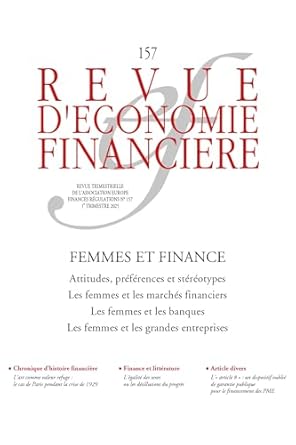
WOMEN and FINANCE. Attitudes, preferences and stereotypes, under the direction of Marie Héléne Broihanne, Gunther Capelle-Blancardet Antoine Rébérioux, Revue d’économie financière -REF n° 157, 1st trim- 2025, 255 pages .
When a somewhat mischievous journalist asked her what it was like to live next to a genius, Marie Curie replied imperturbably: “Ask my husband!!” This humorous remark is an illustration of the treacherous terrain that women have historically faced in gaining proper recognition in the scientific fields, and the same is true today for the financial sector. “In all the cliché-ridden figures that shape the collective imagination, there is one constant: men are omnipresent.” The skills of the ideal-type “financial player” are singularly at odds with the attitudes, preferences, and values typically attributed to women in our societies. Also, the great merit of this new REF collective is that it offers an update on the subject of “Women and Finance” literature, by approaching this theme as widely as possible in its fields of possible investigation: the banking sector, financial markets, regulatory institutions, corporate governance, academia, etc. This issue offers a critical analysis of gender inequalities in the financial sector and in corporate governance. After an introduction by Christine Lagarde, in which she shares her experience and the challenges of access to salary and decision-making power, the very complementary and particularly well-documented contributions of the prestigious co-authors highlight the challenges of gender equity in finance and “go beyond the simple quest for performance gains to strengthen inclusiveness and diversity.” If gender inequalities remain “obvious, lasting and shocking”, progress in this area is all the more remarkable: for example, the majority of bankers are women!!!… But, the proportion of women leaders remains generally low. Women in finance still face strong internal and external barriers, influenced by financial markets. Now the law imposes diversity on boards of directors and helps to break this terrible “glass ceiling” which means that, to date, no woman runs a major banking establishment… even if the presence of women in Central Banks has experienced a significant catch-up effect over the last decade. While the fight towards this goal of equity remains difficult, many opportunities are emerging, calling for educational, institutional and cultural reforms to promote true equality of opportunity. The fact remains that reflection must continue on “quota” policies so that, ultimately, this measure intended to promote equality does not lead to “indirect forms of disadvantage”. As Christine Lagarde reminds us: “women have their place wherever decisions are made. They should not be the exception”. The fact remains that these measures, to be fully effective, must be accompanied by a shared awareness by men “of their domestic responsibilities” in order to instill more confidence in young girls. The path to fight discrimination and promote true equality of opportunities has been traced, but it will require a profound revolution in mentalities for a perfect success. A dense, dispassionate publication that brilliantly illuminates the future of the subject Marie-Hélène Broihanne is a Professor at the University of Strasbourg. Gunther Capelle-Blancard is a University Professor – Paris1. Antoine Rébérioux is a Professor at Paris Cité University. note by Jean-Louis CHAMBON
THE CLIMATE RESILIENCE OF COMPANIES
THE CLIMATE RESILIENCE OF COMPANIES In VIE ET SCIENCES DE L’ENTREPRISE Jean-Jacques Pluchart Chairman of the VSE Editorial Board The academic journal Vie et Sciences de l’Entreprise (VSE), created in 1960 by the Association Nationale des Docteurs en Sciences Économiques (ANDESE)* has published two special issues devoted respectively to the climate resilience of companies (No. 220, 10 editors, 130 pages) and to the application of the Environment Social Governance or ESG principles (No. 221/222, 50 editors, 415 pages). The topics covered deserve the attention of the many readers of clubturgot.com. Issue 220 raises three main questions: do ESG-based management and sustainability reporting contribute to improving a company’s resilience? How is this management exercised in the financial sector? What transformations should be implemented to improve business skills, management training and managerial culture? The research presented shows the progress made by socially responsible companies in terms of performance, organization and values shared with their stakeholders. Issue 221/222 combines several research projects that address original issues raised in the social and societal fields, through the promotion of social enterprises, the cost of free labor, the search for parity between men and women in the public service, the role of standardization in ethical management, the psychological and social capital of a new employee, personalized entrepreneurial support, the inclusion of people with disabilities, etc.; in the industrial and environmental fields, by the management of a sustainable supply chain, the measurement of the home-work footprint, the contribution of design thinking to creation, coopetition within incubators; in the financial field, the paradoxes of financial inclusion, the types of extra-financial audit, financial communication targeting generation Z, institutional activism in F&A, and in the field of governance, the sharing of the leadership of an organization, the entrenchment of leaders, the governance of public companies, the management of a company with a mission. The diversity of these reflections testifies to the vitality of university research and the diversity of issues facing private and public enterprises today. * Each year, ANDESE organizes the international French-speaking competition for the Best Doctoral Theses in Economics and Management, whose jury includes several members of the Turgot Club.

Céline ANTONIN, Nadia ANTONIN, Les crypto-actifs , Ed Economica, January 2025,167 pages
In recent years, the world of payments has seen a number of major technological innovations, the latest of which are crypto-assets. From the famous bitcoin to stablecoins, these new assets arouse both enthusiasm and fear. What are their nature and intrinsic value? Is money invested in crypto-assets as safe as in a bank? Are crypto-assets monitored and regulated? But the impact of crypto-assets doesn’t stop there. Indeed, they have also given rise to a new model of finance, decentralized finance (DeFi). What are the specifics of this intermediary-free finance? How are central banks reacting to this new “currency war” between official currencies and private digital currencies? What tools are they developing to defend their sovereignty? Through a clear and accessible analysis, the authors answer and demystify these hotly debated questions. Definitions, players, services, innovation benefits, micro- and macro-economic and financial risks, and regulations are discussed, leading to the conclusion that the future lies in the development of central bank digital currencies, since “crypto-assets should not be the currency of tomorrow. This conclusion is based on two elements. The first concerns the competition between public and private money, which was favored by Friedrich von Hayek. However, one of the attributes of money put forward since the 1980s is that of trust, based on a social contract. The second point concerns the idea that monetary policy is impotent. The success of Mario Draghi’s “Whatever it takes” policy in July 2012, on the one hand, and the responsibility, albeit partial, of central banks in controlling inflation, on the other, invalidate this idea: monetary policy remains relevant to “reassure” economies, investments and citizens! This would be impossible with an anonymous, disembodied monetary system. This book is extremely educational, using simple words that don’t “drown” the reader in technical or regulatory legalese. Nevertheless, it contains everything an “enlightened” citizen needs to know to find his or her way in this world of innovation, which is already affecting everyone in terms of payments, insurance services or real estate matters. This book is aimed not only at banking, finance and insurance professionals, as well as lawyers, but is also an essential resource for students at business and engineering schools, political studies institutes and universities. Last but not least, it is intended for all those who wish to understand the crypto-asset ecosystem, so as to use it without being subjected to it. But within an operating framework that is marked out so as not to harm the common good. A must-read! Column written by Dominique Chesneau
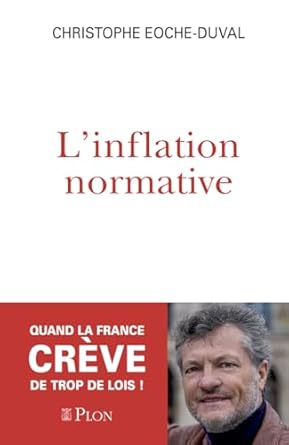
EOCHE-DUVAL Christophe. Normative Inflation, PLON, 224 pages
For several years, Christophe EOCHE-DUVAL has made overproduction of legislation his hobbyhorse and in this book, he offers an objective inventory of the normative apparatus. This is in order to enlighten the reader and to make them aware of the impacts of this overproduction on the functioning of our country. First of all, the author focuses on factually demonstrating this overabundance of standards. To measure this, he relies on the number of pages of the “Official Journal” and on the annual report “Statistics of the norm” of the General Secretariat of the Government established since 2019. From the latter, we can note the number of “Légifrance” words registered in the “Official Journal” as well as in all the standards (laws, ordinances, decrees, orders, etc.). The findings are clear: with more than 400,000 standards already in force, the number of “Légifrance” words has more than doubled in 20 years, reaching more than 46 million in 2024. Also, over the years, the State publishes fewer texts but they are getting longer and longer. In order to understand this inflation, the author presents the sources. International standards, including those of the UN and its satellites, are the primary providers of standards. Each bill has been ratified by the French Parliament since 1958, although this is not mandatory. Then come the European standards that automatically enter into force in national law. Other strata are added to the previous ones, such as prefectural and municipal by-laws, the exact number of which seems impossible to know. Once the inventory is complete, the author seeks to measure the impacts and notes that these standards often paralyze the productive apparatus in all sectors of activity. To make it more noticeable, he tries to estimate the cost. The various analyses seem to converge towards a figure of 3.7% of GDP, or about 60 billion per year. Beyond the cost aspect, these overlapping standards that have accumulated since the beginning of the Fifth Republic at the mercy of the various heads of state, makes it difficult to know which version is in force at the time this document is being written. The State, itself caught in this vice, ends up circumventing the rules in order to speed up the machine that produces the standards. In recent years, the triggering of Article 49.3 or the publication of ordinances, allowing the executive to pass laws in place of Parliament, are examples. The author dedicates a chapter to two accelerators of normative inflation: the finance and Social Security financing laws. These laws, based on government texts, must be validated in a limited time; not allowing sufficient parliamentary time. Another effect of this normative inflation is exposed in the chapter “Legiscracy against democracy”, since only 4% of French people are able to understand the texts and laws. Despite this terrible observation where the state and politicians seem to be caught and struggle to get out of this straitjacket, the author proposes pragmatic solutions which, he hopes, can be raised during the debates of the next presidential election in 2027. He insists on legislating less and focusing on applying existing laws by lowering the normative pace, thus freeing up parliamentary time. He also advocates transparency on the costs of implementing laws to better assess their relevance. This book has a pedagogical virtue for any reader in search of a better understanding of our legislative arsenal. Christophe EOCHE-DUVAL is a senior civil servant and state advisor.

Christian de Boissieu, Marc Schwartz, The New Currency War, Eds Odile Jacob, 285 pages.
The introduction of Lydian coinage around 600 BC marked a major turning point in economic trade. Thanks to Croesus and the electrum of the Pactole River, currency became a universal tool facilitating trade and contributing to the prosperity of civilizations. Greeks and Romans adopted this system, which is the basis of modern economy. Then, over the centuries, this currency will undergo two metamorphoses that will lead to its dematerialization. Paper money, bills of exchange, was created at the end of the 10th century in Song Dynasty China, then democratized during the Crusades and by the first Italian bankers, creating the first international payment networks. With the rise of bank accounts in the 20th century, the last transformation of money was complete: money became a mere entry in a ledger. Currency in all its forms meets three fundamental characteristics. It is a unit of account, an instrument of exchange and a store of value. A fourth characteristic can be added: it constitutes a political and social symbol and creates a sense of belonging to a community. So what about crypto-assets, the ultimate symbol of dematerialization, going so far as to suppress central banks and the trust that goes with it? The authors, in a very educational and documented way, present these different dreams of anti-state “currency”, but also stable coins and the new digital currencies of central banks and the fierce competition between all these assets. But whether “fiat” or digital, two currencies stand out as the two main reserve currencies, the US dollar and the euro. But there is an asymmetry in favor of the dollar, which remains the privileged currency of international trade and which benefits from the famous extraterritoriality. Therefore, a “de-dollarization” is trying to be put in place with the use of new financial instruments promoted by the BRICS as well as massive purchases of gold to bypass the dollar. What future for this dedollarization, what influences on globalization, the weight of the Yuan, what limits? For Ch. De Boissieu and M. Schwartz, the most likely hypothesis is that we will move towards an economic and financial triad in which the euro and yuan will gain credibility but where the dollar will continue to be the preferred currency. Finally, the authors focus on the development of a qualitative theory of money, which is necessary, among other things, but above all, for the financing of the energy transition. Because these very long-term financings with a rather uncertain profitability, which, moreover, arrive in a context of high public and private indebtedness, will require a paradigm shift with savers favoring the quality of the asset over its quantity. With this approach, currency will not be reduced to its exchange rate, but it will have to embody a social political role associated with this quality. Christian de Boissieu is Professor Emeritus at Paris Panthéon Sorbonne, Vice-President of the Cercle des Economistes. Marc Schwartz is CEO of Monnaie de Paris, and Senior Advisor at the Court of Auditors. note by Ph Alezard
Céline ANTONIN and Nadia ANTONIN, CRYPTO-ASSETS. A Threat to the Monetary and Financial Order, Economica, 167 pages. Foreword by Philippe AGHION
Philippe AGHION describes this publication as a “reference book for understanding the issues and threats of crypto-assets…”. The book has twofold originality: – that of a duo of authors (which is not the most common in the field…), a duo of economists whose talent is well established, – but also, a parental duo, uniting mother and daughter around the crossed gazes of two generations that are both complementary and have different research and operational experiences. This is one of the great riches and merits of this shared work. Thus, structured answers are proposed to the many questions that professionals and non-initiates ask themselves about the “ecosystem of crypto-assets”. Clearly emerging as one of the major technological innovations in the world of payments, these crypto-assets are wrongly qualified as “currency” (they only very partially fulfill the three main functions of a currency: instrument of exchange, unit of account, store of value), but they have given birth to a new model of finance, “decentralized finance” (Defi). They seem de facto, as the authors point out, to open: “a ‘new currency war’ between official currencies and private digital currencies, a perspective that cannot leave Central Banks indifferent: ‘it is a change of monetary and financial paradigm’”. The authors strive to make this transparent by developing four main questions: – The genesis of crypto-assets and the blockchain – decentralized finance and crypto-assets, – the currency war in the digital age, and – the analysis of the threats to financial stability of these digital developments. At a time when the new President of the United States is initiating a spectacular “pro-crypto” turnaround, this publication, which is illustrated by analyses accessible to a wide audience, will undoubtedly appear to be a decisive contribution to the understanding of this sensitive subject, the risks of which remain largely underestimated. Céline Antonin, economist at L’OFCE, Professor at Sciences Po, associate researcher at the Labo of the Collège de France. Nadia Antonin, economist, honorary executive of the Banque de France, member of the Academy of Commercial Sciences, author of numerous articles on cryptos. Note by Jean Louis CHAMBON

Bruna Basini et Pierre-Henri de Menthon, Tout et son contraire, Ed Buchet Chastel, mars 2025, 360 pages.
Economists clash violently as they try to decipher, model and propose remedies for the current whirlwind. Everything and its opposite can be found in the “solutions” they propose. The war that divides them is fought in MIT, Harvard, Oxford, Bocconi, the Paris School of Economics, the Toulouse School of Economics, think tanks, international financial institutions and the media. Nobel Prize winners, heads of the IMF, the World Bank, the Fed and the ECB, academics from all over the world and thinkers from all walks of life are all involved. The authors review their major economic debates: inequality, debt, inflation, China, crypto-currencies, the Vatican (!), democracy, libertarians…focusing on their conflicting theses, their analytical errors and inaccuracies. They also draw up portraits of the main protagonists in these face-offs – D. Cohen, T. Piketty, O. Blanchard, M. Aglietta, J. Stiglitz, L. Summers, J. Milei, P. Aghion, D. Acemoglu – and their masters of thought, from Keynes to Schumpeter… and conclude with a chapter on “the tribes”: institutionalists, Keynesians, libertarians, free traders, Malthusians, Marxists, monetarists and Schumpeterians. A lively, enlightening investigation into the ideas of the men and women who make or break today’s economy, written in the style of experienced journalists that makes this book easy to read. An excellent work, whose title is a true reflection of the book and of the authors’ desire to show that economics is not an “exact science”, that no science tells us what to do. The erudition in terms of economic history is notable, and the points of view are set out clearly without bias, with an organization linked to topical themes in a long-term perspective. The end of each chapter includes a summary of ideas and, in some cases, the beginnings of the author’s opinion. Oppositions are sometimes linked to ideological or philosophical presuppositions, but this is not surprising when one recalls the history of this subject. We might have expected the debates to have been placed more in the context of time, showing that economists are often better at explaining the past than predicting the future, and that what is true under certain conditions is no longer true when those conditions change. The nature of a “human” science is that the truths of one moment are not always valid in different temporal and geographical fields of study. Homo economicus may once have behaved rationally, but this is no longer the case, for many reasons, including those aimed at exploiting the cognitive biases of each individual, those linked to filtered, alternative, epistemic facts, sifted through the sieve of feeling, emotion and fear. In these matters too, the 21st century is not the 18th century…! But, as André Comte-Sponville points out in his foreword, if “no knowledge can take the place of will, no will can do without knowledge”. chronicle by Dominique Chesneau

Arnaud ORAIN, Le monde confisqué (The Confiscated World), Flammarion, January 2025, 368 pages.
After having invested in Europe as a reference shareholder in many ports, China has a naval base in Djibouti. The Americans are not to be outdone. Pierre Razoux, academic director of the Mediterranean Foundation of Strategic Studies, recently stated in Les Echos: “Each of the protagonists places their stones as in a game of go.” He adds: “These pawns are sometimes very far from the national territory and their interest is not obvious in times of peace and free navigation without tolls, but if you do not understand right away, in the end you will understand.” Arnaux Orain did not wait for the end of the game that takes place every day before our eyes, he understood: neoliberalism is over! However, this is nothing new; already in the sixteenth and seventeenth centuries and then between 1880 and 1945, the world was seen as finite. Finitude explains that the maritime powers were all driven by a desire for hoarding and predation (hence colonial expansion and warehouse trade). Since 2010, we have entered a new phase where it is not only states that act through a naval hegemony but also “company-states” like Elon Musk’s. The book is dense, erudite and historical references spring up throughout the text. The reader may sometimes get lost in this profusion where historical figures and economic models alternate (the author also claims a methodological ambition which “consists in blurring the lines between intellectual history, economic history and contemporary economy”). In the end, everything becomes clear, capitalism of finitude is when we can state the slogan: There will not be enough for everyone! This brilliant essay invites us not to underestimate behaviors that could cast doubt on the rationality of certain leaders. They are perfectly rational. It is under the pressure of Donald Trump that Panama announces its withdrawal from the new Silk Roads, and it is no coincidence that the Houthis attacked 134 ships in twelve months with an arsenal provided by Iran or China. Arnaud Orain is a specialist in economic history and political economy. He is Director of Studies at the EHSS. His work focuses on economic dynamics and their historical implications. Alain Brunet’note