


The book begins with the observation of a profound crisis in the perception of work by our contemporaries. In the past, work was considered part of the human condition, earning a living by the sweat of one’s brow. It was then experienced as everyone’s participation in a collective progress that could benefit everyone. Today, the worker feels tossed about in the midst of non-negotiable considerations and changes, suffered rather than chosen. The social and moral context marked by the weakening of all collective benchmarks and the predominance of self-referential individualism only aggravates the malaise generated by deindustrialisation for nearly 30 years, and now the prospect of an AI that will apparently further reduce the need for human work. The authors then set out to show that the end of work is a chimera (as much a chimera as the end of history that was announced thirty years ago). They describe how and why, despite the desire to “restore the value of work” and other slogans, collective, political, fiscal and social choices have had the effect of discrediting work, hindering it and taxing it without helping companies to share a unifying quest for meaning with their employees. All in all, a book written by practitioners, Bertrand Martinot is a specialist in the issue of unemployment, employment policies and social dialogue. He received the 2014 Turgot Prize for a previous book Chômage: inverser la courbe (Unemployment: reversing the curve). He was social adviser to the Presidency of the Republic from 2007 to 2008, general delegate for employment and vocational training (DGEFP) from 2008 to 2012, then deputy director general of the Ile-de-France region in charge of economic development, employment and training until 2019. Franck Morel is a labour law lawyer. Advisor to Prime Minister Edouard Philippe and four labour ministers (Xavier Bertrand, Brice Hortefeux, Xavier Darcos and Eric Woerth). Both authors are associate experts at the Montaigne Institute. Hubert Rodarie

Hubert RODARIE, Trump faces a world that needed change… For more politics, for the people and by the people, Editions Eska,249 pages.
This new publication by President Hubert RODARIE, an author who has been recognized and crowned many times, confirms his ability to challenge his readers (who willingly lend themselves to it) by inviting them to leave their comfort zone for an original reading of the major trends and other ruptures in the world. To look beyond the foam of the waves, to understand the underlying undertones that are at work in the upheavals of the planet. … One year after his return, President TRUMP is raising many questions by trying to brutally reshape international relations according to his vision of the new world, accompanying his diatribes with threats, potential recourse to force, establishing punitive customs duties and the unpredictability of his reversals of alliances. Also, many see in this character nothing more than a revolutionary troublemaker undermining the consensus and the post-war world order, arousing contempt with his vulgarity and his extraordinary vanity: “.. strong with the weak and weak (deflated for some!!..) with the strong..”. Without fear of going against the tide, the author uses his expertise as a senior leader, backed by the scientific rigor of the engineer (which is also his trademark), with an impressive and documented knowledge of the History of the United States, to “try to understand the present and future motivations not only of the United States, but, symmetrically, of the European leaders and strategy.” In the first part, the author uses a historical analogy by examining the parallels to the political and social plans between the Athens of the 5th century BC, that of Pericles and the “Golden Age”, and the United States of the 21st century. There are many similarities between Trump and Pericles: they both rely directly on the people, consider their strategies of alliances and empires in the same approach, are supported by powerful real wealth (money, oil), with the same ability to mobilise the popular electorate beyond the “deep state” … “Them against us …” and finally a certain caution vis-à-vis wars to consolidate the support of the people. However, if the success of this first year of TRUMP’s return is quite flamboyant, as evidenced by the Wall Street party, the wait-and-see attitude is flagrant on the side of companies, and the American threat continues to weigh on the future of world GDP, without forgetting the end of the story for Athens, with the reminder of the “Thucydite trap”. However, “This framework makes it possible to understand the structuring dynamics of the United States as well as the logic underlying the actions of the Trump Administration.” The second part highlights: “the key issues, in particular the relations between the elites and the people, as well as the role of politics in the economic system and vis-à-vis the Central Banks in the US and in EUROPE.” In this context, the author develops his very well-argued vision (and produced in his previous works) of the independence and sovereignty of the Central Banks, or of the “symbol of inaction: Debt”, and the discrepancy between speeches and situations. Faced with the change in cooperation between China and the United States, the author’s conviction remains that “Europe must imperatively reaffirm the primacy of politics, by and for the citizen. This is the great existential challenge that can only be met by reinventing itself in depth. A particularly valuable publication for all audiences and for those who seek to predict the winners and losers of “Trumponomics”. Jean-louis CHAMBON Founding President of the cercle TURGOT ,Hubert RODARIE is President of AF2i, Vice President of ARGAN – former Managing Director of an insurance group. He regularly contributes to the economic and scientific press. Author of four particularly notable books, and winner of the Turgot-DFCG Prize in 2016.

Discours et néologie en Afrique : Terrains, méthodes et analyses, Abou Napon (dir), Eds L’Harmattan, 2 tomes, janvier 2026, 1210 pages.
This monumental and unprecedented tribute to the work of Professor Alou Keïta, sociologist and linguist, does not deal with economic and financial issues, but it nevertheless deserves the attention of the readers of our blog, because it testifies to the vitality of African research. The book presents the proceedings of a symposium organized in September 2024. It brings together 92 articles covering two themes: the analysis of African discourses; contemporary African literature and society. The first volume deals with the phonology, syntax, enunciation, lexicology and terminology of African languages. The authors endeavor to document the uses and dynamics of these many languages, which are both contextualized and insufficiently documented. They engage in an analysis of the discourses of African peoples, which cover narratives illustrating human actions influenced by different norms, values and social codes. The work highlights the plurality of African discursive practices, whether public or private, institutional or social. In an international context marked by tensions and more or less contradictory assertions of identity, the work of Alou Ketta, his colleagues and students illustrates the fertility of African research fields. The second volume focuses on language, a means of communication and a vehicle for learning. The articles analyze the relationship between language, society and education. The articles explore the relationship between language, society and education. Their authors endeavor to measure the influence of literature on language learning and the awakening of consciousness. Its practice is influenced, in Africa more than elsewhere, by the social status of the speakers. The authors show that language learning plays a central role in the education of the peoples of Africa, and in particular of its youth, who represent more than a third of its population. This tribute to a great African linguist is part of the current of thought opened by Saussure (the signifier and the signified), Chomsky (the innate character of language), Orwell (newspeak), Lacan (the language of the unconscious) and Damasio (the language of AI). Jean-Jacques Pluchart
AMERICAN STABLECOIN VERSUS DIGITAL EURO
Jean-Jacques Pluchart The digitization of currencies is currently marked by a rivalry between two models, that of stablecoins backed by the US dollar and that of the digital euro representing the Central Bank Digital Currency of the eurozone. This rivalry reflects the opposition between two fundamental systems of the economy, one being mainly regulated in the short term by the market and the other being governed in the long term by the State. It therefore reflects a new “tragedy of horizons”, according to Mark Carney’s famous formula delivered in 2015. The digital euro system, approved by the European Council on 19 February 2025, should be in place by 2028-2029, following an institutional timetable defined by the European Central Bank, while the stablecoin system based on the dollar is already in full development. Monetary stablecoins strive to combine the flexibility of bitcoins and the stability of fiat currencies issued by central banks. They are in principle guaranteed by solid assets such as US Treasury bills and Fed reserves, and their transactions are secured by the blockchain. Their assets are liquid and are not remunerated so as not to compete with banking products. In principle, they only perform the functions of payment (in particular cross-border) and “bridge currency” between currencies. In countries with unstable economies, they can act as an informal store of value. However, they do not fully comply with certain criteria required of systemic currencies. Unity between issuers is not guaranteed in the event of a crisis, and competition and therefore a hierarchy can then be established between them. The elasticity of stablecoins may be affected in the event of a monetary shock, as the system is not guaranteed by a central bank. In the absence of a lender of last resort, cryptocurrencies are suspected of being procyclical. Due to the decentralization of their issuers and the differences between their national regulations, the integrity of the stablecoin system and the protection of their users may be threatened. The market for monetary stablecoins also has an almost monopolistic structure, being largely dominated by the issuers Theter and Circle. Their consolidated outstanding amount is estimated at $350 billion as of 31 December 2025. But due to the uncertainties weighing on their future, the capitalization of stablecoins backed by the US currency is estimated at between $500 and… $3,700 billion by 2030. Other types of stablecoins that can be backed by baskets of cryptocurrencies, indexed to metal indices (such as gold) or commodities, are generally unsecured and are marked by even more erratic fluctuations. According to some economists, especially Anglo-Saxon ones, an inactive and unpaid MNBC cannot replace the large-scale adoption of stablecoins distributed by platforms. They consider that the risk of a threat by stablecoins to monetary sovereignty can only arise in payment networks, because the value of a national or federal currency is stabilised by the balance sheet of the Central Bank, and the convertibility between deposits is guaranteed by banking regulations. According to most monetary economists, the use of dollar-backed stablecoins is still limited (at 11% of global monetary assets at the end of 2025), because they are directly competed with by bank savings products, and above all, because they can indirectly suffer from the erosion of confidence in major currencies such as the US dollar. Monetary stablecoins therefore risk suffering the fate of certain private currencies that have now disappeared, which have marked world monetary history.

A new consumer credit reform to combat over-indebtedness
Nadia Antonin The Banque de France is sounding the alarm: according to the latest monthly barometer of financial inclusion published on 11 December 2025, the number of over-indebtedness files filed with the Banque de France increased by 8.9% over the first eleven months of 2025 compared to the same period in 2024. This increase intensified in November 2025, with an increase of 12.8% compared to November 2024. In addition, according to the Banque de France’s 2024 typological survey published in February 2025, nearly one in two debt files (43%) includes at least one consumer loan. The rise of consumer credit In view of technological developments and changes in consumer habits, consumer credit has experienced strong development in recent years. It is an essential lever for French households. It allows them to finance personal projects such as a car, a trip, household appliances, or to overcome cash flow difficulties. In addition, it represents a strategic activity for banking and financial organisations. Consumer credit is credit granted to individuals for the purchase of a manufactured object, as opposed to production credit granted to the manufacturer. It concerns transactions other than those related to real estate. Its amount is between €200 and €75,000 and its repayment period is greater than three months.It is governed by the Consumer Code, which lays down a set of rules relating to the content and conclusion of the contract. There are several forms of consumer credit: – the personal loan which makes it possible to finance a project without having to justify the use of the funds; – the assigned credit linked to the purchase of a specific good or service; – revolving credit consisting of a credit line, accessible at any time and which is renewed over the course of repayments; – the lease with purchase option which makes it possible to rent a property (for non-professional use) with the option of buying it at the end of the contract at a price fixed from the start; – personal microcredit, which concerns people who do not have access to traditional bank loans, due to low income or a situation of financial precariousness. Consumer credit and over-indebtedness Appearing to be attractive, consumer credit can quickly become a financial trap if you do not understand how it works. It is considered to favour over-indebtedness, that is to say a situation in which a person (or a household) is no longer able to honour their debts (monthly loan payments, bank overdrafts, rents, etc.). Over-indebtedness developed in the late 1980s following the lifting of credit controls in a context of strong growth in consumer credit. Despite the passing of the Neiertz law in December 1989 to combat over-indebtedness, the number of filings has continued to grow. Faced with the growing flow of cases, the government adopted the Lagarde law on 1 July 2010, which imposes strict regulations on consumer credit for amounts between €200 and €75,000 and with a minimum duration of 3 months. To circumvent the Lagarde Law, two new types of loans, not subject to the provisions of the Consumer Code, have appeared: the “split payment”, which consists of paying for a purchase in 3 or 4 instalments, and the “mini-credit”, which is a loan of a few hundred euros. These rapid payment facilities, often perceived as harmless, have led more and more French people into over-indebtedness. In 2024, 17% of over-indebtedness files contained a mini-credit or a split payment, compared to only 1% in 2022 and 7% in 2023 (Source: Observatory of Banking Inclusion). This sharp increase in over-indebtedness prompted the French government to transpose, by order of 3 September 2025, the European Directive (EU) 2023/2025 of 18 October 2023 on consumer credit agreements. Tightening of conditions for access to consumer credit This new reform, which is due to come into force on 20 November 2026, aims to more strictly regulate access to credit and strengthen the protection of borrowers. The new provisions are as follows: – an extension of the scope of consumer credit regulations: until now, only transactions between €200 and €75,000 were regulated. The new rules will apply from the first euro up to €100,000, and will include split payment, mini-credit, bank overdraft and lease with option to purchase within the scope; – a careful study of the borrower’s solvency and a consultation of the Banque de France’s Personal Loan Repayment Incidents File (FICP) before any signing of the contract; – highly regulated advertising. This must be “clear, fair and not misleading”; – a strengthening of information obligations before signing the contract. The standardised preliminary form for the issuance of the offer (FIPEN) given to the borrower will have to describe precisely the characteristics of the contract; – support for the borrower experiencing financial difficulties. The lender will have to support them by offering solutions around renegotiation, rescheduling, spreading, extending the duration of the loan, etc., and directing them towards advisory services; – a new sanctioning power: control and sanctions will now be entrusted to the Directorate General for Competition, Consumer Affairs and Fraud Control (DGCCRF). This new reform of consumer credit to combat over-indebtedness has thoroughly modernised the provisions applicable in France in order to protect borrowers and harmonise the rules at European level. It introduces a requirement for transparency, ethics and accountability.
THE RETURN OF THE DRAGHI REPORT
Jean-Jacques Pluchart The end of 2025 was marked by a reminder of the concrete proposals formulated in the report led by Mario Draghi and published on 9 September 2024. This reminder is explained in particular by the implementation by the United States of an increasingly isolationist policy, which forces the European Union to finally define an industrial strategy that is both more proactive and more concerted. The debates raised on this issue in the European and national parliaments have shown – beyond certain ideological oppositions – the relevance of the recommendations made in the “Draghi report”, in order to redress the economy of the European Union and reassure its population about its future. The report notes the growing backwardness of the Old Continent’s technology and economy since the turn of the century. The delay is considered increasingly irrefutable and irrecoverable, especially in the high-tech sectors, and especially in the field of Artificial Intelligence. According to the report, the investment required to make up for this shortfall would be around 800 billion euros per year over several years, or 4.5% of the GDP of the 27 Member States, in the form of both public and private expenditure. This amount corresponds to that of the Rearm Europe plan intended to strengthen European defence. The technological backwardness is attributable to insufficient growth, driven by a downward trend in the productivity of human and material factors. This drop-out is said to be caused by both scientific and industrial factors, such as insufficient protection of emerging industries, inadequate regulation of high-tech markets (too focused on competition), a lack of investment in the most productive sectors, a delay in the decarbonisation of factories, and above all, an impoverishment of technical skills due to the failures of R&D (in particular public) and the education system in engineering sciences. But the delay would also be due to economic and financial shortcomings, which would imply a revival of the construction of the European capital market, the establishment of a single regulation, the commitment of a European public debt dedicated to productive investments, the development of venture capital, pension funds, securitization of receivables and non-bank financing (shadow banking). Another priority, according to the report, lies in the diversification and security of the European Union’s supplies of critical resources (rare metals, electronic chips, software, active ingredients, etc.), as well as in the strengthening of industrial value chains. However, the report recognizes that Europe has certain advantages in terms of electric mobility, micro-nuclear power, hydrogen exploitation, aeronautical construction, etc. Finally, it underlines the interest of reviving a certain economic patriotism [1] on a European scale, which presupposes the adoption of a form of protectionism through the strengthening of regulatory barriers and ecological standards penalizing certain imported products. The reference to the Draghi report in public debates highlights the opposition between political circles, which are divided on the policies to be implemented to bridge the European gap, and economists, who are generally in favour of a return to a more dirigiste and protectionist form of the market economy. It also pits defenders of the public service against supporters of the private economy, as well as players in the high-tech sectors against those in other sectors of activity. But this reference reveals above all oppositions between the 27 Member States of the Union, some of which consider themselves victims of a ‘prisoner’s dilemma ‘. 1 L’avenir de la compétitivité européenne. Une startégie de compétitivité pour l’Europe, Mario Draghi (dir.) , 2024 2. Cf. Does economic patriotism make sense today ?, C. de Boissieu, D Chesneau (col.), Maxima, 2020
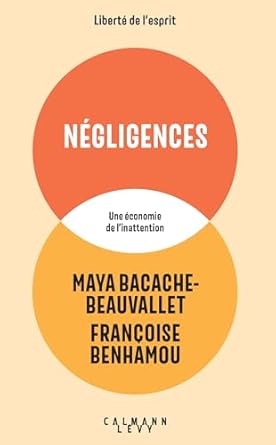
BACACHE-BEAUVALLET M., BENHAMOU F., Négligences. Une économie de l’inattention , Calmann Levy, 2025, pages.210 pages
Since the pioneering works of Mc Luhan and Patino, the theme of “negligence” has become a social debate. This book has the merit of not limiting negligence to simple attention defects due in particular to the attraction of screens or algorithmic black boxes. It extends to all daily actions, professional behaviors and social attitudes. The subtitle of the book, “an economy of inattention”, betrays the ambition of the authors, which is to establish negligence as a scientific discipline. If they pay attention, the reader of the book will discover that there are culpable, natural, rational or irrational negligence … but also, comfortable (when they save time) and desirable (when they are affected). The reader will distinguish between the negligent intellectuals, manual workers, civil servants, the credulous, the overwhelmed, the tired, the drowsy, etc. They will understand that negligence cannot be avoided in the democratic game, the management of organizations and the functioning of society, but that, in some cases, it contributes to new inventions or creations. The forms of negligence are diversified under the effects of digital platforms that practice nudge (soft influence), deploy dark patterns (internet traps) or offer too many “good deals”. The authors do not limit themselves to practical cases, they decline the negligence of intellectuals, decision-makers, the credulous, the tired… but also of citizens and elected representatives caught up in the democratic game, thus demonstrating a penetrating sense of current events. The book therefore deserves the attention of citizens-consumers for the originality of its subject, the relevance of its observations and the quality of its style. Perhaps it is in turn negligent in not analyzing the psychological and psychoanalytical causes of negligence, as well as in not assessing its destructive effects of value at the level of a family, a company or a country. M. BACACHE-BEAUVALLET is a professor at ENS and Telecom Paris. F. BENHAMOU is Professor Emeritus at the University of Paris-Nord and Sciences Po Paris. She is president of the Cercle des économistes. Jean-Jacques Pluchart
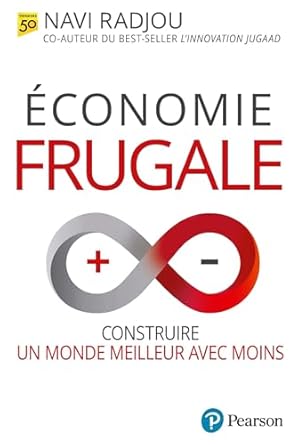
RADJOU Navi, Economie frugale. Construire un monde meilleur avec moins, Pearson, 2025, 260 pages.
Navi Radjou is one of the theorists of “frugal economy”, a term he introduced in 2013 with his bestseller entitled “Jugaad Innovation” (which means “ingenuity” in Hindi). This “art of doing more with less” is, according to him, one of the remedies for the ills of the French economy, which is simultaneously anemic, divided and over-indebted. Frugality consists of making better use of dynamic capacities (creativity and flexibility) and existing natural and human resources. This development must not only be economic, but also social, cultural, ecological and democratic. It must be part of a process of “systemic transition” and “regenerative growth”. ”Democratic regeneration”, however, presupposes that elected representatives and voters no longer reason in terms of ideologies or doctrines, but rather in terms of the real effects of the measures voted on and sometimes applied. The author provides numerous examples of companies and countries that are striving to mobilize such an approach based on the sharing of resources between companies and administrations in the same region (thus redefining the “French industrial districts”), on a “distributed production” between local networks, on a “hyperlocal value chain” (reducing the distances between production and consumption areas), and on a “triple regeneration” (of people, goods and the planet). The application of these new lessons in industrial economics could be facilitated by the use of AI, which would make it possible to better inventory resources, model their synergies and simulate the effects of their combinations. Navi Radjou thus engages in a skillful re-reading of the concepts and practices experimented, with more or less success, aimed at developing the circular economy, the relocation of factories, the rehabilitation of short circuits, the search for economic and social synergies, etc. It therefore seems that “jugaad innovation” is the art of re-accommodating the old recipes for managing organizations and life in society. Navi Radjou is a professor of management at the University of Cambridge and is vice-president of the American consulting firm Forrester. Jean-Jacques Pluchart

BERTEZENE Sandra (dir.), Démocratie en santé et pouvoir d’agir des usagers, LEH Edition, 2025, 473 pages.
The collective work, edited by Sandra Bertezene, prefaced by Cynthia Fleury and introduced and concluded by Philippe Naszalyi, is part of the current, very fertile, research devoted to the economics of well-being and care. As the recent debates in the French parliament on the social security budget have shown, the issues of the organisation of care and social solidarity are now at the centre of public debates. This is why reading this impressive pioneering work in this essential field will help to make both elected officials and voters more aware of the challenges of establishing a true “health democracy”. In this book, the 56 researchers, practitioners and hospital patients have presented their reflections, organised their discussions and formulated their proposals, covering the 6 dimensions of the issue: participation, knowledge, associative engagement, partnerships, recommendations and ethical vigilance. These dimensions were then broken down into 28 chapters, classified into 6 parts, devoted respectively to the role of users in health policies, the place of experiential knowledge in the health system, the commitment of users, the partnership models developed in France and abroad, the proposal of a work agenda, feedback, and finally whistleblowers and digital tools. Several authors propose action plans which generally present 4 main stages: to make the medical and social world aware of the challenges of better solidarity through communication campaigns (this is the purpose of the book); to give better access to existing public, private and especially associative resources; to co-construct new medical, paramedical and support resources, in particular with the assistance of Artificial Intelligence; to encourage the creation of jobs in practically all the functions of the care economy. The book provides an illuminating overview of the hospital and para-hospital world, but, above all, it delivers a message that is both obvious and original: to restore democracy in the health sector, following the example of the social model instituted by the French founders of social security, some of whose principles have been misappropriated for 80 years. Sandra Bertezene and Cynthia Fleury are professors of management sciences at CNAM. Philippe Naszalyi is Professor Emeritus and Director of the Journal of Management Sciences. Jean-Jacques Pluchart

Thierry de MONTBRIAL, L’ère des affrontements, les grands tournants géopolitiques. Dunod, Mars 2025, 535 pages
The author gives us here an account of the main world events and their consequences that have taken place over the last 35 years, starting from the year before the fall of the Berlin Wall, and this from his texts written each summer and published in the bible that is the annual work “Ramses”. His writings, structured in chronological order, allow the reader interested in the evolution of the world in terms of macroeconomics to ultimately understand the ever-growing impact of political decisions and actions on the economic evolution of nations, which has a major impact on international relations. The blood ties to the land of the ancestors mean that the political forces at work must build a common future, taking into account a past sometimes more than a century old, to try to move towards a happy end to history, one which Europeans have dreamed of until very recently. Except that the end of the Cold War brought a reconfiguration of the world, notably with the rise of China following its entry into the WTO, not to mention Russia’s return to the forefront after a hiatus of more than a decade. At the same time, the American leaders after 9/11 did not always implement the best solutions, excited by their control of the countries producing black gold, and the world in the Middle East continued to be destabilised. This book also helps us understand why states moved from a logic of monetary credibility in the 1980s to a logic of fiscal credibility in the late 1990s and early 2000s. After the attacks of September 2001, purely electoral decisions to protect certain strategic American sectors with tariff barriers went against the policy of free trade (a situation that we find ourselves in today under the 47th president of the United States). By retracing most of the events after the Great Recession (2008/2009), the author invites the reader to consider a world that has become multipolar and, moreover, heterogeneous, with profound implications, the most important of which is the search for a minimum of cooperative security with the inescapable reality of international, political and economic competition. In fact, the question of the limits of globalisation is now a concrete one. Thierry de MONTBRIAL is an academic, honorary professor at the École Polytechnique and professor emeritus of the CNAM, founder of Ifri, one of the most influential think-tanks in the international community. Review by Claude GEORGELET