

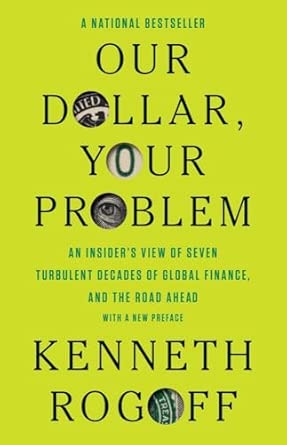
« Our dollar, your problem » reads almost like a novel as Kenneth Rogoff imparts the reader with a precise and technical recital of more than 40 years in renowned university and global institutional financial circles. The original term “our dollar, your problem” was coined by John Connally (US Treasury secretary) in the early 70’s, as he addressed frustrated European leaders following the suspension of the convertibility of the dollar to gold by the Nixon administration. European countries held vast amounts of US treasury bills at the time.
In the current context of mounting geopolitical tensions around the globe and several conflicts in countries that have a historical monetary and economic reliance on the dollar, the so-called “pax era” that relied on the dollar “to produce stability and growth for the indefinite future” may be reaching a key turning point. In any event, Rogoff suggests that the period prior to the pandemic, will most likely give way to increased periods of instability, debt, inflation and volatile exchange rates.
Rogoff delves, by way of his own personal experience, studies and insightful predictions, into the limits of previous challengers to alternative dollar dominance as he evokes the Soviet Union, the Yen, the Euro and China’s Renminbi. He makes a few interesting and pertinent points on the advent of the single European currency. Whilst in theory, the euro had the potential to seriously rival the US dollar, it remains largely a regional currency today. The insufficiencies of a “deeper political union”, “strong fiscal authority”, an “integrated banking system” and lack of sustained growth over the past decades, are just a few of the reasons that Rogoff attributes to the limits of the Euro as a serious contender for dominance against the US dollar.
He sees however, the Chinese renminbi as a “more potent threat to the dollar” in the long term. If, for example, the Chinese authorities were to dissociate the renminbi from the dollar, that would result in a vast swing in Asian economies who rely on the dollar for their supply chains, in favour of the renminbi. Asia represents half of the dollar bloc (outside the US) on a weighted GDP basis. This hypothesis has nonetheless its challenges for China, including the softening of its historically strong growth model and the potential social and financial consequences of succeeding in alternative economic paths. In any event, the author esteems that dollar decoupling by China is inevitable.
In several sections of the book, the author refers to a point that is especially poignant in current geopolitical circumstances; the relationship between military power supported by tech and the strength of a currency. Europe in particular, significantly lags behind the US and China in technology, essential for impactfully strengthening its defence capabilities. He rightfully questions whether Europe can apply the same rigour and achieve the same success in the accelerated ramp-up of its defence ambitions, as to the introduction of the Euro.
Rogoff develops the topic of digital currencies and whilst he recognises that they can compete for a share of transactions against the dollar, their impact will remain relatively contained to the “global underground economy”. In any event, at least for stablecoins, their evolution will be subject, in fine, to government regulation. As far as central bank digital currencies go (CBDC’s), they represent a means of increasing efficiency and financial inclusion and can act as a barrier to an increased penetration of the dollar in global economies. The Fed has been slow to initiate a CBDC; the dollar is still the world’s dominant currency and there seems to be a preference to let others experience the turmoil associated with the launch into CBDC’s. Still, such an initiative as pursued currently by the ECB, could be a trigger to significantly gain terrain on the dominance of the dollar.
The author finishes off this remarkable analysis by addressing the perks of currency dominance and the potential peak of dollar dominance. The obvious perks to a dominant dollar are the liquidity, linked to the strong demand for the currency and its abundant use for trade transactions. The author underlines once again the point made earlier in relation to military strength. The dollar dominance makes it easier for the USA to finance military spending and above all, provides room to manoeuvre financially if a sudden build-up is necessary. This is clearly what we are witnessing today in 2026.
In terms of the question around whether the dollar has or will soon peak as the world’s dominant currency, the author explains that as long as the Fed manages to keep inflation at a sustainable and stable level and that “runaway” American debt is not left unchecked, nothing should fundamentally change. However, a volatile political environment, unrestrained increases in debt and/or political pressure reducing the independency of the Fed, could give way to instability and deliver opportunities for the outliers like China, crypto-currencies or even the Euro to make significant inroads towards changing the status quo.
In a word of conclusion, Rogoff explains from the outset of his significant piece of work, that dominant currencies only change once every one to two centuries. Time will tell if we are reaching the era of one or several potential “new champions”.
Kathleen Wantz-O’Rourke
Kenneth Rogoff, former International Monetary Fund chief economist from 2001-2003, is Maurits C. Boas Professor of Economics at Harvard University. Grand Master in chess, he also serves on several official bodies, including the Council on Foreign Relations, and the Advisory board of the Federal Reserve Bank of New York. His numerous book publications and articles are published and referenced internationally.