

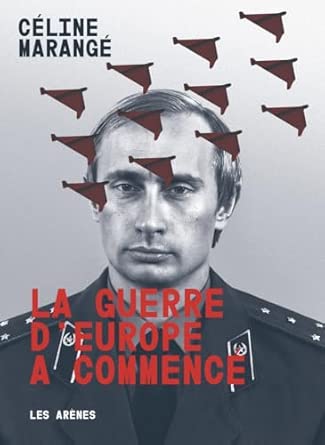
On 5 March 1946, Winston Churchill delivered a speech in which he said, “I do not think that Soviet Russia desires war; what it desires are the fruits of its power as well as of its doctrines. Our difficulties and dangers will not disappear if we turn a blind eye, if we wait to see what happens, or if we practise a policy of appeasement.”
These reflections from another time are strikingly relevant today. The Kremlin wants to become once again the feared power it was in the past by reasserting its rights to lands it considers ancestral. Faced with the rise of these dangers, it is imperative to have clear ideas about the state of the threat, the adversary’s modes of action, our interpretation biases and our level of preparedness.
There is also a much more pernicious danger to be feared: that of the alteration of democratic systems, as artificial intelligence will allow targeting with rare precision and the manipulation of information with unsuspected sophistication. For Ukraine, it is a war of national liberation, a struggle for the survival of the state and a fight for freedom, since the Russian president denies the existence of the Ukrainian nation. The war has forged a new Ukraine, tested, exhausted but united and resolute. The Kremlin is using the war in Ukraine to stage its confrontation with Western countries and accentuate the divisions in the world.
What is certain is that the current confrontation is not only about the survival of Ukraine and the security of Europe, but also about the sustainability of liberal democracy, which is now under attack from all sides. Faced with a danger that is certainly imprecise but blatant, dealing with the most pressing issue is a necessity; imagining the worst is a categorical imperative. Without this effort of imagination and a surge of willpower, there is a great risk of being caught off guard.
Because Russia is actively preparing for the possibility of the war spreading across Europe. Several indicators show that Russia is preparing for a prolonged war:
The defence budget, which represents 38% of Russia’s budget, shows that the Kremlin’s priority is to continue the war. It is rearming at full speed while organising itself to improve its supplies and armaments: it manufactures 300 tanks per year – France, which is the best equipped, has 215 Leclerc tanks. Russia is increasing the size of its army: 600,000 soldiers compared to 150,000 before the war in Ukraine. Lifting the sanctions would give the Russian economy a breath of fresh air.
A militarist regime feeds on war; there are many actions that are already affecting Europe and France in particular, there are also attacks on the integrity of public debate aimed at influencing general opinion, and above all there are attacks on national cohesion.
Europe must prepare for a long-term confrontation where anything goes.
Céline Marangé is a researcher on Russia, Ukraine and Belarus at the Strategic Research Institute of the École Militaire, and an associate member of the Research Centre in
Slavic History (Université Paris 1 Panthéon-Sorbonne)
Reading summary prepared by Michel Gabet