


The Grand Livre des taux d’intérêt (The Great Book of Interest Rates) is an encyclopedia of finance that not only covers rates – the “most important figures in the modern world” – but also all instruments, institutions, procedures, events… of modern finance. The book includes both alphabetical entries by concepts and acronyms, as well as focus sections (especially historical) and quotes from famous financiers, references to the sources consulted, and references to related concepts. It is solidly structured and is written in a clear and precise style. It demonstrates that the traditional book format, when well constructed, is more didactic and practical than online consultation of a search engine, even one enriched by AI. It is also an opportunity to organize useful financial literacy quizzes. Gérard Blandin’s book summarizes in only 328 pages the sum of knowledge that all practitioners, teachers, and students in finance must fully master, and that savers and financial investors must at least partially know. The reader of the Grand Livre will discover several hundred abbreviations and acronyms, regulatory texts, and names of famous financiers and politicians, who are or have been essential in the functioning of monetary, financial, and accounting systems. The Grand Livre is not only practical; it attests to the complexity of contemporary finance and delivers a subliminal message about the unparalleled creativity of financiers, the speed of change in finance, and the importance of its economic and social utility.A graduate of Sciences Po Paris, Gérard Blandin has over thirty years of experience in the field of investments. He has led the editorial teams of several financial weekly publications and is the author of about fifteen works on the stock market, real estate, collective management, and market finance. Jean-Jacques Pluchart

Alain GRANDJEAN, Claude HENRY, Jean JOUZEL, Les orphelins de la planète, Eds Grasset, 186 pages.
The authors respond to the main questions raised for more than ten years by the impacts of global warming and by energy and ecological transitions. They recall the alarms launched since 1990 by the IPCC and other official bodies, as well as the ambitions (often disappointed) displayed in the 29 Conferences of the Parties (COP) organized since 1995. They stress the importance of the COP 21 held in Paris in 2015, which set the goal of limiting global warming to 1.5°C by 2030 and achieving carbon neutrality by 2050. The authors reveal that the IPCC reports have been the target of a real climategate, orchestrated by the energy companies, which have tried to discredit the IPCC’s data, processing, and conclusions through complacent studies. They also denounce the banks that continue to finance projects that harm the environment. They point out that the multiple consequences (especially on human health) of greenhouse gas (GHG) emissions are better documented and that a warming of 3°C, or even 4°C, would be catastrophic for the planet and humanity. They warn of the severity and simultaneity of the latest natural disasters (drought, floods, etc.). The authors are optimistic, however: they identify the devices to be implemented in order to achieve the objectives set by the COP: new instruments of “green finance”, alternative systems of heating, transportation and production, ecological materials… They show the progress of agroecology to preserve the soil and absorb GHGs, as well as the emergence of geoengineering that extracts carbon monoxide from the atmosphere. They hold up European countries as examples for the least energy-efficient nation-states, such as China and the United States. Alain GRANDJEAN is the co-founder of the firm Carbon 4. Claude HENRY is an honorary professor at the Ecole Polytechnique and the University of Colombia. Jean JOUZEL was a member of the IPCC. Jean-Jacques Pluchart
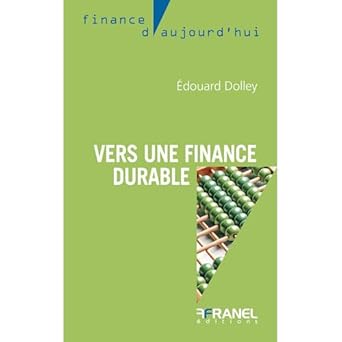
Edouard DOLLEY- Vers une finance durable – Arnaud Franel Editions – 314 pages
The book is interesting in more ways than one: educational, practical, inspiring. You can’t do sustainable finance without doing finance first! This book introduces the main concepts of corporate and market finance, then explains how these concepts are relevant to sustainable finance. Each chapter focuses on a financial concept: wealth, interest rates, returns, balance sheets, asset portfolios, arbitrage, derivatives, and even crypto-assets! This book thus provides a bridge between “traditional” finance and sustainable finance. That covers the educational aspect. It is practical thanks to its original format. In each chapter, the concepts are explained by teachers and practitioners: CFOs, central bankers, commercial bankers, investment bankers, managers, trading room managers, appraisers, accountants, auditors, business leaders, and more. We learn that concepts such as IRR, required rate of return, risk-free rate, company buyouts, arbitrage, CAPM, options and derivatives, and extra-financial valuation are applicable to the models and functioning of sustainable finance. The book is inspiring because it is not a pro domo plea for sustainable finance. On the contrary, the choice of interviewees leads us to question the current systemic limitations: difficulties in determining the rate of return on an ESG project and calculating environmental value, the intrinsic value of carbon, questions about regulations and SRI evaluators, etc. Each chapter includes a conclusion in a few points that summarizes the previous discussion and raises questions, an inspiring format! Natural and social capital cannot be reduced to numbers, but numbers are essential and it is crucial to collect reliable data. And “classic” financial concepts provide a solid foundation that can be adapted to the analysis of broader issues, particularly sustainability. The author rightly asserts that the green and sustainable transition will require a return of trust, governance, and value, and the current difficulties are not overlooked. Regarding trust, E. DOLLEY affirms the need to develop blockchains. Given their energy consumption, this point seems counterintuitive, but the arguments put forward are strong. The traceability of funds invested in projects, the reliability of upstream data that is so difficult to obtain that the OMNIBUS Directive has limited the obligations to obtain it, and “certified” renewable energy sources would justify and satisfy the information needs of economic agents. This book does not develop ready-made solutions, but it provides a kind of serious and accessible compendium. Thus, the transition would be driven by a “bottom-up” approach, as the top-down approach has, according to the author, reached its well-defined limits. Dominique Chesneau

Mathilde VIENNOT, La planification écologique, La découverte (repères), 126 pages.
The French planning of the Glorious Thirty, initiated by Jean Monnet, has given way to a new form of more global and sustainable planning: “ecological planning”, which focuses on the objectives to be achieved and the resources to be implemented in order to ensure energy, ecological, economic and social transitions, by 2030 and 2050. The author shows the diversity of devices to be mobilized, conventions, laws, decrees and standards to be defined in order to establish a “frugal, carbon-free, circular and sustainable economy”. The ecological, economic, and social issues are intertwined and most of the constraints – especially sectoral and territorial – often provoke contradictory reactions from the many social actors involved. This is why the author believes that the transition involves a “democratic renewal”, especially in France. Mathilde Viennot compares the different modes of planning throughout history: Soviet-style authoritarian, French-style indicative, incentive-based in the context of the New Deal, etc. She analyzes the scope and especially the limits of the conventional parameters that underlie economic projections (discount rate, GDP, debt, etc.). She highlights the difficulty of arbitrating between market regulation and the regulation of production and consumption. She believes that ecological planning is based primarily on more sobriety in the ways of housing, moving, and feeding. She compares the different estimates of the necessary over-investments (in 360 and 416 billion euros per year in Europe by 2030) and analyzes the necessary financial arrangements, then deduces that the Union and the European States will have to be at the same time “treasurers, compensators, architects, co-investors, and collectors”.The author demonstrates an exceptional sense of analysis and synthesis on one of the most complex and essential contemporary issues. Mathilde Viennot (ENS, PhD in Economics from EHESS) is a member of France Stratégie. Jean-Jacques Pluchart
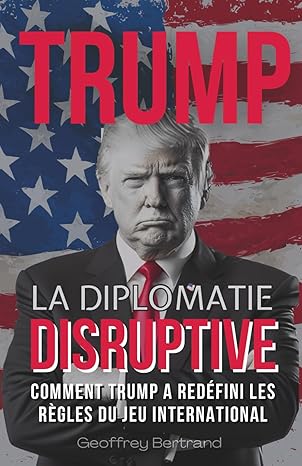
Geoffrey BERTRAND, La Diplomatie Disruptive. Redéfinir les règles du Jeu International, eds GB, 2025, 186 pages.
The book is in the form of a lecture on diplomatic negotiation aimed at overcoming the conventional approaches in use in all embassies. The author apparently delivers his (overly) rich experience of diplomacy in order to “decode the paradigms” that underlie international relations, to deduce that the “disruptive diplomacy” initiated by Donald Trump constitutes an irreversible “diplomatic revolution”. The latter is based on “the Art of Calculated Unpredictability”, which exploits uncertainty as a strategic lever, and “orchestrates new unexpected diplomatic pivots”. The approach, accompanied by direct language and a sometimes brutal style, aims to “reorient the negotiation” by breaking its formal framework and to give priority to efficiency over the maintenance of established positions and respect for principles. It favors bilateral relations over multilateral exchanges, inter-state dialogues over international forums. It also involves “the conquest of the information space” (including messages in the press and social networks, before, during, and after the diplomatic agenda. However, it must be applied “intelligently” and must be adapted to the cultural context of each negotiation, in order to avoid the authors being discredited. The author proposes that France adopt the “Trumpian strategy” without delay in order to preserve its diplomatic heritage and maintain its influence in the world. This advice is all the more risky as the long-term benefits of the “Trumpian method” have not yet been demonstrated, which has already resulted in the reform of the “Global South” bloc of countries. The legendary caution of diplomats invites us to seek a compromise between the conventional protocol and the new disruptive method.Geoffrey Bertrand is apparently a pseudonym that masks the identity of a diplomat or consultant, a journalist or a trainer in geopolitics and/or negotiation techniques… unless it covers a clever simulation designed by an AI algorithm that would have passed the Turing test. Jean-Jacques Pluchart

Nicolas TENZER, Fin de la politique des grandes puissances, Eds L’Observatoire.
Nicolas Tenzer’s latest book delivers a useful lesson in international diplomacy after the upheavals caused by the wars in Ukraine and Israel, as well as by the MAGA movement in the United States. These phenomena have disrupted the international order established at the end of the Second World War and have made relations between the blocs more unlikely. The author strives to map nation-states according to their balance of power. He logically ranks the United States and China among the global powers, but he considers them to be losing momentum. He describes Russia and the former colonizing countries such as France, the United Kingdom, Spain, and Italy as trans-regional powers (he does not clearly state the status of Germany and Japan). He estimates that a dozen states, such as Turkey (whose politics are studied at length), Mexico, Brazil, Indonesia, and South Africa, have an intermediate power status. Other states do not have sufficient critical mass to influence other states, such as the Baltic countries and the countries of Eastern Europe, but the author believes that they could play an increasingly decisive role in the future in the concert of nations.Nicolas Tenzer holds up Ukraine as an example of a “heroic state” defending democratic principles, and is outraged by the falsehoods uttered against it by Russia. He recognizes that its aggression has helped to unite most of the member countries of the European Union. He believes that a Ukrainian victory should help to pacify international relations, restore democratic values, and “dismantle the mental apparatus” of Russia based on falsehoods. He calls for the construction of a new model of relations based no longer on force but on democratic values of responsibility and truth.The book reflects the universality of the author’s knowledge and the depth of his analyses. It is served by a creative and educational style. Reading it will contribute to a better understanding of the new balance between nations. Nicolas Tenzer (Normale sup, Sciences po, ENA) was a teacher at Sciences po and the Paris School of International Affairs. He was a member of the cabinet of the Minister of Economy and Finance (1987-1988), rapporteur at the Court of Auditors (1991-1993), head of department at the General Commissariat of the Plan (1994-2002), and responsible for an interministerial mission on international expertise (2007-2008). He is the founding president of the Center for Study and Reflection for Political Action (CERAP), J-J.Pluchart
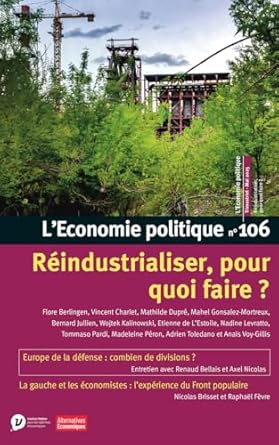
Madeleine PERON et Wojtek KALINOWSKI, (col), Réindustrialiser, pourquoi faire ? Revue L’Économie politique n°106, 2025, 110 pages.
The REP’s No. 106 issue raises a seemingly provocative question, but in reality, it is fundamental and complex. It consists of nine articles analyzing the many difficulties faced by businesses and governments – including France – in their project to reindustrialize a “country without factories” after three decades of industrial decline.Reindustrialization involves arbitrating between more or less contradictory objectives relating to the competitiveness of factories, security of supply, environmental protection, energy savings, balance between territories, social equity … Arbitrations must first be subject to lengthy administrative procedures, costly information campaigns and more or less democratic debates. The choice of activities to rehabilitate and territories to reindustrialize differ according to the countries of the European Union. National industrial links are part of an international chain of value creation, which limits the options. “Industrial territories” operations must therefore reconcile the imperatives of equitable land use, preserve agricultural land in the name of “land sobriety”, rehabilitate brownfield sites and supervise polluting and/or carbon-emitting industries (Net Zero Artificialization objective). These operations involve aligning public and private interests and adopting more sustainable financing systems. They must also be part of profitable circular economy systems that are both energy and raw material efficient. As an example, the case of the development of the sustainable and affordable electric car is remarkably studied.The dossier also includes an article – whose resonance is particularly current – entitled “the left and economists”, dealing with the confrontation from 1936 to 1938 between the leaders of the Popular Front and the economists Alfred Sauvy and Robert Marjolin, about the 40-hour week. An article on the coordination of the actions of the countries of the European Union in favor of Ukraine, closes the file.The authors are expert teachers and researchers and journalists (members of the Veblen Institute) mainly specialized in industrial economics. Jean-Jacques Pluchart

Régis de LAROULLIERE, En route vers les pénuries. Il y a une alternative, CRAPS, 2025, 285 pages.
The author is a “man in a hurry” in the sense of Paul Moran. He practices the art of understatement and prefers numbers to speeches. The clarity of his ideas quickly convinces the reader of the inevitable decline of France, which is falling in most international rankings (it went from 7th to 13th in GDP per capita in just twenty years). After a few pages, the reader knows that he is or will be a victim of multiple shortages, doctors in hospitals and the countryside, teachers in schools, colleges and high schools, police and judges, local traders in rural areas, skilled craftsmen, politicians concerned about the welfare of future generations… Shortages are already affecting some of the necessary resources in the pharmaceutical, digital, automotive value chains… The threat of more or less severe shortages looms over most sectors of activity in a situation of international dependence. The process of decline, measured in particular by the level of external debt, is all the more worrying as it seems to become uncontrollable due to the cumulative effects of its determinants. The author questions the factors that have led France to such a handicap. He attributes it to the aging of its population, its assistantship, its bureaucratization, and its increasingly chaotic political governance. He analyzes the scope of the solutions generally advanced to rectify – at least stabilize – this difficult to control situation. He shows the limits of a reduction in public spending and social assistance, a surtax on the rich and/or retirees. He advocates a form of cultural revolution, based on “additional levers of attraction of work” of a financial, fiscal, social, and cultural nature: better pay and relief of social charges on overtime, simplification of access procedures to work and job mobility, priority given to efficiency over effectiveness, meaning given to work (especially practical) in training courses, promotion of well-being at work, placement of work at the center of personal projects, building models of the artisans of Notre Dame and the organizers of the Olympic Games…The book’s interest is twofold: it highlights the seriousness of the threat of shortages weighing on the French; it shows – if not demonstrates – that there is no other way out than the fulfillment of each French person through work. Régis de LAROULLIERE (Normalian mathematics, associate actuary and ENA graduate) was the director of Crédit Foncier and the Médéric group. He is one of the founders of CRAPS (the social protection think tank). Jean-Jacques Pluchart
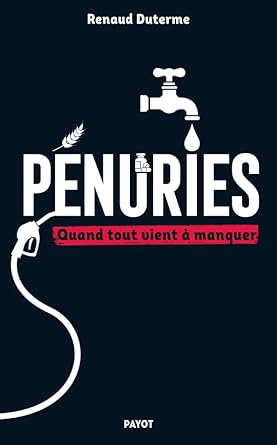
DUTERME R., Pénuries – Quand tout vient à manquer, Payot, 211 pages
“The 20th century was the century of abundance. The 21st will be one of limits.” We frequently discuss energy transition, relocalization and sobriety, but partly as if they were simple options. The author leads us to see that these are no longer options, but realities. This book makes this perfectly clear, and not by hyperbole or by trying to scare the reader. It’s not a doomsday story, nor is it about eternal progress. It simply welcomes the fact that we’ve reached the limits. Scarcity is no longer the exception and is now becoming the norm. Oil is at the heart of his analysis. He reminds us of a little-known fact: Energy Returned on Energy Invested (EROEI). From 100:1 at the beginning of the twentieth century, it now stands at 11:1, a figure that threatens our entire equilibrium. Nothing can be done without abundant, cheap energy. Electricity is not a silver bullet, just a vector. It’s a means of transporting energy. The author also mentions minerals and raw materials. We depend disproportionately on scarce resources, often from unstable countries. We use them for everything: telephones, batteries, infrastructure. But if one link breaks, we have no plan B. Freight transport is under pressure worldwide. It has a very low profit margin. One small thing can paralyze an entire production operation. Even industrial agriculture depends on it: fertilizers, machinery, transport… in reality, nothing is autonomous. It’s a system we’ve built ourselves. Over-specialization, globalization and the cult of efficiency have left us unable to cope when things go wrong. We’ve pursued efficiency and forgotten resilience. Renaud Duterme links this to the economic logic handed down by Ricardo and the rise of neoliberalism. The issue is not just technological; it’s a political vision. In the final section, he is less alarmist, but just as serious. He says we’re going to suffer shortages, and the question is really this: do we want to suffer them or be prepared for them? It’s not a question of stopping everything or going backwards. It’s an invitation to reconsider what we make, why and for whom. Relocate where it really counts. To overcome this system of unlimited growth and recognize that this century will have limits – physical and environmental, as well as social. In other words, this is not a technical manual or a political tract. It’s a clear, honest text. It confronts us with reality. It doesn’t try to scare us; it tries to convince us, by giving us the facts, and it succeeds. It’s a book to read not so much for what you can learn from it, but for what you can prepare yourself for. Because, in the future, it won’t just be a question of technologies, but of choices, compromises and even collective thinking. Renaud Duterme holds a degree in development sciences from the Université Libre de Bruxelles, where he also teaches geography. Attentive to questions of inequality and ecology, he is the author of De quoi l’effondrement est-il le nom? (2016, foreword by Pablo Servigne), Petit manuel pour une géographie de combat (2020) and Nos mythologies écologiques (2021). Florence Anglès
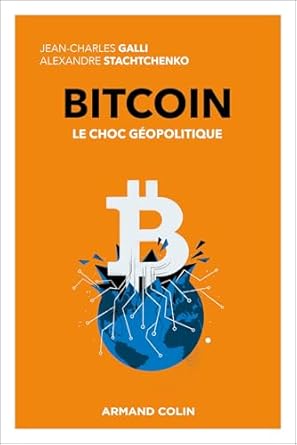
Jean-Charles GALLI et Alexandre STACHTCENKO, Bitcoin, Le choc géopolitique, Armand Colin, 2025, 250 pages.
The book raises useful questions about the development of bitcoin, which was designed in 2009 by Satoshe Nakamoto and relaunched in 2025 by the new American presidency. Bitcoin is both a cryptographic asset and an alternative currency under shadow banking. It performs the three functions of an official currency: unit of account, transaction vector, and store of value. The bitcoin system is decentralized and self-managed. It exploits blockchain technology, based on the encapsulation of transactions in blocks whose digital footprint (the hash) in the form of complex probabilistic equations, is verified by mining farms (Proof of Work).The control of the system – which is increasingly used by states, administrations, businesses, and households – now presents strategic challenges for governments, central banks, and commercial banks. Transactions financed by bitcoins are subject to regulation by the Financial Stability Board, the Basel Committee, the Bank for International Settlements, the Financial Action Task Force, at the international level, and the MICA regulation, within the framework of the European Union. Despite this increasingly restrictive framework, since the failure of Facebook’s libra, bitcoin continues to raise questions and concerns among monetary institutions, financial institutions, and the general public. Bitcoin also raises ecological problems, being a consumer of electricity and contributing to global warming.The authors of the book expose the dilemmas faced by governments, some of which (Salvador, Nigeria) have adopted it as an official currency, others (like China) have banned it, and most tolerate its use under certain conditions. The European Central Bank has relegated it to the rank of “pseudo-currency”. It seems that bitcoin is now considered a “safe haven” (the “bitcoin-gold”), a way to circumvent international sanctions (for Russia), an alternative to the dollar (for the BRICS), or “a digital value reserve”.Reading the book requires sustained attention because of its conceptual and technical nature, but it contributes to a better understanding of the strengths and weaknesses of the current international monetary system.Jean-Charles Galli is a teacher-researcher and advisor to start-ups. Alexandre Stachtcenko is a strategy director at Paymium. Jean-Jacques Pluchart