

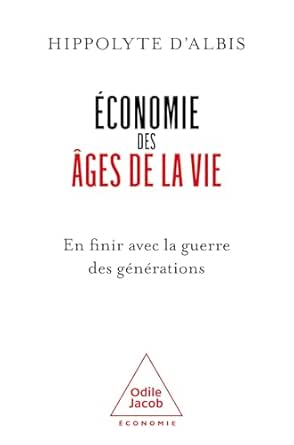
The idea of a generational conflict has now become a recurring framework through which public debate in France is interpreted. Baby boomers, born in the immediate post-war period and now largely retired, are often portrayed as the beneficiaries of a system whose advantages they are said to have appropriated at the expense of subsequent generations, whose future prospects and retirement security have thereby been undermined. Should this indictment be regarded as an objective reality, or rather as the product of a contemporary myth sustained by clichés? Hippolyte d’Albis invites us to move beyond such oversimplified representations by drawing on the economics of age, now established as an autonomous field of economic analysis, grounded in the use of statistical data and national transfer accounts. The value of this method lies in its ability to capture all the flows that contribute to individuals’ well-being throughout the course of life, whether these derive from the family, the market, or the state. In this respect, it departs from traditional approaches based on rigid administrative age categories—children, working-age adults, retirees—in order to privilege a functional reading of life trajectories. What matters is no longer belonging to a given age category, but rather the actual capacity of individuals to generate sufficient income to cover their current consumption, or conversely, the extent to which they find themselves in a situation of deficit or surplus. Such an approach makes it possible to better understand how generations are articulated with one another within the broader framework of collective production and redistribution. Since national transfer accounts have been available since 1979, it is possible to observe over the long term the transformations of these equilibria. Two major lessons emerge from this analysis. The first concerns the evolution of the economic life cycle. Contrary to what one might expect, the age at which individuals enter the surplus phase has not been postponed. It remains fixed at 24, despite the lengthening of higher education. This apparently paradoxical result can be explained by the low incomes earned at the beginning of careers in the 1980s, which at the time delayed full economic autonomy. By contrast, the age at which individuals enter the second deficit phase has shifted markedly upward, rising from 58 in 1980 to 60 today, a change explained primarily by the increase in senior employment rates. Far from freezing generational positions, the analysis thus highlights the plasticity of economic ages. The second lesson concerns the structure of well-being transfers. Since the late 1970s, the state has remained the principal provider of resources, with a relatively stable share of around 70 percent. At the same time, the role of the family has declined considerably, its contribution having been cut in half, while that of the market has tripled. This reconfiguration has not, however, taken place uniformly across age groups. The role of the state has strengthened in favor of the young, partly offsetting the erosion of family support, while it has diminished for older people, among whom market-based resources—especially those derived from assets and wealth—have come to occupy a growing place. Such an evolution directly contradicts the idea that baby boomers systematically benefit from more favorable treatment than younger generations. In reality, solidarity mechanisms benefit the young first and foremost, through spending on education, training, and labor-market integration. Older generations rely more heavily on capital income than on increased public support. The real source of tension therefore lies less in any supposed intergenerational appropriation of collective resources than in the effects of a particular demographic structure: the numerical weight of the baby-boom cohorts places specific pressure on the balance of the social protection system. But can one reasonably blame a generation for being numerous ? Still, this clarification does not settle the normative question. For while it would be absurd to hold a generation responsible for its own demographic weight, it does not follow that current generations should bear alone the cost of the resulting imbalance. The demographic argument cannot suffice to justify an unequal distribution of effort. This is why some rebalancing appears inevitable—not in order to condemn past generations, but to restore a measure of justice between those that succeed one another. Hippolyte d’Albis, Professor at ESSEC and Vice-President of the Cercle des économistes. Ph Alezard

Clément Carbonnier, Nathalie Morel, Bruno Palier, Michaël Zemmour (dir.), Les politiques publiques par la défiscalisation, Presses de Sciences Po, 2024, 333 pages.
In Public Policies through Tax Expenditures, the authors analyse a phenomenon that has become central to French public action: the growing use of taxation as a tool to steer economic and social behaviour. The book focuses on tax expenditures — often referred to as “tax loopholes” — and assesses their rationale, cost and effectiveness. The main argument is clear: tax incentives are a form of public policy in their own right. Even when they do not appear as visible budgetary spending, they mobilise collective resources and shape the decisions of households and firms. Over time, this instrument has expanded into many areas, including employment, health, family policy, long-term care, research and development, housing, and philanthropy. The authors show that this trend follows a strong political logic. Tax measures are easier to introduce than direct spending programmes and often appear less costly, since they take the form of foregone revenue rather than explicit expenditure. Yet their multiplication makes the system more complex and increasingly difficult to manage. A recurring finding of the book is that the effectiveness of these measures is uneven. In several cases, evaluations highlight windfall effects or benefits concentrated among higher-income households. Family policies, certain long-term care measures and housing-related tax incentives illustrate the gap that can emerge between stated objectives and actual outcomes. Once implemented, these mechanisms also become difficult to reverse, which encourages their accumulation over time. Employment policy provides a particularly telling example. France has relied heavily on tax and social contribution reductions to lower labour costs. While these measures have produced some positive effects, their overall cost raises questions about their real efficiency and about the opportunity cost compared with direct investment or training policies. The chapter on research and development points to another limitation: despite significant tax incentives, innovation performance remains below that of several comparable economies. Here again, the authors highlight issues of targeting and uneven effectiveness across programmes. The analysis of housing and philanthropy extends this diagnosis. Tax incentives can contribute to inflationary effects or indirectly steer public resources towards the preferences of wealthier taxpayers. The debate therefore goes beyond financial cost and raises broader questions about governance and policy coherence. The book does not reject tax incentives as a whole. Instead, it reminds readers that a tax advantage remains a form of public spending and should be assessed accordingly. As governments increasingly rely on taxation to implement policy, the risk is that public action becomes less transparent and harder to control. The book ultimately raises a simple question: when is fiscal incentive the right tool, and when should governments rely on direct, clearly debated public spending? Clément Carbonnier is an economist (Paris 1, CES, LIEPP),Nathalie Morel is a political scientist (Sciences Po-CEE, LIEPP),Bruno Palier is a political scientist (CNRS, Sciences Po-CEE, LIEPP),Michaël Zemmour is an economist (Lyon 2, Triangle, LIEPP). Benoit FRAYER