

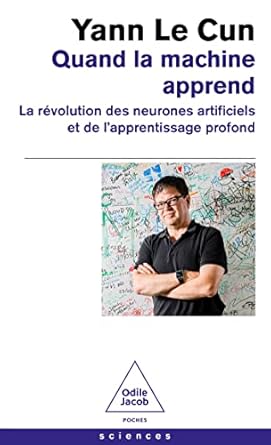
This atypical book presents three levels of reading. The life story of a young French engineer with a passion for algorithms who will meet other enthusiasts, go into exile in the United States, work in the largest American laboratories, teach at the University of New York, win the Turing Prize, be considered the father of neural networks or “deep learning” and finally lead the fundamental research of Facebook. But mathematicians and computer scientists will also be able to discover or deepen, through examples of codes and equations, the functioning of these machines which can acquire by themselves the experience and the capacities to accomplish tasks which are assigned to them. Finally, AI users will be interested in its latest developments, but also in its excesses (especially Cambridge Analytica) or its algorithmic biases. Yann Le Cun delivers his vision on the economic, social, societal and ethical impacts of AI, as well as on the future progress of this still young science whose powers of transformation of our society are considerable. Philippe Alezard’s note
THE NEW DOCTRINES OF CENTRAL BANKS
Benoît Coeuré and Hans-Helmut Kotz (eds) Revue d’économie financière-REF (Financial Economics Review) No. 144, 2022 The latest issue of the REF answers the main questions raised by the current revision of the European Central Bank’s monetary policy. It brings together the governors of several central banks and recognized monetary experts. It combines both theoretical and practical approaches to the issues raised by the revision of the ECB’s strategy. It is currently the best French-language source for reflection on the contemporary monetary economy. In the introduction, Benoît Coeuré and Hans-Helmut Kotz draw lessons from the financial crises that have occurred since 2008. They note that central banks have been able to adapt their strategies to changes in their economic and financial environments through the coordinated use of conventional and unconventional instruments. Central banks have been true to their mandates, focusing on the fight against inflation and supporting economic growth through an “inexorable decline in interest rates.” They note that the current economic situation requires the implementation of a new monetary policy. How can we redirect savings towards consumption and investment, initiate disinflation, combine the monetary and fiscal policies of States, support energy and climate transitions, and regulate crypto-assets? In the first part, the authors compare the monetary doctrines applied by the ECB (P-R. Lane) and the FED (R-H Clarida) respectively. They question the effectiveness of unconventional measures (low interest rates, forward guidance, purchase of public debt, liquidity support) and explore the possible new approaches of central banks in a more demanding economic environment, marked by a “double shock” of supply and demand (F. Villeroy de Galhau, V. Brignon, and B. Cabrillac). They analyze the changes in strategies (O. Issing) and the possible exceptional measures in order to practice a “flexible targeting of inflation” (O. Schumacher). In the second part, the experts discuss the ways of “budgeting monetary policies”, recalling that central banks are not in principle intended to intervene in the fiscal policies of governments (S-G. Cecchetti, K-E. Schoenholtz), but that in practice, the ECB’s accommodative policies were intended to support the private economy, but have in fact encouraged the fiscal drift of certain states, particularly in southern Europe (A. Orphanides). In a third part, the authors analyze the new challenges that central banks must face in order to promote energy and climate transitions, as well as to deal with the development of cryptocurrencies. M. Derer, D. Dohrmann and J. Gerik question the role of the ECB in hedging the financial risks generated by climate change, while M. Thiemann assesses the impacts of monetary policies on the management of the Covid crisis. M. Aglietta and N. Valla trace the history of digital currencies and identify the roles of central banks in their regulation and in the creation of central bank digital currencies (CBDCs). Finally, L. Scialom measures the societal responsibility of central banks in crisis management, while P. Berès shows that since Mario Draghi’s “whatever it takes” in 2012, central banks have replaced welfare states. Note by J-J. Pluchart
Olivier Pastré and Jean-Marc Sylvestre, The True Story of the Financial Crisis, Perrin Publishing, 2008, 300 pages (Turgot Prize 2008)
The authors are among the first to trace the subprime crisis – which is not, in their opinion, comparable to that of 1929 – to measure its severity, and then to identify the winners and losers. They propose new ways to regulate financial markets and the creation of new financial vehicles. They believe that the responsibilities of the crisis are collective, each stakeholder (central banks, banks, regulators, rating agencies, traders, states, savers) having not sufficiently measured both the nature and the extent of the risks of the financialization of the economy. Despite these excesses, the authors nonetheless celebrate the virtues of financial globalization, money creation and fiscal discipline. The outcome of the crisis lies in the common will of the many actors involved to thoroughly reform financial markets and global regulatory systems, to revise IFRS prudential standards (deemed pro-cyclical) and to reorganize the banking sector. This last issue is essential, because banks are major providers of credit to SMEs and households, and therefore, creators of productive jobs. A clear and documented analysis of the ins and outs of the last crisis. Olivier Pastré and Jean-Marc Sylvestre are respectively university professor and economic journalist.
LE MONDE, MODE D’EMPLOI, Eds Flammarion, 290 pages, 2023.
Jacques Attali, economist and writer, opens his book with a strong statement “We cannot say it enough: economic science is not the instruction manual of the world”. He says that it is sometimes better to rely on “common sense”. Proverbs like “a bird in the hand is worth two in the bush” are just as useful. The author therefore proposes to ” reveal the world’s instruction manual “.For the author, everything is taught to us by history, hence his extensive exploration of the historical domain. We start from very far, since he evokes situations dating back 200,000 years! It’s more historical story telling, but it allows you to dream a little. The author introduces two important concepts: the form, which are the territories of the planet subject to the same law of the world; the heart, which is the command center of the form.The analysis consists of crossing the commandments and the territories. Nine are studied; it is noted that three of the nine hearts are located in the United States. The first concerns Bruges from 1250 to 1348. After the analysis of history, the author brings us back to the present, in 2023. This is a very dense section loaded with statistics. One has the impression of being subjected to an avalanche of figures in all areas. A software like ChatGPT could have facilitated the extraction of these encrypted documents. The picture is quite bleak and analyzes the various crises we are going through: the climate crisis, wars and their nuclear threats. The US/China rivalry is widely documented…How will we approach the 2050 milestone? What threatens us is the economy of death: the production of fossil fuels, the meat diet, the excessive practice of social networks and video games.The author encourages us to make predictions. In his 2015 book “Peut-on prévoir l’avenir ?” (Can we predict the future?) (Fayard), he described the process of taking a blank sheet of paper, planning your day, then continuing to broaden your horizons. This method also concerned States, for strategic forecasts. “Forecasting is the best ally of freedom,” he concluded.Where will the heart be in 2050? In the United States? Perhaps not, because it will no longer be a superpower. In China? It will have to control its declining demographics and solve its ecological problem. In India? It is not impossible.In conclusion, the author suggests a better situation, if each of us asks the essential questions for a balanced social life. Respect for individual freedoms also requires questioning behaviors that harm our environment. Perhaps a glimmer of hope for future generations …(review by Renzo Borsato) (review by Renzo Borsato)
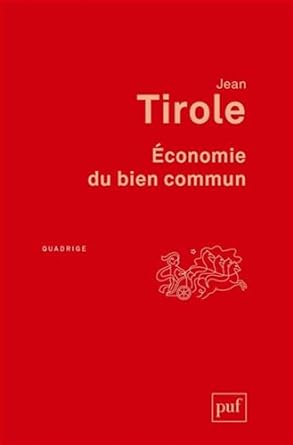
ÉCONOMIE DU BIEN COMMUN Éditions PUF, 2016, 550 pages
The author notes that the scope of public decision-making continues to shrink. The judiciary and regulatory authorities are independent of political power. Governments are largely powerless to reduce unemployment, deal with financial crises, protect the environment, integrate the European market, accommodate migrants … “Treating the world as a commodity” raises more and more questions from the public about the preservation of “common goods”. These include the planet, water, air, biodiversity, heritage, knowledge, etc. The notion of common goods is however subjective, because it depends on the desires of each individual, which are oriented towards work or leisure, consumption or solidarity, secularism or religion, etc. In order to remove “this veil of ignorance”, Jean Tirole invites everyone to apply a method initiated in the 18th century by Thomas Hobbes and John Locke, which consists of imagining the organization of the society in which one would like to live and the position that one would like to occupy there. The author shows that citizens – regardless of their social status and their professions – are subject to a growing number of incentives issued by the various institutions of the market economy. These incentives must serve the common good by framing its private uses. The purpose of economic science is not to prioritize common goods, but rather to show the issues attached to their preservation and to build the tools to better manage them. It is therefore at the service of a governance of common goods that is intermediate between the “all-State” and the “all-market”. In the war between economists, Jean Tirole has clearly chosen his side, displaying himself as resolutely liberal. Nevertheless, he supports the principle of a modern and efficient state that is capable of strategy in order to better regulate finance and prevent economic and social crises.

20 ans qui bouleversèrent le monde, de Berlin à Pekin (20 years that shook the world, from Berlin to Beijing), Dunod, 2008, 596 pages.
From the famous annual Ramses report of the IFRI, Thierry de Montbrial’s book is a broad retrospective of the political and economic events that have marked the world for 20 years. The reader is impressed by the extent of the changes experienced by humanity. He is surprised to find that, despite its disagreements and dysfunctions, the European Economic Community – which became the European Union in 1992 – has exerted an increasing influence on other nations. He witnesses almost “live” the crises and the realizations of terrorism, financial bubbles, global warming … He observes the emergence of a new multipolar international system, both heterogeneous and global, marked by shared sovereignty. The author advocates a “variable geometry” regulation to adjust the devices (institutions, rules, systems) to the overall performance (economic, social, ecological) desired by civil society. These measures would respect the sovereignty of nation-states or federations of states. It would preserve the history of nations and the genius of peoples. Reading the book allows us to better understand the importance of the debates on global governance, revived by the current crisis. Review by J-J.Pluchart