

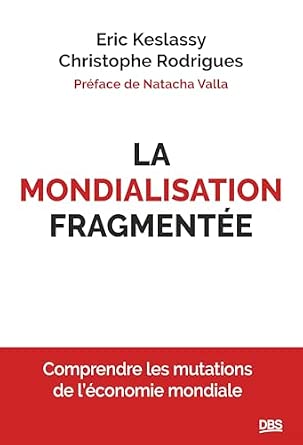
The purpose of the book by Éric KESLASSY and Christophe RODRIGUES is to demonstrate, through historical and economic analyses, how the economic cooperation cooperation between nations, which was intended to guarantee peace between states, is now “fragmented”.
The effects of globalisation have had noticeable effects on democracy. Recently, the Russian-Ukrainian conflict has changed the organisation of globalisation, which is tending towards a “movement of globalisation among friends”: international trade is organised according to geopolitical affinities, slowing down global economic growth and driving inflation up.
The book then looks more specifically at the history of globalisation through the various agreements and treaties. Based on international cooperation, these agreements were made in order to establish a multilateral order in monetary and commercial terms: the establishment of the gold standard in 1870, the Bretton Woods agreements in 1944 to organise the new international monetary system after the Second World War. The United States thus became the world’s creditor, and emerged with very clear economic dominance, with the dollar as the key currency. Then came the GATT agreement in 1947 to reduce customs duties and stimulate world trade before the creation of the WTO in 1995.
A new period began with hyperglobalisation, from 1990 to 2007, with the entry of China and India. During this period, the US economy was hit by the “Chinese shock” and deindustrialisation. Over time, the economic and social consequences have generated inequalities among populations worldwide, thus creating conditions favourable to the rise of populism. History reveals that the Donald Trump’s protectionism is part of an old American tradition: tradition: since its independence, the United States has always sought to protect their industries from foreign competition.
The multilateralism of the WTO today no longer seems to to meet the interests and vision of the member states. With hyperglobalisation having gone too far, many regional trade agreements have been put in (380 in force, notified to the WTO).
Faced with this fragmented globalisation, Europe must regain industrial sovereignty to face up to American protectionism and the “Chinese steamroller”. In the last part of the book, the authors propose two major lines of thought on the reindustrialisation of the continent and the accelerated decarbonisation of its production system.
A book that is both economic and historical, offering the reader an in-depth analysis of the global imbalances that weigh on Europe, so that it can regain control of its economic and political future.
Éric KESLASSY holds a doctorate in economic sociology
(Paris-Dauphine). After teaching economics and sociology for many years at
Sciences Po, he is a professor of economics and social sciences in the preparatory
preparatory class at La Prépa Autrement (LPA).
Christophe RODRIGUES is a senior lecturer in
economics and social sciences. He teaches in the preparatory class at the Lycée
du Parc de Lyon and in the CPES of the École Normale Supérieure de Lyon.
Reading note by Sophie FRIOT