

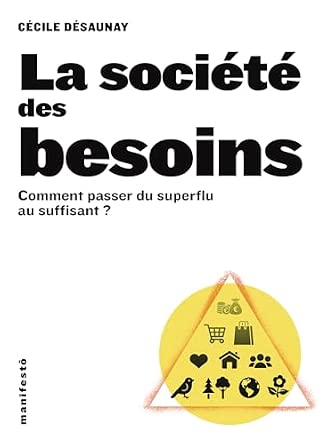
After the publication of her first book, published in 2021, devoted to the Consumer Society, the author presents her reflections on the evolution of consumerism in France.
Analysis of the latest national data reflects a strong trend of a gradual slowdown in consumption. The downturn can be explained by the combination of several factors : an ageing population whose needs are largely met, a saturation of material needs, and increasingly constrained households. Paradoxically, our society is generally wealthy, but the basic needs of all individuals are not being met. Mechanically, this rate of dissatisfaction should increase with the decrease in purchasing power and a cost of living that will continue to rise.
This deterioration in living conditions, along with environmental and climatic constraints, will increasingly influence our behaviour and decisions, causing tensions between individuals and, more broadly, between citizens and public authorities. This will require trade-offs and a new approach to meeting material and non-material needs. Meeting basic needs, whether material or immaterial, in this context of economic contraction will require a reversal of the current pyramid of Needs (Base) and natural ecosystems (Top), with a new hierarchy: needs of natural ecosystems (Base) and Economy (Base).
This reversal of priorities will result in a profound change for consumers and producers , and in strong incentives from the political sphere to, on the one hand, meet the 2050 environmental objectives (carbon neutrality ) by developing several actions: the circular economy, recycling, second-hand rather than new, product design, the development of services, the taxation of products and services with a high environmental impact, global and individual quotas, etc. And on the other hand, to meet basic needs, not excluding the use of more punitive taxation on income , property, inheritance , etc. The author draws on on ADEME ‘s studies and projections,
the advice of certain national experts, and draws extensively on international literature.
Question : the transposition of the desired trajectory for France would require a great deal of education in order to be exported, even within Europe, as national situations and interests can diverge and even conflict. Some of the points touched upon would require more in-depth analysis of the carbon, environmental, social and societal impacts on many issues: electric cars, international treaties on agriculture, intermittent energies, etc.
Cécile Désaunay, Director
of Studies at Futuribles. In 2021 in the Manifestô collection “La société de déconsommation, la
revolution of living better by consuming less”
Hubert ALCARAZ