


The reader will not find in this booklet “the means to earn more by working less”, but he will know how to rebuild a society based on work, allowing both to live better and acquire wealth. The author notes that labor productivity has declined since the 1980s, due to the country’s de-industrialization and the weakening of skills due to educational downgrading. He recalls that France was downgraded from the 6th to the 27th place in the world ranking of GDP per capita. He notes that the purchasing power of the French is no longer progressing and that two-thirds of their wealth comes from inheritance. The French who do not work live better than those who do. Work only supports purchasing power through social assistance in all forms. The progressivity of taxes and contributions financing these aids also discourages employees from working overtime and employers from recruiting and/or increasing the wages of their employees. Workers retain, on average, only half of their gross earnings, while annuitants receive a third, retirees a sixth, and heirs less than a tenth. This results in different forms of resistance to work, which mobilize more protesters than other social conflicts, encourage sick leave, “silent resignations” and/or rejections of “bullshit jobs”. In 2025, the working population must also support twice as many retirees as in 1980. According to the author, this phenomenon is due to an unequal distribution of the value created by labor, which favors both financial and real estate capital. The French no longer believe in the “collective discourse” that orders them to get back to work. The author therefore strives to propose a new “social contract” aimed at bridging the gap between the living standards of workers, rentiers, retirees, and heirs. He proposes measures to enhance the value of work and the purchasing power of assets through a better remuneration, thanks to more professional training, a revival of innovation (especially through AI), a reindustrialization of the country associated with a limitation of imports of dumped products, a more flexible employment and a greater professional mobility. He advocates a “revenge of employees on customers”, by redistributing VAT rates in favor of basic necessities. He advises building a “new ideal of work”, based on the values of responsibility, respect, and empathy. The author engages in a rigorous and educational exercise of analyzing the French evil of professional attrition and puts forward coherent proposals to address it.Antoine Foucher was the Chief of staff of a labor Secretary. He currently heads the consulting firm Quintet. Jean-Jacques Pluchart

Felix TORRES, Du berceau au tombeau. Une histoire critique de l’Etat-Providence, Eds de l’Eclaireur, 2025, 192 pages.
The author engages in a critical analysis of the French social protection system, based on the welfare state model inherited from Beveridge’s “3 U”. He draws up a genealogy of the notions – both familiar and unknown – of social protection, social security, social state, welfare state, national solidarity, universal minimum income, “inactivity trap” … He analyzes the drifts of the system’s financing and taxation methods, which he compares to the mechanisms implemented in other major democracies. He recalls the successive alarms launched, since the 1970s, by politicians, such as Georges Pompidou and Jacques Chaban Delmas, by historians, such as Pierre Rosanvallon, or by jurists, such as Pierre Laroque. He observes the many attempts – sometimes utopian and often in vain – to “redefine solidarity”, “rethink rights”, “restore duties”, “improve redistribution”, “recover the untraceable budget balance” … He shows the complexity of legal constructions, fiscal adjustments, financial arrangements … to “fill the hole of the Secu”. He reveals that these excesses are both accelerated and inevitable, due to the political instability of the country and the “French taboo of capitalization”. He ironizes the typically French sense of the ideological controversy around the notions of social charges and contributions, insurance and levies, pensions and retirement… He welcomes the zeal of the technocrats who ensure the governance of the State-funded parity, in the absence of structural reforms.The author recommends, following Erell Thevenon, to adopt a model of “State-Providence” located between the “universal and the individual”. The State refocuses on its “core mission” on a “solidarity base”. Private actors are guaranteed by contract against health and occupational risks, depending on their personal life choices. In any case, it seems that the rebalancing of the French system requires “more work” and “less aid”, as well as a reduction of “real inequalities” but also “undue advantages”.Felix Torres (ENS, associate Professor of history, doctor of anthropology) is the author of numerous books on institutions and companies, where he demonstrates a vast economic and social culture and a rare mastery of historical and anthropological approaches. Jean-Jacques Pluchart

Régis de LAROULLIERE, En route vers les pénuries. Il y a une alternative, CRAPS, 2025, 285 pages.
The author is a “man in a hurry” in the sense of Paul Moran. He practices the art of understatement and prefers numbers to speeches. The clarity of his ideas quickly convinces the reader of the inevitable decline of France, which is falling in most international rankings (it went from 7th to 13th in GDP per capita in just twenty years). After a few pages, the reader knows that he is or will be a victim of multiple shortages, doctors in hospitals and the countryside, teachers in schools, colleges and high schools, police and judges, local traders in rural areas, skilled craftsmen, politicians concerned about the welfare of future generations… Shortages are already affecting some of the necessary resources in the pharmaceutical, digital, automotive value chains… The threat of more or less severe shortages looms over most sectors of activity in a situation of international dependence. The process of decline, measured in particular by the level of external debt, is all the more worrying as it seems to become uncontrollable due to the cumulative effects of its determinants. The author questions the factors that have led France to such a handicap. He attributes it to the aging of its population, its assistantship, its bureaucratization, and its increasingly chaotic political governance. He analyzes the scope of the solutions generally advanced to rectify – at least stabilize – this difficult to control situation. He shows the limits of a reduction in public spending and social assistance, a surtax on the rich and/or retirees. He advocates a form of cultural revolution, based on “additional levers of attraction of work” of a financial, fiscal, social, and cultural nature: better pay and relief of social charges on overtime, simplification of access procedures to work and job mobility, priority given to efficiency over effectiveness, meaning given to work (especially practical) in training courses, promotion of well-being at work, placement of work at the center of personal projects, building models of the artisans of Notre Dame and the organizers of the Olympic Games…The book’s interest is twofold: it highlights the seriousness of the threat of shortages weighing on the French; it shows – if not demonstrates – that there is no other way out than the fulfillment of each French person through work. Régis de LAROULLIERE (Normalian mathematics, associate actuary and ENA graduate) was the director of Crédit Foncier and the Médéric group. He is one of the founders of CRAPS (the social protection think tank). Jean-Jacques Pluchart
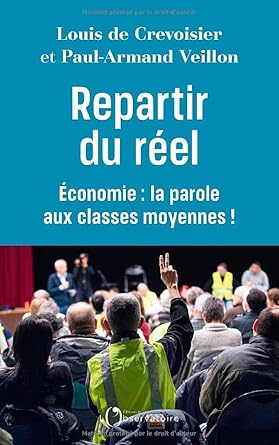
DE CREVOISIER Louis, VEILLON Paul-Armand. Repartir du réel, L’OBSERVATOIRE, 205 pages
“Starting from reality”, a certain touch of arrogance in the title as if it was just necessary to start again and listen to what the “France from below” says to put equity and justice in public policies and reforms. The authors report a certain self-criticism of their peers and what they have lacked until today: understanding the experience of workers, far from the metropolises, public transport and the Grandes Écoles. They drew inspiration from their experiences, the cahiers de doléances and the reports of the great national debate established in 2019, a few months after the start of the yellow vests crisis. In December 2024, President Emmanuel Macron called, “to govern”, “from reality and not from fantasies or untruths”. The words are clear, but the middle classes are getting impatient. These middle classes, neither poor nor rich, seek at all costs to have a job that pays, a decent standard of living and hope for their social advancement and that of their children. Starting point of the yellow vests crisis and the mobilizations on the roundabouts. Employees must be able to consider an increase in their wages throughout their career and the social system must be more incentive to work: the gap between inactivity and a job at the minimum wage is considered too small. The authors propose the creation of an “employee dividend” in order to increase the sharing of value. In an indebted France, the financing of the social model remains a stumbling block between politicians and economists. Solutions exist to support the purchasing power of workers but require courage in implementation: lower public spending, increase social contributions and/or working time, or change the way the pension system works. Taxes for whom and for what? The middle classes are not against taxes but want value for their money and are not satisfied with the level of public services. Given this, the authors propose to directly link the Court of Auditors to Parliament in order to have a better assessment of public spending. Regarding taxation, it must be more virtuous in order to reward behaviors that contribute to collective interests. Purchasing power, another theme discussed at length by politicians in search of voters. In a service and deindustrialized France, productivity has been slowing down for several decades and can no longer guarantee dynamic growth. Constrained by their income, the middle classes are eyeing their spending. Among the avenues mentioned for leveraging growth, the authors mention complementary health and highways. Added to this is the ecological crisis and adaptation to the energy transition. Once again, the middle classes find themselves in difficulty to find decent, isolated housing and are often “strangled” by rising energy costs. In the last part, the authors highlight the opportunities for the middle classes. In terms of education, the authors wish to strengthen the level of mathematics and encourage students to move towards scientific fields; without forgetting the revaluation of teachers. At the dawn of future electoral periods and budgeting, the authors thus establish many concrete proposals that must be at the heart of the debates. An educational and enlightening book, a must read. Louis DE CREVOISIER is a senior official, Inspector of Finance. He was previously Deputy Director of the Cabinet of the Minister of Transport. Paul-Armand VEILLON is a senior civil servant, deputy director of the office of the Minister in charge of Public Accounts. Sophie FRIOT

Dominique Foray, Innovations – Une économie pour les temps à venir, La Découverte, mai 2025, 320 pages
“Death Valley”! This is the first notion that appears in a randomly found figure entitled: The life cycle of a start-up. It is all the more striking that the said “valley” does not end up extending over a period that we imagine to be leading to all dangers. This may be an explanation for the fact that, while they have experience, a network, and capital, executives of large groups invest little in start-ups, as shown in a recent study by Forvis Mazars. These are two different worlds (The word “risk” in venture capital is certainly not foreign). Beyond this anecdotal knowledge, we have in our hands a book that does not deny Schumpeter and his creative destruction, but introduces a number of concepts that are sometimes well established (such as positive externalities of all kinds or spillovers) but also less known (such as innovatization) to explain how large programs like Apollo can be great technological successes, but without marked innovation. The difference with SpaceX is that it is centered on innovation driven by a change in value, a reduction in costs, where business opportunities explode. The three parts of the book focus with the microeconomics of innovation, macroeconomic and historical analysis up to the end of the twentieth century. The last part, very ambitious (if we refer to the traditional use of the idea of innovation) has no other purpose than to define an economy capable of “contributing to the solutions of major societal problems”. Incidentally, Dominique Foray, a member of the Swiss Science Council, does not fail to point out how Europe would – according to him – have already lost access to space, despite a Brussels agenda tinged with technological sovereignty and strategic autonomy, as well as his “dissection” of the curious animal that is the CNRS, which is particularly cruel when comparing this noble institution to the Swiss system. Dominique Foray is Professor Emeritus at the Swiss Federal Institute of Technology in Lausanne and a member of the Swiss Science Council. His work focuses on the knowledge economy, the economy and innovation policies. His work on smart specialization has strongly influenced the regional policies of the European Union. Alain BRUNET

Céline ANTONIN, Nadia ANTONIN, Les crypto-actifs , Ed Economica, January 2025,167 pages
In recent years, the world of payments has seen a number of major technological innovations, the latest of which are crypto-assets. From the famous bitcoin to stablecoins, these new assets arouse both enthusiasm and fear. What are their nature and intrinsic value? Is money invested in crypto-assets as safe as in a bank? Are crypto-assets monitored and regulated? But the impact of crypto-assets doesn’t stop there. Indeed, they have also given rise to a new model of finance, decentralized finance (DeFi). What are the specifics of this intermediary-free finance? How are central banks reacting to this new “currency war” between official currencies and private digital currencies? What tools are they developing to defend their sovereignty? Through a clear and accessible analysis, the authors answer and demystify these hotly debated questions. Definitions, players, services, innovation benefits, micro- and macro-economic and financial risks, and regulations are discussed, leading to the conclusion that the future lies in the development of central bank digital currencies, since “crypto-assets should not be the currency of tomorrow. This conclusion is based on two elements. The first concerns the competition between public and private money, which was favored by Friedrich von Hayek. However, one of the attributes of money put forward since the 1980s is that of trust, based on a social contract. The second point concerns the idea that monetary policy is impotent. The success of Mario Draghi’s “Whatever it takes” policy in July 2012, on the one hand, and the responsibility, albeit partial, of central banks in controlling inflation, on the other, invalidate this idea: monetary policy remains relevant to “reassure” economies, investments and citizens! This would be impossible with an anonymous, disembodied monetary system. This book is extremely educational, using simple words that don’t “drown” the reader in technical or regulatory legalese. Nevertheless, it contains everything an “enlightened” citizen needs to know to find his or her way in this world of innovation, which is already affecting everyone in terms of payments, insurance services or real estate matters. This book is aimed not only at banking, finance and insurance professionals, as well as lawyers, but is also an essential resource for students at business and engineering schools, political studies institutes and universities. Last but not least, it is intended for all those who wish to understand the crypto-asset ecosystem, so as to use it without being subjected to it. But within an operating framework that is marked out so as not to harm the common good. A must-read! Column written by Dominique Chesneau