

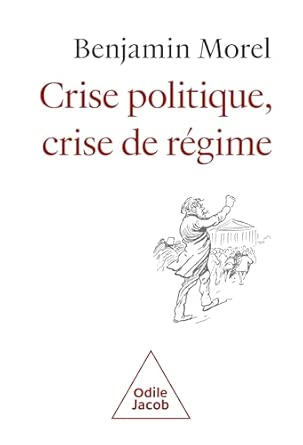
The Fifth Republic is based on a simple fact: whoever holds the majority holds power. Yet this majority has become elusive. Power has left the Élysée Palace, is not in the National Assembly, and no longer resides in the government.
The aim of this book is to understand how a system that has long functioned on the basis of a clear majority becomes unstable when that majority disappears. Benjamin Morel begins by examining the reasons why we have shifted from a stable two-party system to a dysfunctional three-party system. He then analyzes the effects of this shift on the political system: the temptation to expand the powers of the head of state by overinterpreting the Constitution, the proliferation of expedients to govern regardless (maintaining a resigned government, executive orders…), all of which are precedents whose accumulation paves the way for an illiberal drift.
The book presents the following themes: tripolarization, an unstable legislature, escaping the trap of instability, a regime in a fragile balance, and governing nonetheless under a Constitution designed to ward off instability while remaining vulnerable to illiberal abuses.
The book’s conclusion is tinged with a certain optimism: the one who defines the crisis is also the one who provides solutions, provided we do not allow ourselves to be misled by false prophets.
Changing the electoral system is not an end in itself. Parliament must be better equipped to enable it to ensure the co-construction of legislation between Parliament and the government. The functioning of a regime is not a metaphysical property of the norm; it is a property of the society that receives it. The state functions like public services. A government can lose its political legitimacy when it can no longer translate election results into consent: To govern despite this is to govern in spite of it! What holds a legal order together is everyone’s conviction that it is in their interest to respect it and play by the rules.
Some say it would be easy to solve the problem. A new Constitution would cure our ills. A new election would sweep away our worries. What is causing the crisis is the overall mismatch between the election and the expectations surrounding it. These expectations are divided into three camps, yet they all expect one of them to govern with the absolute powers of a majority bloc. All eyes remain fixed on the presidential election, even as the electoral landscape makes the return of a Jupiter unlikely. Faced with this paradox, which every citizen carries within them, the solutions lie not in the texts but in the minds!
Dominique Chesneau