

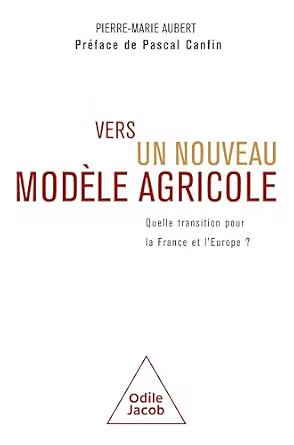
The author presents a new agricultural model, whose protagonists are both farmers and consumers. He suggests that future consumers must adapt by changing their diet to include more fruit and vegetables and less meat. His alternative: if necessary, pay more for commercial products with healthier production, while limiting pesticides while maintaining or even increasing yields.
The author shows that this model, while it has made it possible to considerably increase yields considerably, has also generated significant environmental, social and economic costs. In particular, he highlights soil depletion, dependence on inputs, loss of biodiversity and the weakening of farms. He proposes a gradual transformation transformation of the agricultural system based on greater consideration of ecological balances and a reduction in dependence on external resources. resources. It stresses the need to rethink public policies in order to truly support farmers in this transition. The change of model cannot be based solely on the individual responsibility of farmers. Agriculture must be more integrated with its environment
This well-researched book on new agricultural models and on global agricultural markets does not, however, address large-scale retail, as the average cost of producing agricultural products is only 8% of the final cost of the product. Moreover, the bibliography mentioned at the end of each chapter remains incomplete.
In his preface, MEP Pascal Cantin expresses his support for his preface to the reading of this book, which is the result of work carried out at IDDRI), in which the author summarises the issues addressed by this institute.
Pierre Marie Aubert is an AgroParisTech engineer and programme manager at IDDRI (a think tank) conducting studies on these subjects with a political and international aspect.
Pona Samnik