

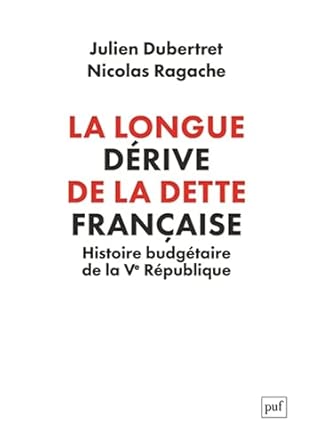
“The long drift of French debt” could be the headline of an economic media outlet at a time when the yield on the French 10-year OAT 10-year yield has just crossed the 4% threshold, its highest level since October 2008.
In this essay, published last April, Julien Dubertret and Nicolas Ragache have traced essay, published last April, 70 years of France’s fiscal policy, from 1958 to the present day. The work is extensively documented using the long series from INSEE. The economic guidelines and the presentations of the draft finance bills are supplemented by extracts from general policy statements.
A remarkable account, after years of work and research, with a clear objective: to inform citizens about the successes and failures observed over the period. A look back into the past necessary in order to better understand the current situation of public finances and to try to answer this question: how could we have gone go from a public debt-to-GDP ratio of 48% in 1980 to 109% in 2023 and more than 115% in 2025?
We learn that the real turning point for the French public deficit French public deficit was in 1981 and not in 1975. The second half of the 1970s 1970s saw a period of rising labour costs in France and a very long-lasting loss of competitiveness among French companies, aggravated by the introduction of business tax.
The 3% deficit limit was formulated in France in 1982-1983. This limit would later be adopted by European legislation and has become entrenched as a dogma to be respected, making it acceptable as long as it remains below 3% of GDP: “The deficit has become a public resource public resource in its own right.”
Some lessons from this budgetary history noted over the years:
– The temptation to see public spending as the fundamental source of growth, even at the peak of the cycle
– Combating inflation: the State must not resort to money creation to finance its own expenses
– The widespread over-regulation was already highlighted in the 1960s
– The post-oil shock recovery plan: an accommodating fiscal and monetary policy was not the right solution in the face of a major supply shock linked to the rise in oil prices.
– “The excessive focus on the economic situation to the detriment of the needs for structural adjustment is a recurring trap.” For example, the use of privatisation revenues, which are by nature one-off, to finance current budgetary expenditure
– In the early 1980s, the reform of the financial markets allowed the issuance of the first OATs (Obligation Assimilable au Trésor) in 1985. A reform which, in the long term, would facilitate the financing of public deficits.
– The equation aimed at reducing public spending to simultaneously reduce taxes and the deficit, works if growth is sufficiently dynamic
– Michel Rocard’s White Paper, published in April 1991, first raised the question of the balance of pension schemes with the lowering to 60 years of the full pension age to 60, which came into force in 1983
The book ends with a bleak picture of the economic situation in France, based on a model of public spending and high compulsory levies, in a fragmented parliamentary landscape.
This essay is recommended for future presidential election candidates, election, where the authors invite them to rely on a better understanding of the economic cycle and on ambitious long-term objectives that are that are less dependent on growth.
Julien DUBERTRET was budget adviser to the Prime
Minister before taking over as head of the Budget Directorate in 2011, where he
he had joined in 1992, and then to serve in the General Inspectorate of Finance. He is now an expert at the firm Global Sovereign Advisory.
Nicolas RAGACHE is an economist and lawyer who graduated from Ensae,
the École d’économie de Paris and Paris-Panthéon-Assas. He has held
administrator positions at Bercy, ministerial adviser, and is currently
chief economist of the Afep (French Association of Private Companies).
Reading note by Sophie
FRIOT