

Jean-Jacques Pluchart
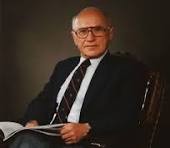
There has been a renewed interest in Milton Friedman’s thinking in recent weeks, as the US economy is marked by a return of inflation, a stagnation of real wages and a rejection by the courts of the customs duties imposed by the new US presidency.
After studying economics and mathematics, Milton Friedman (1914-2006) was the assistant to Simon Kuznets, the “father of GDP”, and then a lecturer and researcher at several American universities, notably Stanford. He was involved in the design of the Marshall Plan before receiving the Nobel Prize in Economics (1976). He was notably the inspiration behind the Chicago School and the anti-staginflationary policies initiated at the end of the post-war boom in the United States and the United Kingdom – and to a lesser extent in continental Europe – during the 1970s and 1980s. He has published numerous books, including A Monetary History of the United States, 1867–1910, Inflation and the Monetary System, and Capitalism and Freedom. His thinking is unfairly summarised by a few simple formulas according to which “business has an economic and not a social role”, or “the market is better than the State for the conduct of economic activity”. But he actually developed an original and prescient way of thinking on the “inflation-unemployment” dilemma, on the missions of central banks, on the trade-off between freedom and equality, and on the role of education in reducing inequalities.
Milton Friedman became known for his analysis of the 1929 crisis and for his criticism of the “Fordian compromise” and especially of the Keynesian analysis of consumption. He argued that the latter did not depend on household income at a given time, but rather on the perception of their “permanent income” in the medium term, which he described as “adaptive anticipation”. If the future is perceived as stable, agents tend to consume, and if the economic situation is perceived as unstable, they tend to save.
But above all, Milton Friedman is the “champion” of entrepreneurial freedom and market competition. He opposes all situations of monopoly, “free rider” or market dominance. He denounces Keynes’ “error”, according to which “inflation combats unemployment”, and he criticises the “Phillips curve”, according to which the unemployment rate is inversely related to nominal wages (“the greater the increase in wages, the lower the unemployment”). He considers that the key indicators are real wages and not nominal wages, as well as the “natural rate of unemployment”, that is to say the minimum rate below which a State cannot boost employment through purely cyclical measures. He thus criticises the “monetary illusion” whereby the unemployment rate does not depend in the short term on changes in nominal wages and prices, but rather in the long term on changes in real wages and employment. He thus inspired the famous NAIRU and NAWRU indicators (non-accelerating wage rate of unemployability), which arecurrently closely monitored due to the resurgence of unemployment and inflation in some countries.
Friedman also argues that the “arbitrator state” must confine itself to exercising sovereign functions (justice, security, transport), guaranteeing competition in the markets and refraining from any regulation that might limit the efficiency of the markets. The state must avoid increasing the “compulsory expenditure” of businesses (which weighs on their investments) and households (which reduces their consumption). It must favour measures that promote the mobility of the factors of production, and in particular of talent, in order to “limit the simple reproduction of the elites”. Like Tocqueville, he considers that inequalities are “fair” when they are justified by talent and/or work and not by situations of rent. He is in favour of competition between public and private schools and universities in order to develop capacities and skills, and to reduce the costs of education.
Milton Friedman is the champion of monetary orthodoxy. He denounces the “versatility” of governments and central banks in monetary matters, as well as the cult of the gold standard. He recommends applying a stable “rule”, believing that the role of a central bank is first and foremost to pursue an anti-inflationary policy (the inflation rate must, according to him, be between 2 and 2.5%) by setting interest rates to regulate credit and by providing forward guidance that gives indications on the future direction of monetary policy.
On the fiscal front, he opposes progressive income taxation (with the exception of very high incomes), but he is in favour of low taxation of dividends and high taxation of inheritances, with the exception, however, of “fair inheritances” accumulated through talent and effort, his objective being to promote the efficiency of the financial markets and the equity financing of the most profitable investments. He is opposed to any universal income but is in favour of a “negative tax” for the lowest-income households and scholarships for the most deserving students.
A reading or re-reading of Milton Friedman’s numerous publications and communications is therefore essential in the face of the “pressing national obligation” to restore fundamental economic balances