

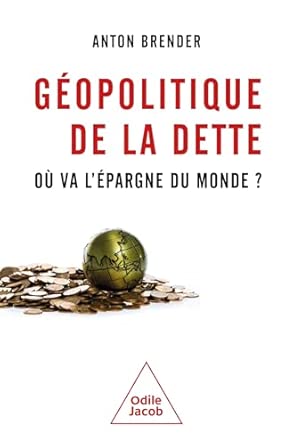
Around the world, debt is rising sharply and records keep being broken. The threshold of 300,000 billion, euros or dollars, the difference is no longer essential at this scale, in public and private debt has now been crossed. Speaking about France’s debt in the summer of 2025, François Bayrou referred to “an Everest of debt” during his time at Matignon. But Anton Brender reminds us of an often overlooked truth: “the debts of some are always the claims of others.” While there has never been so much debt, this is also because household financial wealth has never been so high. The “Everest of debt” therefore has its counterpart in an “Everest of global savings.”
In a highly pedagogical manner, the author explains the fundamental mechanisms underpinning a financial economy. On one side are the natural borrowers: companies, which need to finance their production capacity, factories, warehouses and investments; and governments, which provide non-market services and must finance their deficits. On the other side are the natural savers: households, primarily, whose savings directly or indirectly meet the financing needs of the economy.
The end of the Bretton Woods agreements, the oil shocks and the increasing opening of capital movements broadened the scope of savings and debt. They also contributed to the emergence of external imbalances, born from the interaction between the economic policies pursued by different countries. China’s entry into world trade in 2001 was, in this respect, a decisive moment. Chinese trade surpluses captured part of domestic demand in the United States and Europe. They contributed to the destruction of industrial jobs in Western countries and led central banks to respond by sharply lowering interest rates. American household debt thus enabled, as its mirror image, Chinese household saving. This dynamic helped prepare the ground for the financial crisis of 2008.
In a quarter of a century, the United States became the borrower of last resort for the planet. It financed the development of emerging countries at the cost of a colossal debt and the loss of millions of industrial jobs. In January 2025, Donald Trump announced the end of what he called a “scam” and embarked on a policy of unprecedented tariff barriers, the largest since the 1930s, while largely disregarding existing rules. The dynamics of world trade, and therefore of global savings and debt, are profoundly affected by this shift.
The world may therefore move from a situation characterized by a limited number of borrowers to one in which financing needs become far more numerous. Asian industrial powers, first and foremost China, will have to support their domestic markets. Japan will have to encourage its population to draw down savings. Europe will have to finance its defence, security and energy transition simultaneously. Emerging countries will also need capital to continue their development.
Ph Alezard