

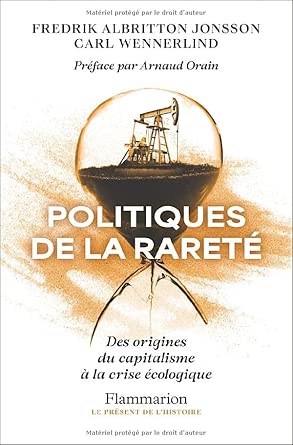
The authors trace the genealogy of the concept of “scarcity” of natural resources. They distinguish between Neo-Aristotelian, utopian, Malthusian, romantic, socialist and planetary scarcities. They criticise the capitalist and liberal system that has developed since the First Industrial Revolution and advocate rethinking the “relationship between nature and the economy”, which has gone through several periods since the origin of humanity.
This relationship begins with the “cornucopian” approach, marked by the illusion that nature will eternally provide for all of man’s needs (despite food shortages and famines). This approach is opposed to the “finitist thesis”, according to which the world’s population must moderate its consumption by becoming aware of the gradual and inevitable extinction of natural resources. Globalisation is putting increasing pressure on natural resources and biodiversity. Is 21st-century man capable of stopping the reduction of his ecological footprint? This approach has gradually extended to multiple resources: metals and rare earths, arable land, endangered species, etc.
During the classical age, the physiocrats hoped for a “great restoration” made possible by the “rational exploitation of the land”; they were certain that “man would decipher the source code of nature”. From the Age of Enlightenment onwards, philosophers believed that “technical reason” would dominate the “naturalist ideal”, and in the 19th century, the engineers of the Industrial Revolution advocated the division of labour and free trade. Economists were confident that, in order to avoid degrading their environment, households would adapt their consumption patterns and that companies would create new processes and products that were economical in terms of energy and non-recyclable by-products. Man was then considered a homo faber capable of “sculpting the world in his image”.
But it was not until the 1970s that governments became fully aware of the challenges of preserving the environment and the need to establish a “sustainable and people-friendly economy” that meets the real needs of the population. The authors then recall the criticisms of modern consumerism and environmental degradation that were formulated by the Vatican in its encyclical Laudato si and by the various environmental movements. In particular, they analyse the effects of carbon emissions, ocean acidification, damage to biodiversity, etc. The phenomenon seems all the more worrying to them because 20 th -century man is unable to measure and correct the long-term effects of his activities. They share certain principles advocated by radical environmental movements, in favour of self-sufficiency and economic degrowth. They support the theory of Kahneman (Nobel Prize winner in Economics) according to which, due to a “negativity bias”, the pessimistic forecasts of the Club of Rome or the IPCC are generally viewed with disbelief or scepticism by the majority of the population.
The book testifies to the scholarship, persuasiveness and activist experience of its authors; it sheds light on the dilemma of the choice between a sustainable economy and a sustainable natural environment, without being able to resolve it.
Frederik ALBRITTON
JONSSON is a professor at the University of Chicago and Carl WENNERLIND is a historian specialising in modern Europe.