

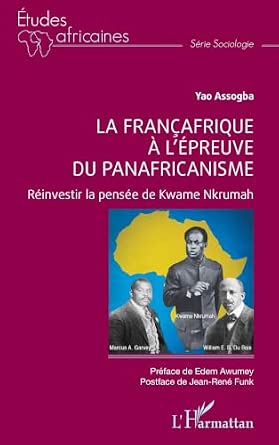
Professor Yao Assogba offers an original reflection on Pan-Africanism and Françafrique. He recalls the origins of the Pan-African movements initiated in 1900 by Henry Sylvester-Williams of Trinidad, influenced by Rosa Louis McKarly and by Martin Luther King, then developed by Marcus Aurelius Mosiah Garvey (1887-1940), who founded the Race First doctrine and the Back to Africa project, and by William Edward Burghardt Du Bois (1863-1963), who championed the cause of “Africa for the Africans”. These two currents were united in the thinking of Kwame Nkrumah (1909-1970), the first president of the Republic of Ghana, author of the book Africa Must Unite.
“Nkumanism” is a political movement whose objectives are the complete independence of African states and the creation of the United States of Africa, modelled on the United States of America. It opposes all forms of neo-colonialism and espouses a materialist and socialist ideology, combining African traditions and Western modernity. It is based on “humanist and egalitarian principles”. It is based on the ideal type of the new political homo africanus”. The movement still has a certain influence on the population and especially on African youth, particularly within the framework of the Alliance of Sahel States, made up of Mali, Burkina Faso and Niger.
Yao Assogba applies the sociological approach advocated by Max Weber to analyse the Françafrique system put in place by France in 1960 when the states of West Africa, East Africa and the Great Lakes (i.e. 400 million inhabitants and 8 million km2), which had been part of the colonial Empire and then of the French Community, declared their independence. The system is based on the recognition of the independence of each state and the establishment of a “post-colonial pact” comprising several forms of industrial cooperation (the exploitation of resources and public procurement), economic cooperation (the CFA franc, the exclusivity of certain trade exchanges, etc.), geopolitical cooperation (the representation of African states by France in certain international bodies) and cultural cooperation (the Francophonie).
In conclusion, the author outlines an analysis of the current situation in the former French-speaking Africa, based on the verbatim accounts of certain French figures involved in the conflicts in the Sahel. He notes that Nkrumanism is losing ground to the advances of Islamic movements, Iran, Russia and China.
Yao Assogba is Professor Emeritus of Sociology at Laval University (Canada) and holds the Chair of La Francophonie.
Jean-Jacques Pluchart