

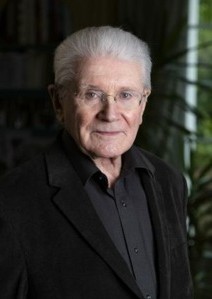
Founding member of CIRET
Professor René Passet, a founding member of the Centre International de Recherches et Études Transdisciplinaires (CIRET), who has just passed away at the age of 99, is the French economist who succeeded in liberating economic discourse from its confinement in order to consider it within the infinitely broader context of life on Earth.
Contemporary economic discourse has its origins in the image of the pin factory put forward by Adam Smith in his seminal work The Wealth of Nations. We are familiar with the principle. A craftsman, working alone in his workshop, can at best produce 10 pins in a day’s work. Therefore, ten craftsmen will produce around one hundred. However, ten workers working together in a machine-equipped factory and dividing the work between them may produce 10,000 pins, i.e., 1,000 each. This represents a 10,000% increase in productivity. National prosperity will therefore increase by the same amount. To this is added the principle of comparative advantage, which suggests that the English should manufacture and sell textiles to the Portuguese, in return for which the Portuguese will sell them Port wine. The entire contemporary economic system is based on this dual principle.
The problem is that it oversimplifies reality. First question: Is a factory worker, who spends their time performing repetitive tasks that are imposed on them, more or less happy than a craftsman in their small workshop? Economists are more or less silent on this point. Second question: Is the desired abundance compatible with the quantity of raw materials and energy available in the Earth’s subsoil, and can the waste from industrial activity be absorbed by the Earth without causing damage? The classical economist is also silent on this point. And so it is René Passet who, in his best-known book, L’Economique et le Vivant, asks whether the principle of economic efficiency is indeed compatible with the principle of preserving and reproducing living organisms.
However, this question has become fundamental to the very survival of humanity. Some people suggest that the ‘green economy’, ‘sustainable development’ and ‘renewable energies’ will make it possible to ensure compatibility between economic life and the preservation of living organisms. However, these are merely words. As Nicholas Georgescu-Roegen, who was an economist but also a physicist, clearly demonstrated, ‘economic development’ manifests itself as a local expression of negentropy. And energy consumption, in whatever form, cannot sustainably exceed the amount of energy available. And as soon as energy consumption on Earth exceeds the supply of solar energy, we have to draw on reserves, which are limited. We can see this clearly, for example, in the case of ‘rare earth elements’, which are now indispensable for electronics.
The question, in line with the logic of the living world as espoused by René Passet, is how we got to this point. This is the subject of the comprehensive work he published under the title Les grandes représentations du monde et de l’économie à travers l’histoire (‘The Major Representations of the World and the Economy Throughout History’), which spans over 900 large-format pages. We will not attempt here to present a summary of this work, which would inevitably be incomplete. What we will take away from it is that the economic discourse, as it currently drives the majority of humanity, is an ideological construct. This ideological construct draws on philosophical currents that can be traced through history, and which have led to a worldview characteristic of the ‘modern world’. This worldview is leading humanity towards catastrophe, and that is why the assertion of a critical mindset is not only necessary but urgent, given the increasing effects of global warming and the poisoning of the biosphere.
I will conclude with a personal reflection. In 1975, René Passet was the chair of my doctoral thesis examination board at what was then the University of Paris 1. I cannot imagine any professor of economics other than him who would have accepted a topic that fell more within the domain of anthropology than economics, and whose opening words were borrowed from Prof. Jacob Viner, ‘Economics is what economists say’. The passing of a man who will probably be recognised in the future as a pioneer therefore places a duty on us at CIRET to continue along the path he has thus charted.
Hubert Landier
René Passet, L’économique et le vivant, Petite bibliothèque Payot, 1983.
René Passet, Les grandes représentations du monde et de l’économie à travers l’histoire, Les Liens qui Libèrent, 2010.