

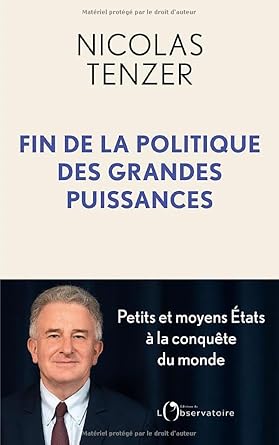
Nicolas Tenzer’s latest book delivers a useful lesson in international diplomacy after the upheavals caused by the wars in Ukraine and Israel, as well as by the MAGA movement in the United States. These phenomena have disrupted the international order established at the end of the Second World War and have made relations between the blocs more unlikely. The author strives to map nation-states according to their balance of power. He logically ranks the United States and China among the global powers, but he considers them to be losing momentum. He describes Russia and the former colonizing countries such as France, the United Kingdom, Spain, and Italy as trans-regional powers (he does not clearly state the status of Germany and Japan). He estimates that a dozen states, such as Turkey (whose politics are studied at length), Mexico, Brazil, Indonesia, and South Africa, have an intermediate power status. Other states do not have sufficient critical mass to influence other states, such as the Baltic countries and the countries of Eastern Europe, but the author believes that they could play an increasingly decisive role in the future in the concert of nations.
Nicolas Tenzer holds up Ukraine as an example of a “heroic state” defending democratic principles, and is outraged by the falsehoods uttered against it by Russia. He recognizes that its aggression has helped to unite most of the member countries of the European Union. He believes that a Ukrainian victory should help to pacify international relations, restore democratic values, and “dismantle the mental apparatus” of Russia based on falsehoods. He calls for the construction of a new model of relations based no longer on force but on democratic values of responsibility and truth.
The book reflects the universality of the author’s knowledge and the depth of his analyses. It is served by a creative and educational style. Reading it will contribute to a better understanding of the new balance between nations.
Nicolas Tenzer (Normale sup, Sciences po, ENA) was a teacher at Sciences po and the Paris School of International Affairs. He was a member of the cabinet of the Minister of Economy and Finance (1987-1988), rapporteur at the Court of Auditors (1991-1993), head of department at the General Commissariat of the Plan (1994-2002), and responsible for an interministerial mission on international expertise (2007-2008). He is the founding president of the Center for Study and Reflection for Political Action (CERAP),
J-J.Pluchart