

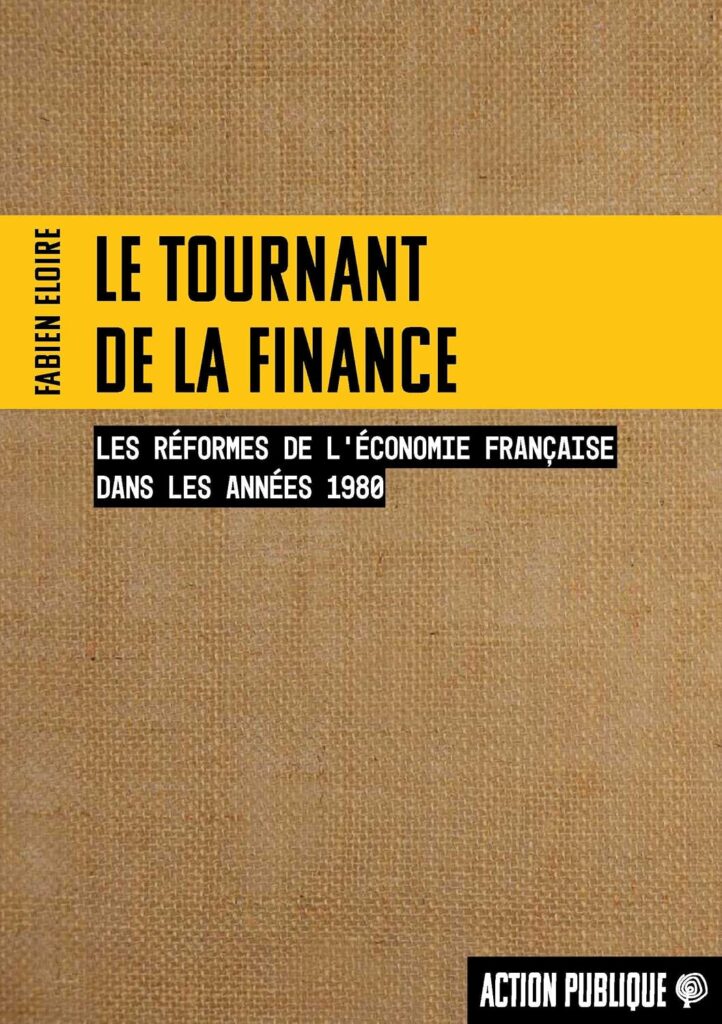
In the mid-1970s, the French financial sector was on the verge of a major transformation that some have termed the financialization of the French economy. Ten years later, measures had been implemented. This book examines the events that brought about these changes and the reforms developed within ministries and government agencies that led to a new framework for public policy in the monetary and financial spheres.
By examining the key players behind the scenes and the goals they pursued, by analyzing their rhetoric and justifications, and by describing the inner workings of their respective institutions, the sociological approach at the heart of this book demonstrates the complexity involved in understanding the trajectory of reform—a demonstration that is successfully achieved in this work.
The objective is to describe and analyze the period from 1980 to 1986, during which far-reaching changes were initiated in the monetary and financial sectors:
-The end of the Bretton Woods agreements (1973) and the oil crises (1973, 1979): monetary instability and the need for reforms.
-The left’s rise to power in 1981, followed by an economic reorientation beginning in 1983 (competitive disinflation).
-The Fabius government (1984–1986) and Economy Minister Pierre Bérégovoy: key figures in the reforms.
The first part of the book is devoted to the period preceding the monetary and financial reforms of the “Tournant de la rigueur” (1981–1983); it analyzes the mechanisms that led to the shift from a stimulus policy to one more in line with the prevailing orthodoxy in economic policy, based on maintaining the “grands équilibres.”
The second part deals with monetary and financial reforms proper (capital markets, credit policy, and stock market modernization). It focuses in particular on the inner workings of the central administration and the bureaucratic process by which officials from the Treasury Directorate, in collaboration with the Bank of France and the office of the Minister of Economy and Finance, designed and implemented these measures. This analysis is fascinating in that it describes the educational role played by senior civil servants toward their counterparts in the Socialist Party and Parliament, and, above all, the explanatory methodology adopted by Jacques Delors and Pierre Bérégovoy.
Part Three analyzes the course of reforms pursued by the French government from a “neoliberal” perspective. Behind the economic debates lie symbolic and geopolitical issues as well, and the choice of Europe weighs heavily on the Socialists’ economic policies. The text notes the existence of a “White Paper” drafted by members of the Bérégovoy cabinet (under the leadership and coordination of JC Naouri), considered the most comprehensive resource for understanding all the measures taken during this period, which calls for “the modernization of the economy, the reconciliation of business with society, and balanced budgets.”
The fourth part revisits the origins of the new economic strategy for disinflation. Bourdieu is drawn into the discussion because, according to him, it is necessary to understand “the state of opinion among the mobilized and organized segment of opinion makers.” The author confirms that the homogeneity of the backgrounds and socioeconomic origins of these “influencers,” the “pioneers,” and the “new converts” is key to the development of this “neoliberal” policy.
The conclusion draws a connection between these reforms of the economy’s financing system in the 1980s—which affected the very structures of France’s monetary and financial institutions—and the trend toward the financialization of the economy that took hold in the following decade. Finally, the author steps beyond his role as a researcher and commentator on the facts to point out that this “deregulated, liberalized, and flexibilized” post-reform world has favored “those who hold capital.”
This book will captivate those who lived through this period—which significantly changed the way they worked—as well as those who, beyond simply recalling the structural measures that shaped the French economy, are interested in the “making of laws and regulations” from a sociological perspective. A fascinating book!
Dominique Chesneau