

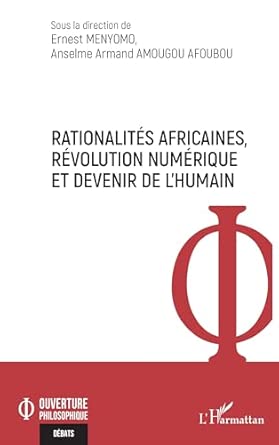
This collective work seeks to define African rationality (or, more accurately, African rationalities) by combining philosophical, historical, semiological and sociological analyses. The authors seek to move away from the Western approach to rationality inherited from the thought of Descartes and Kant. African rationality is based on a vision of Africans seeking to free themselves from natural and historical determinisms, and from Cartesian, Kantian and Comtean logics, as well as from existentialist and spiritualist logics. The authors’ ambitious goal is to develop a new African hermeneutic. They undertake a ‘decolonisation of African knowledge’, adopting an original methodology based on an analysis of the logics applied to African languages by the developers of digital algorithms. The languages of AI algorithms are striving to translate the many dialects and languages of African countries. They represent a lever that is both unifying for the peoples of Africa and promising for Africa’s youth. The authors of the book describe this process as ‘digital humanism’, as it influences the relationship of Africans not only with the Western world but also with the Global South. Although digitalised, the ‘New African Thought’ nevertheless retains its originality.
The ‘Afrocentric’ and ‘Eurocentric’ approaches are based on original representations of homo africanus and homo economicus. Inspired by Kwame Nkrumah, the authors draw notably on the ideas of Edgar Morin and Bruno Latour, according to whom rationality is neither ‘absolute’ nor ‘limited’, but rather ‘expanded’, ‘plural’ and ‘contextual’. It is shaped by empirical and experimental processes, amplified by social media, AI models and new technologies. The way of thinking of Homo africanus – particularly in the management of organisations – may incorporate practices related to the paranormal, telepathy, metamorphosis or divination, based on beliefs that only partially conform to conventional scientific criteria. ‘To think differently does not mean to think against reason, but to think using other forms of reason.’
This heterodox approach to science is justified by the fact that science does not progress in a continuous manner, but rather experiences a random series of ‘derationalising’ revolutions based on inspirations, flashes of insight or hallucinations. The boundary between the rational and the irrational, the scientific and the non-scientific, thus continues to shift. Science is made up of narratives whose rationality evolves over time and across space.
A demanding reading of the book therefore invites us to reflect on cultural otherness.
The authors, who are lecturer-researchers at African universities.
Jean-Jacques Pluchart