

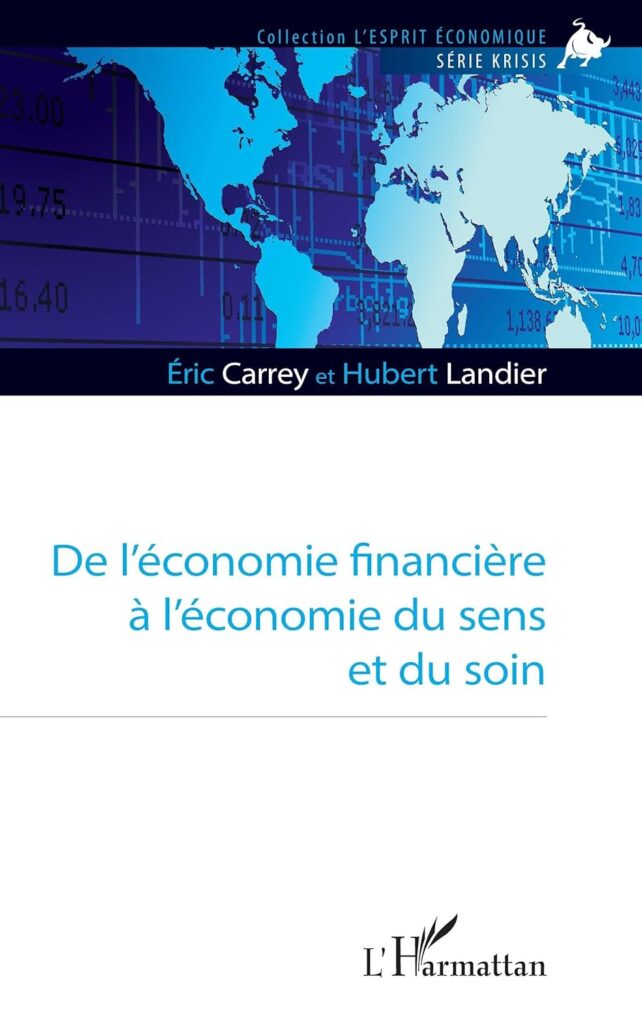
The latest book by Eric Carrey and Hubert Landier raises an issue that is currently much debated in all cultures around the world, centered on the two strongly synergistic concepts of “meaning and care” applied to the planet, humanity, society, business and the individual.
The authors emphasize that the numerous measures implemented over the past half-century at the international, national and local levels, in terms of sustainable development and social, environmental and governance responsibility, despite their progress, are insufficient to meet the expectations of producers, consumers and citizens. Their quest for meaning in their actions and their aspirations for solidarity and well-being are thwarted by governments’ desire to restore major economic and financial balances, by the attempts of workers’ attempt to adapt to new technologies, by f consumers ’fears of facing shortages, but also by the determination of more and more social actors to achieve the energy, ecological and digital transitions. The authors invite us to go beyond the canonical notions of homo economicus by recalling the genealogy of the concepts that have marked out the vast field of “meaning and care”: the economies of gift-giving, the common good, well-being, happiness; circular and frugal economies; cooperative, associative and partnership-based governance, CARE and CURE practices, etc. They revisit the notions of sustainability, resilience, responsibility, solidarity, etc. Using illuminating ideal-type cases, the authors analyze the application of these concepts to the planet (water, air, earth) and to different objects (clothes, bottles, etc.).They strive to perceive the weak signals that herald the turning points in our civilization, its vital principles, its essential practices, its mobilizing values and its new languages.
Hubert Landier (Doctor of Economics) is Professor Emeritus of Universities. Eric Carrey (St Cyr, Exeter and ESSEC) is a professor of social and solidarity economics.
Jean Jacques Pluchart