

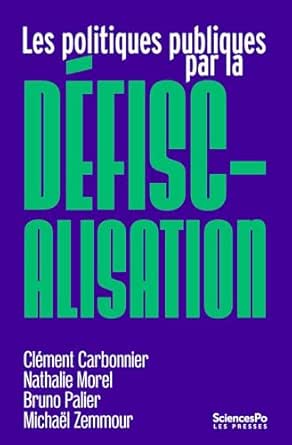
In Public Policies through Tax Expenditures, the authors analyse a phenomenon that has become central to French public action: the growing use of taxation as a tool to steer economic and social behaviour. The book focuses on tax expenditures — often referred to as “tax loopholes” — and assesses their rationale, cost and effectiveness.
The main argument is clear: tax incentives are a form of public policy in their own right. Even when they do not appear as visible budgetary spending, they mobilise collective resources and shape the decisions of households and firms. Over time, this instrument has expanded into many areas, including employment, health, family policy, long-term care, research and development, housing, and philanthropy.
The authors show that this trend follows a strong political logic. Tax measures are easier to introduce than direct spending programmes and often appear less costly, since they take the form of foregone revenue rather than explicit expenditure. Yet their multiplication makes the system more complex and increasingly difficult to manage.
A recurring finding of the book is that the effectiveness of these measures is uneven. In several cases, evaluations highlight windfall effects or benefits concentrated among higher-income households. Family policies, certain long-term care measures and housing-related tax incentives illustrate the gap that can emerge between stated objectives and actual outcomes. Once implemented, these mechanisms also become difficult to reverse, which encourages their accumulation over time.
Employment policy provides a particularly telling example. France has relied heavily on tax and social contribution reductions to lower labour costs. While these measures have produced some positive effects, their overall cost raises questions about their real efficiency and about the opportunity cost compared with direct investment or training policies.
The chapter on research and development points to another limitation: despite significant tax incentives, innovation performance remains below that of several comparable economies. Here again, the authors highlight issues of targeting and uneven effectiveness across programmes.
The analysis of housing and philanthropy extends this diagnosis. Tax incentives can contribute to inflationary effects or indirectly steer public resources towards the preferences of wealthier taxpayers. The debate therefore goes beyond financial cost and raises broader questions about governance and policy coherence.
The book does not reject tax incentives as a whole. Instead, it reminds readers that a tax advantage remains a form of public spending and should be assessed accordingly. As governments increasingly rely on taxation to implement policy, the risk is that public action becomes less transparent and harder to control. The book ultimately raises a simple question: when is fiscal incentive the right tool, and when should governments rely on direct, clearly debated public spending?
Clément Carbonnier is an economist (Paris 1, CES, LIEPP),Nathalie Morel is a political scientist (Sciences Po-CEE, LIEPP),Bruno Palier is a political scientist (CNRS, Sciences Po-CEE, LIEPP),Michaël Zemmour is an economist (Lyon 2, Triangle, LIEPP).
Benoit FRAYER