

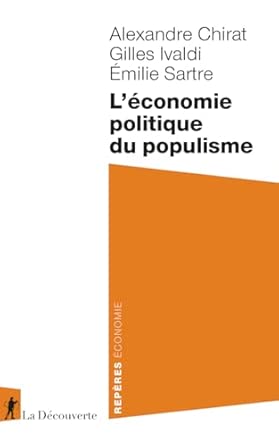
This short book has the merit of presenting the numerous scholarly works devoted to the themes and practices related to populist economics and cultures around the world. The authors outline the numerous ideological, discursive, socio-cultural and economic definitions and approaches to populism. They review the histories and analyze the agendas of the three main currents: the left (LFI in France), the right (RN) and the center (the ‘Gilets Jaunes’). The first group bases its program on a critique of neoliberalism, a fight against inequality, and a form of communitarianism. The second focuses its actions on an identity-based withdrawal and on sovereignty. The third group criticizes the elites and the tax system.
In particular, the authors present the work of Downs, who argues that populism is based on ‘rational ignorance and irrationality’, as populist agendas rely on reasoning that is both superficial and biased. They seek a ‘minimal democratic consensus’. Overall, populist economists seek to demonstrate that technological progress favours capital and destroys labour, and that deindustrialization – a factor in unemployment and inequality – results from insufficient control of imports (which do not comply with national and international standards).
Socio-cultural research attributes the rise of right-wing populism to fears of the decline of traditional or religious values and, above all, of social decline. The authors also highlight the partisan role played by certain media outlets and social networks. Both right- and left-wing movements are engaging in ‘platform populism’ through the use of AI.
In a final section, the authors present a map of populist movements in the Americas (North and South) and Europe (West and East), categorized according to their more or less non-aligned ideologies. They analyze the findings of key scientific studies (including those by Nobel Prize-winning economists), demonstrating that all radical populist agendas have failed and have led to a decline of at least 10% in the GDP of the country under populist rule over a 10-year period. The authors consider whether ‘illiberal democracies’ are viable in the long term.
Alexandre Chirat is a lecturer and researcher at the University of Besançon. Gilles Ivaldi is a researcher at the CNRS, and Emilie Sartre is a lecturer at the University of Nottingham.
Jean-Jacques Pluchart