

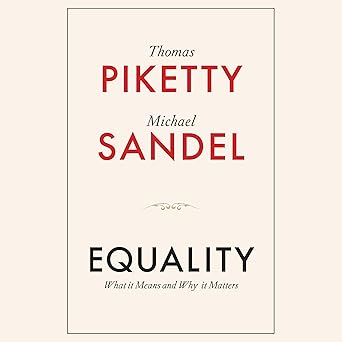
The book transcribes a lively debate between these two influential thinkers, held at the Paris School of Economics in May 2024. Both Piketty, an economics professor, and Sandel, a professor of political philosophy, present structured arguments that place the question of equality—and its opposite, inequality—at the heart of a perceived malaise in today’s democracies. Their central hypothesis is that wealth is fundamentally a collective achievement, not merely the result of individual effort, and that redistribution requires a shared sense of engagement and community as a prerequisite for genuine equality. Throughout the debate, both thinkers offer tangible proposals for reducing inequality, and while they agree on many points, they do not hesitate to challenge each other’s arguments, which adds dynamism and passion to the discussion. All the same, the reader will likely question the feasibility of implementing the wide array of proposals discussed. Further, accept that some generalisations are inherent in any debate! So-called “northern economies” such as the USA & Europe, have enjoyed prosperity. The efforts to reduce inequality have progressed over the past century through increased access to education, basic goods, income and wealth. Both debaters argue that these northern economies have largely benefited from less developed “southern economies” through the exploitation of natural resources and the division of labour. The challenge of sustainability at a planetary level further complicates the task of reducing inequalities. The thinkers guide the reader through a journey that confronts theory and historical developments with concrete suggestions, focusing on three principal pillars of equality: the distribution of income and wealth, political voice and power, and dignity, recognition, and respect. The book covers a wide range of topics, including money, market forces, globalization, forms of allegiance beyond nations, political dogma, and missed opportunities—especially within the social democratic sphere. Consequently, extreme political factions have adopted many traditional social justice topics. It also explores the tension between meritocracy and broader representativity, the importance of education (particularly investment in higher education), the equality of tax and remuneration systems, identity, borders and migration, and climate change. A key part of the debate centres on the dignity of work. Michael Sandel suggests that society should value those who contribute to the common good, not just those who succeed in a meritocratic system. He points out that in the United States, over $160 billion is spent each year on higher education for a privileged few, while vocational and technical training receives only about $1 billion, mostly serving the working class. Sandel questions why jobs like teaching, nursing, or medicine are paid so much less than financial roles such as hedge fund management. This conversation took place before the significant expansion of generative AI. Since 2024, artificial intelligence has advanced rapidly, transforming many industries and changing the nature of work. Generative AI tools are now widely used in fields like education, healthcare, finance, and the arts. These technologies have made some tasks easier and more efficient, but they have also created new challenges. Many highly skilled workers are seeing their jobs change or even disappear, while new roles are emerging that require different abilities. As we embark upon this incredibly fast and uncontainable acceleration of generative AI and its future successors, these basic questions have never been more relevant. As AI continues to evolve, society must rethink what work means, how people contribute, and how to recognize and reward vocational and technical skills. The question of dignity of work will be challenged on a large-scale as various traditional professions disappear. The ideas developed by Piketty, Sandel, and others in the social-democratic tradition may just well help guide mainstream thinking as we adapt to these changes. Kathleen Wantz-O’Rourke Thomas Piketty is Professor at EHESS and at the Paris School of Economics. He is also co-director of the World Inequality Lab and the World Inequality Database, and one of initiators of the Manifesto for the democratization of Europe. He has been a visiting professor at MIT and the London School of Economics. In 2013 he was awarded the “Yrjö Jahnsson” prize by the European Economic Association. Michael Sandel teaches political philosophy at Harvard University. He has been a visiting professor at the Sorbonne and delivered the Tanner Lectures on Human Values at Oxford, the BBC’s Reith Lectures, and the Kellogg Lecture on Jurisprudence at the U.S. Library of Congress. He has served on the President’s Council on Bioethics and is a member of the American Academy of Arts and Sciences. A graduate of Brandeis University, he received his doctorate from Oxford University, where he was a Rhodes Scholar.

The FIVE report – Financing Innovative Ventures in Europe
The report, commissioned by the French and German finance ministers, Jörg Kukies and Christian Noyer, was made public in January 2026. The FIVE (Financing Innovative Ventures in Europe) report proposes concrete measures to improve access to capital for high-growth companies (scale-ups and nuggets) in Europe.It makes concrete recommendations on access to late-stage financing for innovative European companies. It aims to strengthen the EU’s competitiveness and create a more efficient and integrated European capital market. The findings The absence of European world leaders in certain high-tech sectors is a paradox, insofar as the ecosystem of young shoots of the Old Continent is generally solid. Experts argue that the ability to turn start-ups into “nuggets” is an essential condition for the competitiveness of the industry and the sovereignty of Europe. They note that the current development deficit stems from a shortage of venture capital in the final phase, a lack of adequate capital reserves, due in particular to the inadequacy of funded pensions, the risk aversion of institutional investors, regulatory constraints and the fragmentation of the European capital market. The authors point out that the European Union is at a critical juncture, requiring “bold and immediate action “. The proposals The think tank has formulated five main proposals. – EU Member States should develop supplementary funded pension schemes to complement their pension systems. Without a sufficient pool of retirement savings, Europe will remain unable to finance large-scale innovation. Following the Swedish example, European countries should undertake ambitious reforms of their supplementary pension systems in order to meet the challenges of demographic ageing and the lack of funding for innovation – A larger share of existing institutional and retail capital should be mobilised to finance innovation.In the short term, it would be essential to unlock existing pools of institutional capital, particularly those of insurers. In order to promote the allocation of institutional investors in venture capital, initiatives such as Tibi and WIN should be deployed in Europe.4.3. Transparency and liquidity are other non-prudential barriers that need to be addressed – National and European public funding for investments in growth companies should be better adapted to the capital needs of scale-ups, and a 28th company law regime should be created to facilitate their cross-border expansion and limit transaction costs. – Stock option plans should also be harmonized, including the current listing and trading frameworks. – Equity markets in the Old Continent should offer more attractive financing conditions. Finally, measures should be taken to enhance the attractiveness of listing in the EU. In order to support listings, the EU should promote greater integration and increased liquidity in its markets. Jean-Jacques Pluchart