

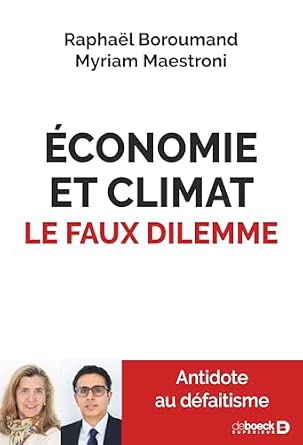
In their book, Myriam MAESTRONI and Raphaël BOROUMAND propose reconciling the “climate sceptics” and the “climate defeatists”. They believe in combining all the levers in favour of selective, restrained and low-carbon growth, “without pitting the concerns of making ends meet against those of the end of the world”.
Decarbonisation will be expensive, but these investments are much lower than the costs of climate change. This requires the decline of certain sectors, such as textiles, and the growth of low-carbon sectors that are useful to the economy.
They refer to the “champagne curve” effect by showing that, above a certain threshold of economic development, the growth of carbon emissions no longer improves the well-being of populations.
The authors advocate energy efficiency as one of the major solutions, along with the massive development of renewable energies, in order to reduce greenhouse gas emissions. This energy efficiency must be optimised in all sectors: increasing renewable energies and managing their intermittency through storage solutions, massively developing green hydrogen, decarbonising transport and developing carbon dioxide capture.
The authors present a comprehensive overview of energy systems and new geopolitical challenges. Europe wants to be a champion of sustainable development but is heavily dependent on external suppliers, such as China for rare metals and the United States for shale gas, since the start of the war in Ukraine. It “must not confuse regulatory leadership with climate leadership”. Indeed, to achieve the renewable energy development goals, it had abolished customs duties on Chinese solar panels in 2018. Barely 10 years later, this decision shows the mistakes made in meeting short-term objectives, while a new European energy and industrial policy requires a long-term vision.
In the absence of strategic resources on its territory, the authors believe that Europe has a role to play in the development of processing plants dedicated to the recycling and refining of minerals.
No energy source is risk-free or universally accepted. But the book gives pride of place to hydrogen, seen as the energy of the future since it does not emit CO2. The emergence of the green hydrogen sector can meet the combination of economic growth, job creation and ecological transition.
All these developments require investments that states will not be able to finance on their own. The financial world and citizens’ savings will have to be called upon to ensure the decarbonisation objectives are met.
A comprehensive and well-researched book that will delight readers who are convinced that a new path of economic and sustainable development is possible.
Raphaël BOROUMAND is a professor of economics at PSB,
and a specialist in energy and climate. He holds a PhD from EHESS-Paris and is a HDR
in Economics (Paris-Saclay University). He advises public institutions (ministries, parliament, regulators, think tanks) and private institutions on strategies for energy, climate policy, and risk management in the commodities markets.
Myriam MAESTRONI is a leader committed to the
energy transition, who became a managing director in the energy sector at a very young age
before founding Economie d’Energie and the company DEESCO. She chairs the E5T endowment fund as well as the “100 leaders pour la Planète” programme. Decorated with the Legion of Honour and the National Order of Merit, she sits on several boards of directors and is in the top 40 of the Forbes France ranking.
Reading note by Sophie
FRIOT