

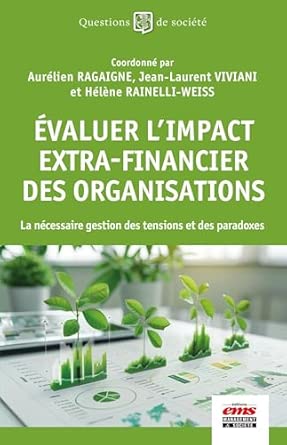
This work is eminently collective: no less than 21 contributors, most of them from the University of Rennes (Accounting – Finance of the IGR-IAE Rennes) to analyse the extra-financial impact of organisations.Despite
institutionalised extra-financial evaluation practices and systematic reporting by large companies, ambiguity and tension seem to determine the evaluation of the extra-financial impact of organisations. Ambiguity of the place given to evaluations by beneficiary organisations when the activities of the Vigéo agency (social and environmental rating agency created in 2002 with Nicole Notat, former secretary general of the CFDT) were bought by Moody’s in 2019. Therefore, it becomes difficult not to underline the link of subordination that exists between the financial and the extra-financial. We
already know that finance is a long-term process. The authors highlight the recurring tensions between financial and extra-financial performance, two objectives that are at the heart of sustainable finance. Three avenues of reflection are envisaged: (i) promotion of a new balance between these two objectives, leaving more room for the expression of stakeholders, (ii) implementation of a more relevant regulation, replacing the relative ESG measures with absolute measures of extra-financial performance, (iii) determination of the real level of stakeholder involvement to support more sustainable business models. If
the authors’ stated ambition is to provide a structuring support for the development of partnerships dedicated to the study of contemporary issues of overall performance and responsibility of organizations, it can be said that the book has arrived at the right time. Indeed, Patrick d’Humières, author of “Entreprise et géopolitique” (Business and Geopolitics) does not fail to point out that the request for ESG information first came from investors and that we can only be surprised that this lever is not used against the Chinese manufacturing submersion to “stop illegitimate dumping in the name of social, environmental and loyalty differentials, contrary to the values that constitute the foundation of our model of society”.
Aurélien Ragaigne works on the subject of extra-financial indicators and managerial situations
subject to tensions and paradoxes. Jean-Laurent Viviani’s research focuses on
corporate finance, risk management and sustainable finance. Hélène
RAINELLI-WEISS is Director of the Master’s in Finance, Treasury course, and is interested
in how organisational theories can help to understand the
functioning of the financial industry.
Alain Brunet