

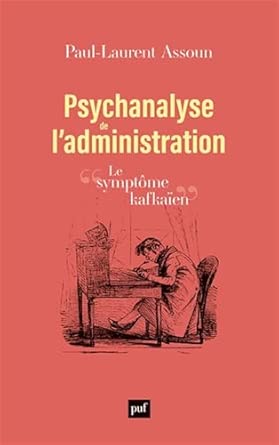
The book bears witness to the many talents of the author, who observes the conscious and unconscious dimensions of public administration.
In the first part, the author presents himself as a historian and linguist. He traces the genealogy of the concept of “administration”, initiated by Bonnin in the eighteenth century and inspired by the spirit of Montesquieu’s laws and the practical spirit of Turgot, then enriched by the positivism of Auguste Comte. He recalls with Mirabeau that “administration is both a science and an art”. He redefines the “secular ethics” of the administration, oriented towards the “good of the service”, the author of the rights and duties of the citizen and the initiator of a “disembodied social bond”. He analyses administrative language, marked by a certain “verbal fetishism” and charged with “symbolic violence”.
In a second part, the author engages in a psychoanalysis of the public administration, which he considers to be affected by the “Kafkaesque symptom”. He likens the rule to an “administrative superego” and the repetition compulsion of the official to a Freudian “id”. The employee is driven by a passion for regulation and impulses of control. The administrative body therefore has a disciplinary character, which causes the citizen, lost in the “bureaucratic labyrinth”, to feel “social anxiety” and “disturbing strangeness”. He shows that any administrative deregulation – including space-time – causes affects in administrators and the administered. He shows that the “lost file” is a missed act. Through a striking analysis, he transposes the clinical case of “the man with the rat”, analyzed by Freud, to the “administrative body”.
In a third part, he becomes a literary critic, recalling the portraits – most often in charge – of administrative customs, which were drawn up by Courteline, Feydeau, Mirbeau, Melville, Gogol, but also Balzac, Flaubert and Camus.
The French complain that France is “under-governed and over-administered”. They are calling for a simplification of procedures and a reduction of standards. They will understand by reading this book that it is simple to complicate and difficult to simplify, especially since the civil servant and the citizen are increasingly enslaved to their impulses and to Artificial Intelligence.
Paul-Laurent Assoun (ENS Saint Cloud) is a psychoanalyst and university professor. He has written numerous books and articles in the various fields of social sciences.
Jean-Jacques Pluchart