

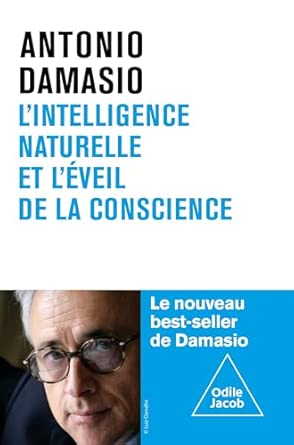
This book tells the extraordinary story of life and natural intelligence, from the emergence of protocells four billion years ago to the appearance, 500 million years ago, of organisms endowed with mind, feelings and consciousness, thanks to a radical novelty: the nervous system.
For the author, current advances in neurobiology can provide satisfactory answers to the question of the “manufacture” of consciousness. According to him, this is “the biological process that allows everyone to experience their individual life, in other words, to know that we are alive and that we exist“. The complex beings that we are come into the world equipped with biological mechanisms to protect the life we have against major threats that could jeopardise it. These mechanisms are “homeostatic” feelings, which participate in the regulation of life by maintaining key organs or functions in an ideal range: “homeostasis”.
This is the fundamental break proposed by Damasio. Consciousness is not born in the brain, but in the feelings necessary to sustain life. It emerges from a permanent dialogue, via the spinal cord and the vagus nerve, between the inside of the body and certain areas of the brain, much more differentiated than those dedicated to cognition. This dialogue is that of interoception. The continuation of life depends on the reliability of the information it provides and the responses that the subject provides. We feel before we think. Hunger, thirst, pain or fatigue are conscious biological responses to the vulnerability of life. Interoceptive or homeostatic feelings are spontaneously conscious, with a single purpose: to inform the entire mental process with warning signals that cannot be ignored. We are thus viscerally aware, what the author calls the “sensitive mind”.
Nature has given this sensitive spirit two valuable allies: exteroception, which brings together all the sensory receptors – sight, hearing, taste, touch, smell – allowing us to connect to our environment, and proprioception, which makes all voluntary movements such as walking, eating, running or talking possible. Consciousness is therefore not a software installed in the brain, but the juxtaposition of all these living processes.
The brain alone does not hold the key to mental processes: it depends on the physiology of the body and the non-neural components of the brain. Natural intelligence is a property of the living, which sets it apart from artificial intelligence, which does not have to worry about its life since it does not have one. AI has no homeostatic feelings. Machines can process huge amounts of information, speed up many tasks and reduce costs, but they cannot rely on the feelings that allow us to sort things out. They remain dependent on their human owners – and humans can be bad.
It is this conscious vulnerability, a distinctive feature of human intelligence, that should be introduced into AI. It would induce a form of artificial prudence that could inhibit risky behaviour just as it has led to the development of moral systems and justice in humans.
Antonio Damasio, Professor of Neuroscience, Neurology, Psychology and Philosophy at the University of California. He heads the Brain and Creativity Institute. Member of the National Academy of Medicine and the American Academy of Arts and Sciences.
Ph Alezard