

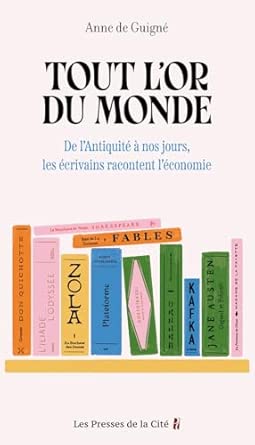
The author, a great reporter at Le Figaro, engages in a difficult and original exercise: to draw economic lessons from world fiction. The exercise is particularly successful because the book enriches its readers with useful economic knowledge and valuable cultural contributions. The author declines her literary career by rereading 18 works covering 6 periods.
The first relates the lessons lavished by the authors of Genesis (the curse of work), Homer (the role of money), Hesiod (misery), Thucydides (the financing of war) and Petrone (manipulation and fraud). The second covers medieval times, with Tristan and Isolde, the tale of the Grail, the Roman de Renart and the ballads of Christine de Pisan, which illustrate the difficult material and social conditions of peasants, women and the bourgeoisie of cities and fairs. The third sequence is marked by the shift in the market economy, with analyses of the works of Shakespeare, Cervantes, Lafayette, La Fontaine, Rousseau and Casanova, marked by tensions between financial interests and friendship, rules of the past and the future, work and income, nature and culture, investment and speculation. The fourth age is that of the transition from economics to the state of science with the economic lessons of Goethe, Austin, Stendhal, Balzac, Dostoievki, Zola, Mann and Wharton, who describe the effects of capitalism and conventions on the economic situations of women, the bourgeois, workers and consumers. The next phase is devoted to London (work ethic), Kafka (the excesses of bureaucracy), Yourcenar (the end of religions), Akhmatova (totalitarianism), Ayn Rand (individualism), Perec (consumerism), Druon (social declassification), Pamuk (standardisation) and Wolf (ambition). The last sequence focuses on 21st century literature, with books by Houellebecque (the attraction of platforms), Adiichie (migration), Coe (the torments of the middle class), Egan (the development of digital technology) and Koenig (digital and ecological transitions).
Anne de Guigné’s book thus makes it possible to rediscover or discover the thoughts and biographies of authors who have lived through their century and economic laws that have spanned the centuries. The author’s elegant and lively style gives the book a character that is both educational and cultural.
Anne de Guigné is a senior reporter at Le Figaro, in charge of economic issues, and the author of several books.
Jean-Jacques Pluchart