

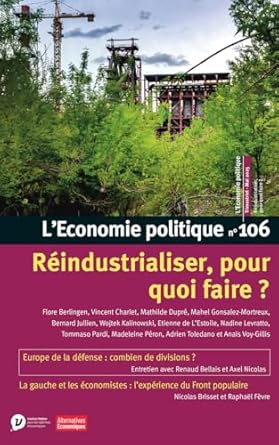
The REP’s No. 106 issue raises a seemingly provocative question, but in reality, it is fundamental and complex. It consists of nine articles analyzing the many difficulties faced by businesses and governments – including France – in their project to reindustrialize a “country without factories” after three decades of industrial decline.
Reindustrialization involves arbitrating between more or less contradictory objectives relating to the competitiveness of factories, security of supply, environmental protection, energy savings, balance between territories, social equity … Arbitrations must first be subject to lengthy administrative procedures, costly information campaigns and more or less democratic debates. The choice of activities to rehabilitate and territories to reindustrialize differ according to the countries of the European Union. National industrial links are part of an international chain of value creation, which limits the options. “Industrial territories” operations must therefore reconcile the imperatives of equitable land use, preserve agricultural land in the name of “land sobriety”, rehabilitate brownfield sites and supervise polluting and/or carbon-emitting industries (Net Zero Artificialization objective). These operations involve aligning public and private interests and adopting more sustainable financing systems. They must also be part of profitable circular economy systems that are both energy and raw material efficient. As an example, the case of the development of the sustainable and affordable electric car is remarkably studied.
The dossier also includes an article – whose resonance is particularly current – entitled “the left and economists”, dealing with the confrontation from 1936 to 1938 between the leaders of the Popular Front and the economists Alfred Sauvy and Robert Marjolin, about the 40-hour week. An article on the coordination of the actions of the countries of the European Union in favor of Ukraine, closes the file.
The authors are expert teachers and researchers and journalists (members of the Veblen Institute) mainly specialized in industrial economics.
Jean-Jacques Pluchart