

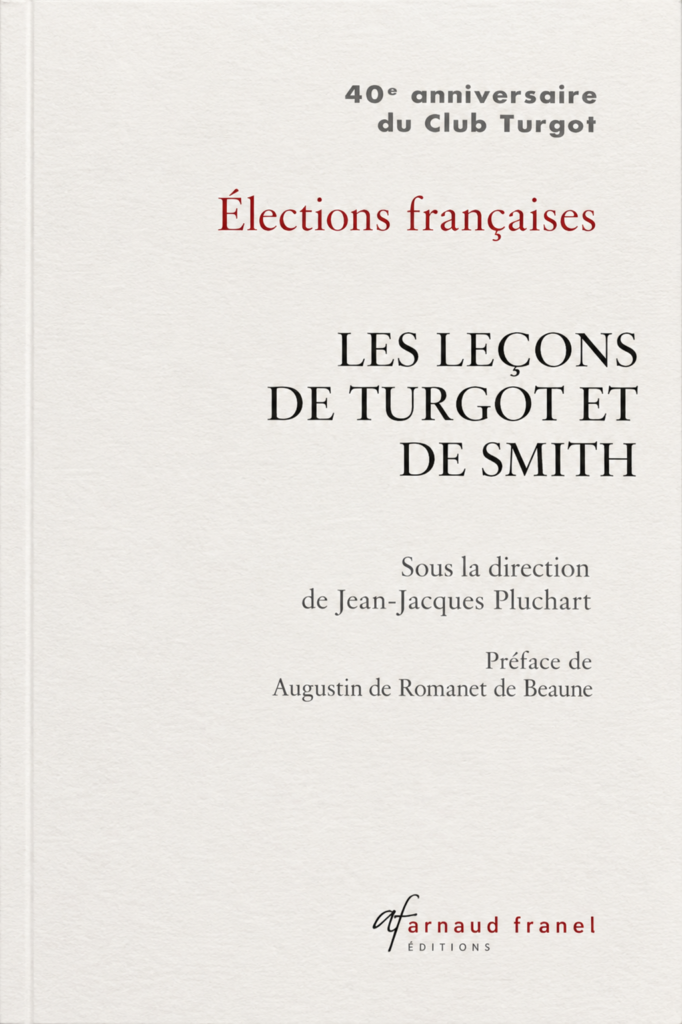
French elections. The lessons of Smith and Turgot
by Augustin de Romanet de Beaune, Président of Cercle Turgot
The Turgot Prize is celebrating its fortieth anniversary, making it one of the oldest and most prestigious French-language prizes in economics. Year after year, it has honoured works that shared a common preference for reasoned argument over invective. It is in this spirit that the members of its jury and its pre-selection committee wanted, on the eve of the 2027 deadlines, to bring together twelve contributions on the economic and financial issues that will determine the next decade.
This book stands out for the breadth of its scope: it addresses a multitude of current issues without ever concealing the complexity of matters. This is its first merit, and it is no small one at a time when we often prefer reassuring soundbites to challenging analysis. Browsing through it, or reading it in full, will be extremely useful to all those interested in economics, and especially to students: the authors set out, in a very instructive way, the challenges that policymakers, as well as economic, banking and financial stakeholders, will have to face in the years to come.
However, the reader should not approach this book as a treatise. Each chapter is a stand-alone essay, written by a practitioner in the field, and can be read independently of the others. You can start wherever you like: with corporate finance or capital markets, with the ecological and energy transitions, with artificial intelligence, with public finances, taxation, pensions, crypto-assets or European strategy. Those preparing a programme will find orders of magnitude; those who have to make decisions will find arguments; those who simply want to understand will find an honest overview of the current situation. The foreword also offers a reasoned review of the most recent French-language economic publications, which is valuable in itself as a reading guide.
Three contributions can be highlighted.
The chapter on tax and social systems compares the manifestos of the main political parties and proposes to classify them according to a divide between neoliberals and socio-ecologists, which is more illuminating than the conventional division between democrats and populists. The proposal deserves discussion; it has the merit of being a proposal.
The chapter on pensions usefully shifts the debate. It points out that if France had Germany’s employment rate, its gross domestic product would be ten per cent higher and the burden of its pensions would be reduced to the European average. France’s problem is therefore not primarily an issue of age: it lies further back, in work itself.
The final chapter offers an original interpretation of US strategy. By linking the December 2025 National Security Strategy to a contemporary corollary of the Monroe Doctrine, supplemented by what the author calls a Hamilton Doctrine, and by recalling that Washington’s shift in trade policy is less a return to classical protectionism than a return to the spirit of the Havana Charter of 1948, he reveals a coherence where many see only improvisation.
The conclusion is not merely a summary: it proposes a grammar of public decision-making, structured around four paradoxical imperatives that every leader will have to confront. Reconciling sovereignty and openness. Managing long transitions while responding to short-term crises. Striking a balance between growth and fairness, between the ethic of work and that of well-being. Maintaining the right balance between the state and the market, between innovation and regulation. None of these tensions can be resolved with a slogan. All of them must be managed.
Finally, a word about the person who led this book. Jean-Jacques Pluchart led the project and wrote four chapters, the foreword and the conclusion. Those around him at the Cercle Turgot know that this is only the visible part of his work. Each year, he reads, annotates and presents to the pre-selection committee the dozens of books on economics and finance published in French, and this patient rigour is the very basis of the Prize’s authority. The Cercle Turgot owes him a great deal, and I would like to pay tribute to him, as well as to Jean-Louis Chambon, the founding president of the Cercle and the tireless driving force behind its work.
In August 1774, Turgot wrote to the King that there would be no bankruptcy, no increase in taxes and no borrowing, and he added that wealth comes from work and saving, not from public spending. Two and a half centuries later, the sentence has lost none of its power, nor of its discomfort. May those who will seek the votes of the French people tomorrow have the wisdom to reread it.