

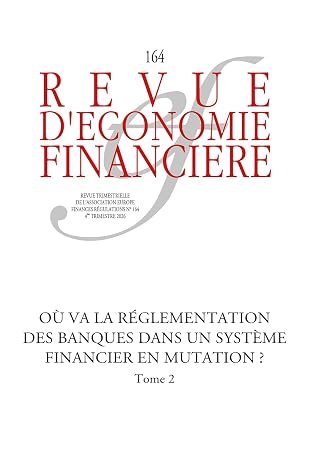
Banking regulations, beyond their traditional roles, also oversee risk-taking and aim to prevent a bank failure from spreading across the entire economy. But should the same rules apply to all banks, regardless of their country of origin, balance sheet size, or whether they are cooperative or capitalist? American and European banks aren’t subject to the same requirements, and their regulatory frameworks have significant differences. This gap helps boost the profitability and capitalization of American banks while fueling the ongoing debate about the competitiveness gap with European banks.
The goal of this issue is to understand where we stand today not just for banks but also for non-bank financial institutions (NBFIs) – the so-called ‘Shadow Banking,’ which we’ll see is a diverse set of entities within a single country as well as across different countries and regions.
We’ll also look at questioning the ‘neutrality’ of regulation, the best way to finance the real economy and innovation, the allocation of responsibilities and roles of public and private banks, and the need to study shadow banking, not institutionally, but based on the types of operations being carried out…
These topics are so numerous and require so much information and care in their study that the authors of the Review decided to create two issues:
– This one will provide answers to the questions: where do we come from? And where are we now?
– Issue 164, which will be published at the end of 2026, will open up new perspectives: those of future developments and the challenges that banking regulation will have to address to continue adapting to a constantly changing financial environment marked by new uncertainties.
These two issues aim to understand not only how banking regulation has been built, but also how it could transform.
The question ‘where do we come from’ is addressed like this:
– Designing an optimal financial architecture by learning lessons from the United States
– Putting banking prudential regulation into perspective
The theme ‘where do we stand’ is better documented:
– Links between banks and sovereign borrowers
– Overview of the European banking sector: progress made, persistent fragmentation, and new challenges (including the current killer incompatibility between declared political will, sovereignty concerns, and opposition from ‘small’ targets versus the continental but already supra-national ‘banking giants’)
– European regulation, supervision, and performance of European banks: ten years on; interesting chapter because feedback at national and European levels is almost non-existent to date…
– Banks of the European Union: efficient today, undervalued tomorrow; without a question mark, this title is not a question but a statement…
– – Banks and shadow banking: a happy marriage! A technical chapter as it thoroughly and didactically reviews their scopes, which vary depending on their nationality and therefore the operations carried out rather than the organization of these institutions.
– The importance of cooperative banks in Germany for regional access to banking services; along with service quality, costs, and public support in the sense of the Länder.
– Correct the failures of capital markets through public development banks; and we will think about the sectoral investment strategy, risk compensation, and capturing part of the value created by public authorities.
– Capital Markets Union and Savings and Investment Union: the difficulties linked to diversity… but there is an ‘obligation of results’ for the development of European SMEs and mid-sized companies, while low growth and rising interest rates raise questions about their sustainability in the near future.
From reading this book, you can see that the European financial landscape today appears as a diverse whole, the result of gradual development and deep changes, but also marked by a great heterogeneity of national situations and practices that need to be taken into account. So, the Banking Union and the Savings and Investment Union won’t be completed for a few years and will require, in order to do so, addressing the main challenges of banking regulation by coming up with responses that are still being developed in academic and regulatory circles, and finally, politically. A “big program” that will be the focus of the next issue of the Review.
Once again, the contributors to the discussion deliver brilliant, educational presentations (even though the reader needs to have some basic knowledge!), which should be read, absorbed, and questioned so that the European construction is sustainable and benefits the economy as a whole.
Dominique CHESNEAU