

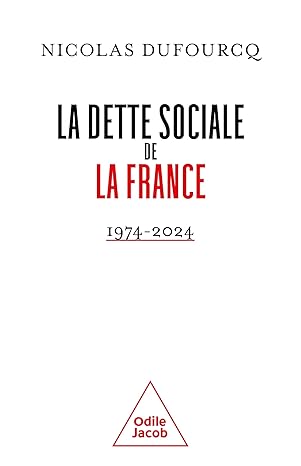
In his essay, France’s social debt (1974-2024), Nicolas Dufourcq performs far more than a mere fiscal autopsy; he conducts an ontological deconstruction of the French welfare state. As the head of BPI France, the country’s public investment bank, Mr Dufourcq exposes what he terms a “family secret”: that two-thirds of France’s sovereign debt, some €2 trillion, has morphed into a colossal “consumer credit” facility, used to bankroll daily benefits rather than to invest in the nation’s future.
The diagnosis is as clinical as it is compelling. Mr Dufourcq identifies 1974 as the year of the fall, when France inaugurated its first “whatever it takes” policy, shifting from a contributory insurance model to a permanent infusion of debt-funded assistance. Invoking Clément Rosset’s philosophy of “the real and its double,” the author lambasts a collective denial that ignores the “longevity revolution” and its impact on a sclerotic economy. While the “social horse” gallops ahead, fueled by the “white powder” of debt, the “economic horse” is left gasping for air. To break this cycle, he proposes an “Iron Rule”: a constitutional mandate for strictly balanced social accounts.
The work is meticulously documented, drawing on testimonies from fifty members of the political and administrative elite. Yet, despite being dedicated to the nation’s entrepreneurs, they are conspicuously absent from the interviews. Here lies the work’s tragic paradox, and perhaps that of France itself: by giving voice solely to the mandarins of the state, the analysis remains partially confined within the circle of those who managed, justified, or presided over the very imbalances it decries. When former minister Marisol Touraine “vigorously contests that deficits stem from runaway social spending”, the reader perceives the extent to which the chronicle of failure is still being written by its own protagonists. The original sin of the system has been the progressive decoupling of social rights from the requirement of production.
This is the hamartia of a system that, by substituting social entitlements for wealth creation, has condemned its pact of solidarity to become little more than a pious wish, broken by the unforgiving arithmetic of economy and demographics. Recalling Virgil’s labor improbus omnia vincit, Mr Dufourcq reminds us that one does not reform a country by fighting against reality. The ultimate lesson is clear: the social Republic will be saved neither by incantations nor denial, but by rehabilitating wealth creation as the prerequisite for solidarity. France must now decide if it is ready for the discipline of the real.
A lifetime civil servant and graduate of HEC Paris and Sciences Po, Nicolas Dufourcq is a former official of the Inspection générale des finances and has served as Chief Executive Officer of Bpifrance since its inception in 2013.
Yoann Lopez