

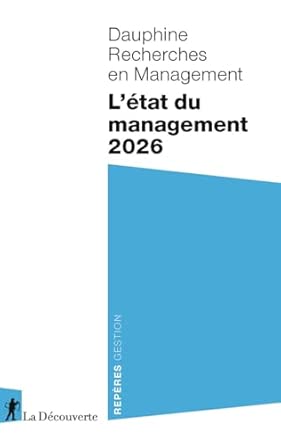
Were it not for the current circumstances, we would be tempted to say that, just like Beaujolais Nouveau, the Dauphine Recherches en Management (DRM) laboratory is publishing its annual overview of new management practices. This year is special, as 2026 marks the 50th anniversary of Paris-Dauphine University’s involvement in management science research. This 17th edition of a publication previously entitled L’Etat des entreprises (2009–2017) and then L’Etat du management (2018–2026) reflects DRM’s commitment to collaborating with businesses while advancing academic research.The
2026 edition is set against a backdrop where the key word is ‘uncertainty’: political instability, economic crises, climate issues and the challenges posed by artificial intelligence. The rather optimistic views held by authors such as Aghion are far from widely shared (see Acemoglu), which fuels a debate that decision-makers and business leaders cannot avoid when economic activities are considered over the long term. The first chapter of the book is therefore dedicated to the long term, specifically to a brand’s intangible heritage, where the development of historical resources forms an integral part of the value chain. With this in mind, reputation, which is the subject of the second chapter, is exposed to multiple threats (online reputation, compliance, media coverage, etc.). It is also one of the most fragile intangible assets. Dealing with a crisis situation becomes a major challenge, and in this case, silence is most certainly not golden. Chapter 3, which takes us back to the early 1980s with a reflection on the concept of leadership, is reassuring: ‘To achieve great things, one does not need to be a great genius; one does not need to be above people; one needs to be with them’ (Montesquieu). Phew! Here at last is an area where the threat of artificial intelligence is reduced – by definition. Chapter 4 focuses on the ‘taboo’ that needs to be broken in order for a sector as highly charged as sextech not to act as a self-limiting factor for female entrepreneurs determined to develop a project that transcends social barriers. In this context, where norms sometimes become fleeting and the boundaries between work and pleasure blur, Chapter 5 shows that co-working spaces are places of work, consumption and socialisation all at once. Digital transformation does not only affect processes associated with the world of work, as demonstrated by Chapter 6, which focuses on new modes of music production that are inexorably leading to a form of homogenisation of production. Digitalisation also affects sporting events, as detailed in the final chapter, through over-mediatisation and a dilution of their original authenticity, even though it enables spectators to be ‘co-creators of value’. As we can see, the wealth of information contained in this ‘State of Management 2026’ paints a panorama of work that extends well beyond the boundaries of the traditional company.
Dauphine Recherches en Management (DRM – CNRS Joint Research Unit 7088), established on 1 January 2005, is one of the leading French research centres in management sciences. This publication was produced under the supervision of Sarah Lasri, Céline Michaïlesco and Sébastien Damart.
Alain Brunet