

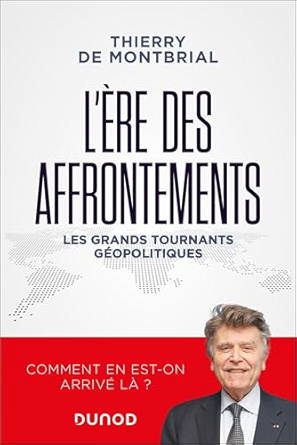
The author gives us here an account of the main world events and their consequences that have taken place over the last 35 years, starting from the year before the fall of the Berlin Wall, and this from his texts written each summer and published in the bible that is the annual work “Ramses”.
His writings, structured in chronological order, allow the reader interested in the evolution of the world in terms of macroeconomics to ultimately understand the ever-growing impact of political decisions and actions on the economic evolution of nations, which has a major impact on international relations.
The blood ties to the land of the ancestors mean that the political forces at work must build a common future, taking into account a past sometimes more than a century old, to try to move towards a happy end to history, one which Europeans have dreamed of until very recently.
Except that the end of the Cold War brought a reconfiguration of the world, notably with the rise of China following its entry into the WTO, not to mention Russia’s return to the forefront after a hiatus of more than a decade. At the same time, the American leaders after 9/11 did not always implement the best solutions, excited by their control of the countries producing black gold, and the world in the Middle East continued to be destabilised.
This book also helps us understand why states moved from a logic of monetary credibility in the 1980s to a logic of fiscal credibility in the late 1990s and early 2000s. After the attacks of September 2001, purely electoral decisions to protect certain strategic American sectors with tariff barriers went against the policy of free trade (a situation that we find ourselves in today under the 47th president of the United States).
By retracing most of the events after the Great Recession (2008/2009), the author invites the reader to consider a world that has become multipolar and, moreover, heterogeneous, with profound implications, the most important of which is the search for a minimum of cooperative security with the inescapable reality of international, political and economic competition. In fact, the question of the limits of globalisation is now a concrete one.
Thierry de MONTBRIAL is an academic, honorary professor at the École Polytechnique and professor emeritus of the CNAM, founder of Ifri, one of the most influential think-tanks in the international community.
Review by Claude GEORGELET