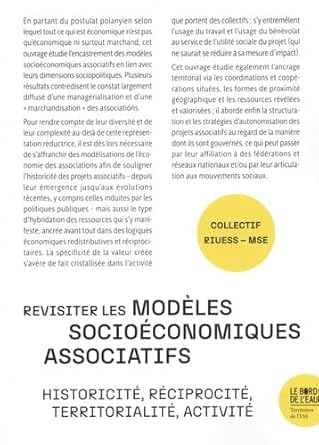
Based on an extensive research program described in the book, the authors’ collective provides a precise overview of the different forms of associations and their resources; with, among other things, the extent of their dependence on public funding.
The first part of the book is devoted to setting the framework of associations in the broad sense and to understanding their functioning as well as the plurality of market and non-market financial resources. The analysis of monetary resources shows that associations continue to drain public funding that is decisive for their socio-economic model in order to achieve their budgetary balance. The role of volunteering also remains major in the emergence of projects and in the functioning of associations, although some of them are becoming professionalized.
The second part of the book focuses on the socio-economic models of associative social centers. The latter developed at the end of the 19th century in bourgeois circles. Their initial objective was to strengthen family and neighborhood ties during this period of industrial and urban development. Today, according to their purpose, social centers share the goal of fostering links and exchanges. The authors raise the issue of the monetary valuation of volunteering in the accounting balance sheets of this type of association, due to a lack of method.
In a third part, the authors present the socio-economic model of “third-places”. This category is defined as a “space of sociability, of citizen initiative, where a community can meet, gather, exchange and share resources, skills and knowledge”. Whatever their actions, “third-places” claim autonomy by relying on non-monetary resources but still remain dependent on public funding.
The fourth part of the book focuses on socio-economic models in the field of integration. The authors present their research and analysis in the IAE (Insertion par l’Activité Economique) sector and on the TZC (Territoires Zéro Chômeurs) experiment.
In conclusion, the authors highlight three avenues for reflection: the mobilization of work and volunteering, access to capital, and the evaluation of social utility towards social impact.
This book is very widely documented and makes it a collection that can serve as a reference in their field. With a very academic style, a technical and specialized vocabulary, this book is aimed at seasoned readers.
The Inter-University Network of the Social and Solidarity Economy (RIUESS) was established in the year 2000. Today, it brings together around twenty French universities around its objective: to promote training and research in the social and solidarity economy and to encourage exchanges and shared initiatives between SSE actors. This book was produced by a multidisciplinary team composed of members of the network, economists, sociologists, and a philosopher, constituting the RIUESS-MSE collective.
With contributions from Mariagrazia Cairo Crocco, Melaine Cervera, Cyrille Ferraton, Anne Fretel, Laurent Gardin, Patrick Gianfaldoni, Florence Jany-Catrice, Vincent Lhuillier, Pierre Robert, Delphine Vallade.
Reading note by Sophie FRIOT