

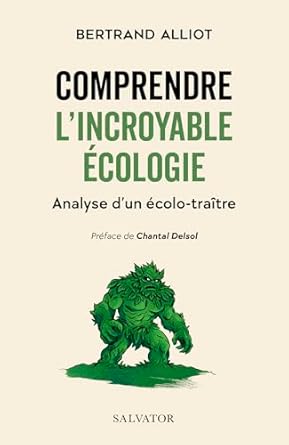
The author offers his vision on the genesis, influence, and evolution of this current of thought in the political and economic sphere of a part of the world, in particular Europe. If environmental awareness has always been correlated to mankind in various forms, it experienced a boom with the beginning of industrialization and the emergence of the first theses on the need to regulate the world population.
The Environment becomes, over the course of events, the matrix of more identity-based and more radical currents. This is how, at the end of the 19th century, the word “ecology” was born, to designate the “scientific discipline which studies the natural environments as well as the relations and interactions between the living beings and these environments”. Very quickly, “ecology” deviates from this definition and their representatives, ecologists, to become a messianic movement based on a quasi-religious rhetoric.
The new “ecology” is based on the concept of “imminent global systemic crisis”, fueling its rationality and justification on materials provided by the news: acid rain, nuclear risks, overpopulation, the ozone layer, greenhouse gas emissions related to human activities, energy transition… Each theme is the subject of active advertising via broadcasting and popularization relays: NGOs, Conferences/Debates, ad-hoc Commissions, media, experts of all kinds, reports/theses. Funding is legion through international organizations, governments, contributions, bequests/donations… It is worth noting the remarkable plasticity of the approach: Each new theme drives out the previous one, as was the case with acid rain, overpopulation, the ozone layer, nuclear power… Global warming is the new battlefield for environmentalists, fueled by a number of reports, including those of the IPCC.
The European Union is among the good students on its territory but is less concerned about the possible environmental damage of its international suppliers, the global impact study being mainly reserved for its own nationals. This virtuous approach of the European Union is not, for the moment, imitated by its direct competitors (United States, China, India, Brazil…) less hampered by the norms and beneficiaries of our environmental challenges which translates, for the European Union, into an impoverishment, a “soft” decline, a deindustrialization, a loss of sovereignty, and an over-indebtedness for some. Can this asymmetric competitiveness gap, to some extent, explain the decline of Europe and its erasure in this new world?
The author’s final optimism is based on an awareness of the European Union’s economic, social, and political issues, but also on the gradual disappearance of ecology as a dominant thought by its inability to anticipate and solve problems.
Bertrand ALLIOT, actor of the environmental movement. Former ecologist and columnist. Published “Une histoire naturelle de l’homme” (A Natural History of Man). Ed. de l’Artilleur in 2020.
Hubert Alcaraz